
Civil War Pipe Carved by a Soldier in Co. C of the Famed 5th New York Infantry or Duryee’s ZouavesJanuary 23, 2026
Civil War Pipe Carved by a Soldier in Co. C of the Famed 5th New York Infantry or Duryee’s Zouaves
SOLD
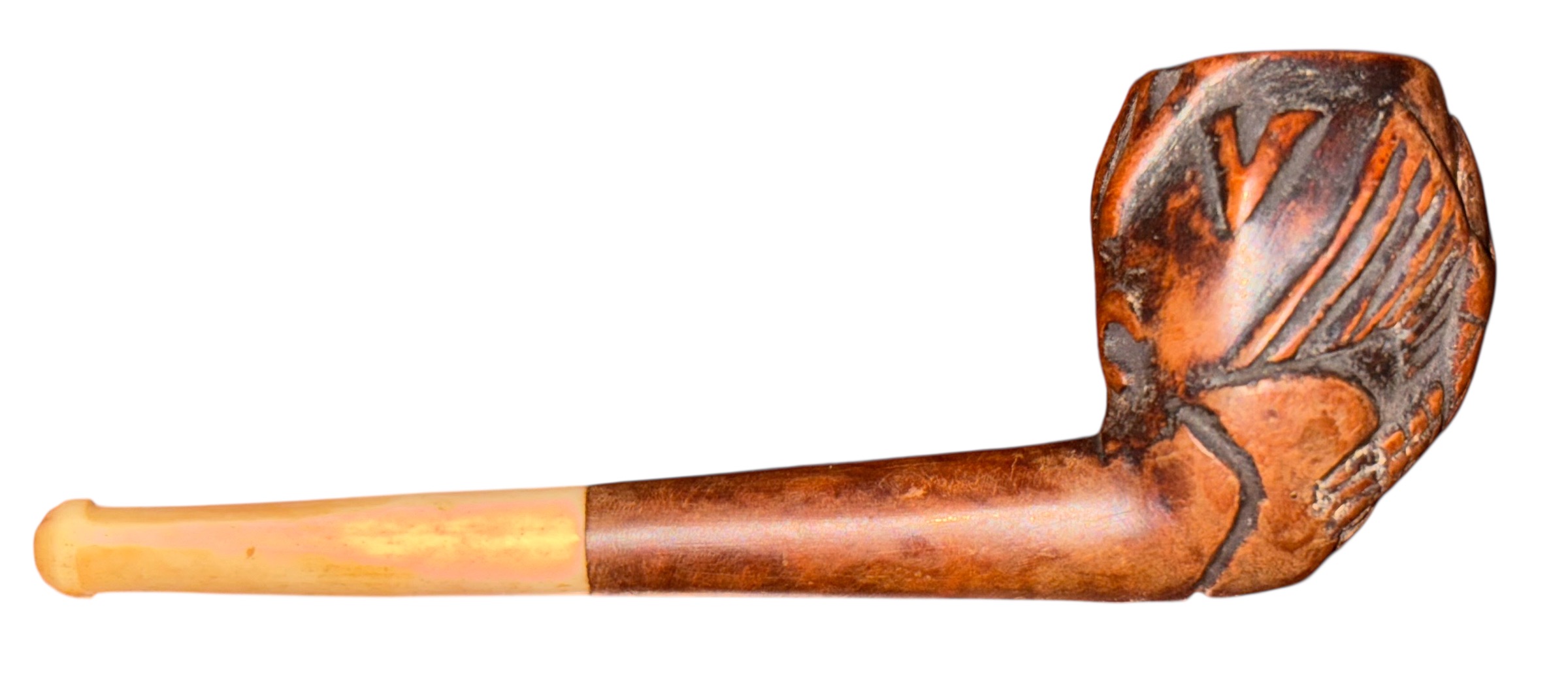
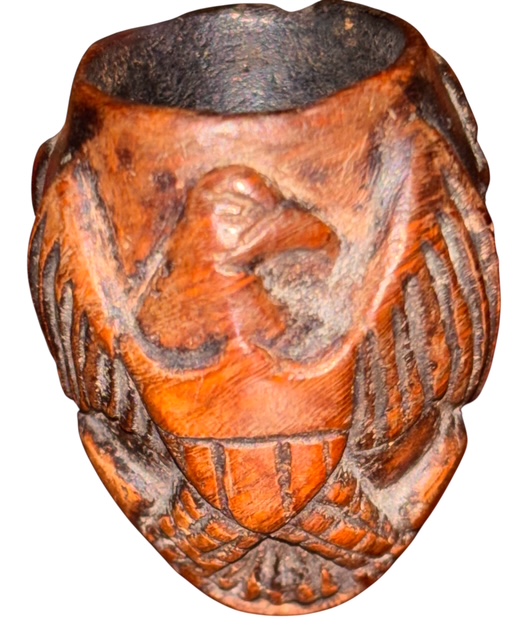
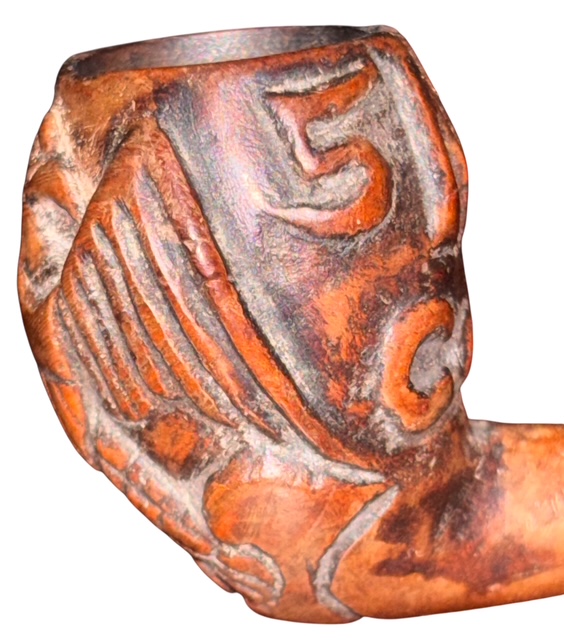
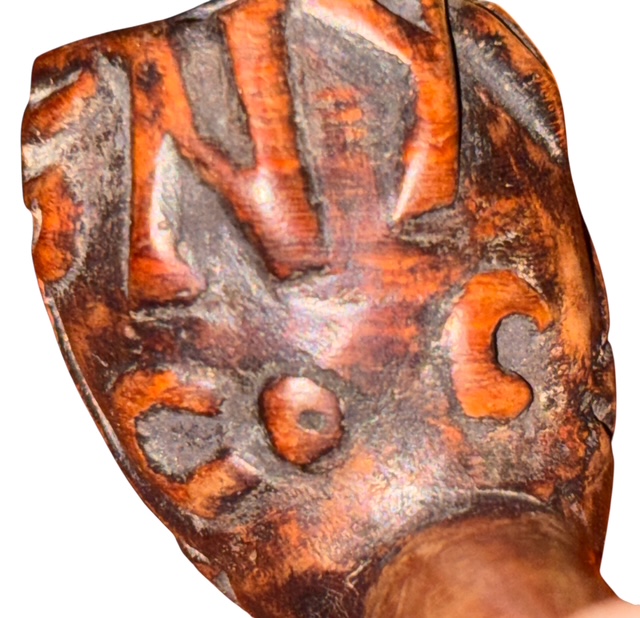
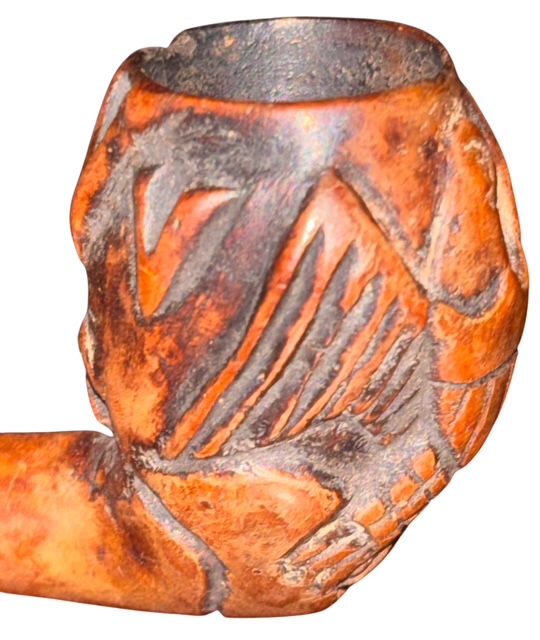
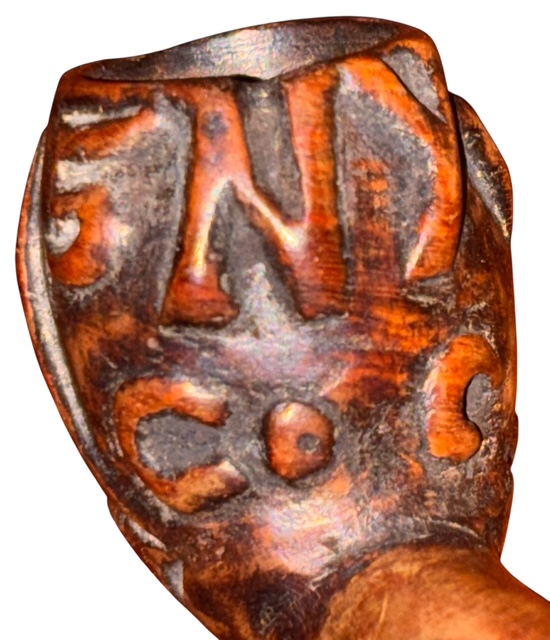
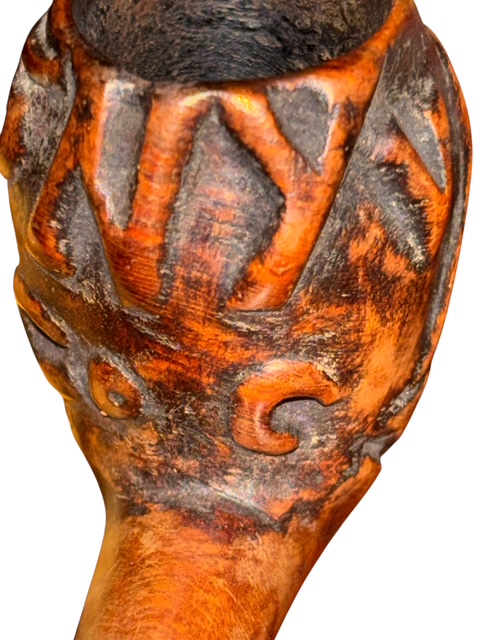
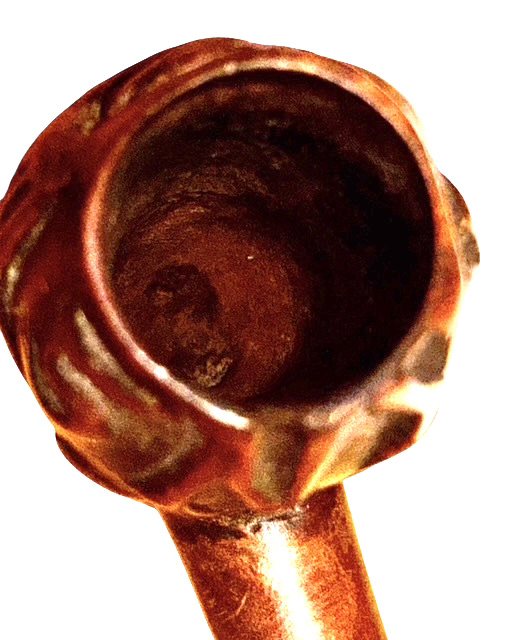
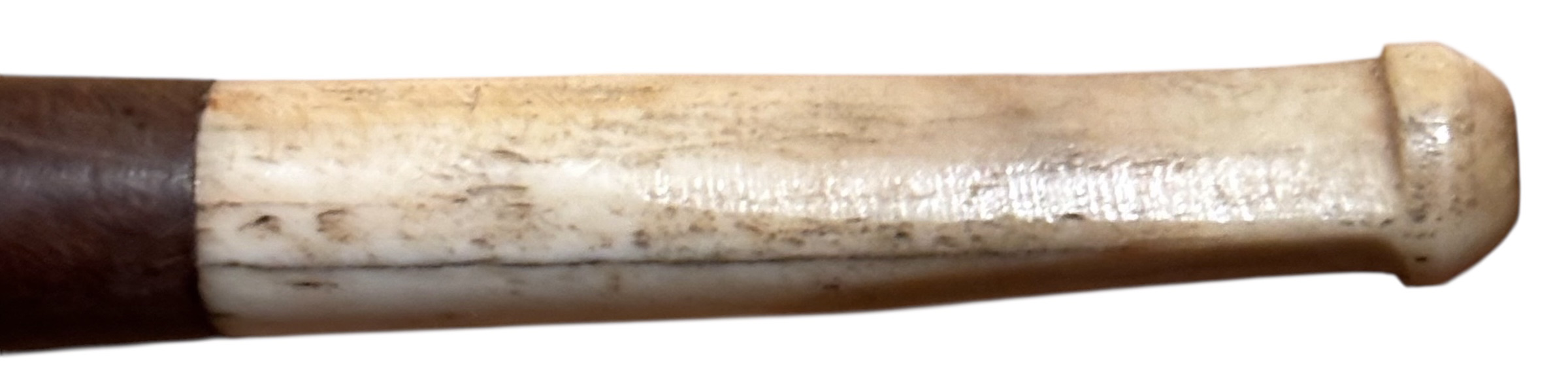
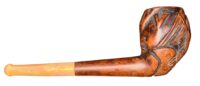
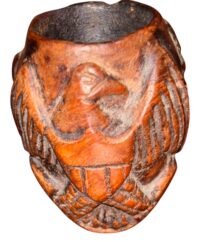
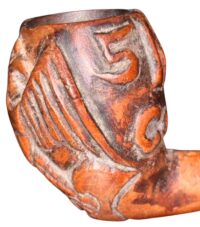
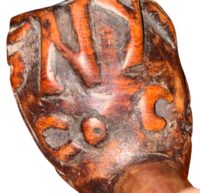
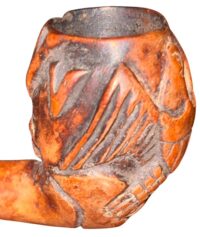
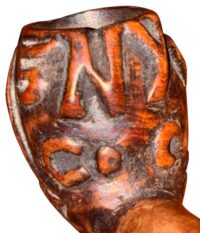
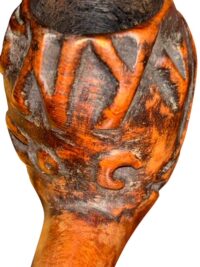
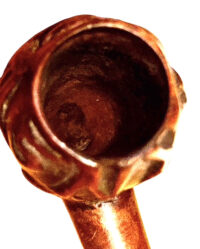
Civil War Pipe Carved by a Soldier in Co. C of the Famed 5th New York Infantry or Duryee’s Zouaves – This artfully carved, diminutive pipe features a burl walnut bowl with a carved, American eagle and shield, at the front of the bowl; on the back of the bowl, nearest to the stem, is carved, in raised letters, the following:
“5 NYV
Co C”
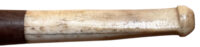
The stem of the pipe was fashioned out of animal bone. The pipe and stem remain in excellent condition. The 5th New York comprised the famed Duryee’s Zouaves, a New York regiment that saw action in multiple significant engagements during their enlistment; the regiment’s name refers to Abram Duryee, who commanded the 5th New York Volunteer Infantry; the regiment was known for its flamboyant, Zouave-style uniform which they wore for essentially their entire initial two-year enlistment, from their formation in May 1861 until their muster-out in May 1863. Recruits for Company C of the 5th New York Infantry (Duryee’s Zouaves) came primarily from New York City, along with Astoria (Queens County) and Poughkeepsie (Dutchess County), with men often joining where they lived. The history of this famed regiment is detailed below.
This pipe is an excellent example of Civil War period, soldier folk art; it is approximately 4” in length.
The following is taken from The Union army: a history of military affairs in the loyal states, 1861-65 — records of the regiments in the Union army — cyclopedia of battles — memoirs of commanders and soldiers. Madison, WI: Federal Pub. Co., 1908.
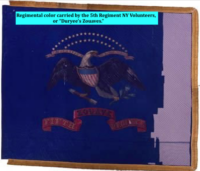
Cols., Abraham Duryee, Governeur K. Warren, Hiram Duryea, Cleveland Winslow, Frederick Winthrop, Henry W. Ryder, William F. Drum; Lieut-Cols., Governeur K. Warren, Hiram Duryea, Harmon D. Hull, George Duryea, Henry W. Ryder, George L. Guthrie, William F. Drum; Majs., J. Mansfield Davis, Hiram Duryea, Harmon D. Hull, Cleveland Winslow, George Duryea, Henry W. Ryder, George L. Guthrie, Paul A. Oliver, Henry Shickhardt, Carlisle Boyd. The 5th known as the National or Duryee’s Zouaves, was recruited in New York city and the immediate vicinity and mustered into the U. S. service for a term of two years, at Fort Schuyler, New York harbor, May 9, 1861. On the 23d it embarked for Fortress Monroe, camped for a few days near Hampton Bridge, then moved to Camp Butler, Newport News, and was attached to Pierce’s brigade. The troops of the 5th led the force at the battle of Big Bethel and lost 5 killed, 16 wounded and 2 missing. In September the regiment was sent to Baltimore for garrison duty and remained there until May, 1862, when it was assigned to Sykes’ brigade, -reserve infantry of the Army of the Potomac, and on May 17, to the 3d brigade, and division, 5th corps, with which it fought in the battles of the campaign on the Peninsula. It participated in the siege of Yorktown, the fighting near Hanover Court House, the Seven Days’ battles, losing at Games’ mill 55 killed, 37 wounded and 15 missing, and winning notice by the coolness with which, after heavy loss, the regiment was reformed under fire in order to fill the places of the fallen men. At Malvern hill, the 5th was active, then spent a short time at Harrison’s landing, and afterward took a prominent part in the battle of the second Bull Run, where, of 490 members present, it lost 117 killed or mortally wounded, 23 per cent, of those engaged, the greatest loss of life in any infantry regiment in any one battle. The remnant of the regiment served with the division through the battles of Antietam, Shepherdstown, Snicker’s gap and Fredericksburg without serious loss, and went into winter quarters at Falmouth. It was also active at the battle of Chancellorsville and then returned to New York city, where it was mustered out on May 14, 1863. The total strength of the command was 1,508, of whom 117 were killed or died of wounds, 11.7 per cent, and 34 died from other causes. During almost the entire term of service, the regiment was attached to Gen. Sykes’ famous division of regulars, which contained one brigade of volunteers, in which the 5th bore a prominent and worthy part. Col. Fox names the 5th as one of the “three hundred fighting regiments” and quotes Gen. Sykes as having said it was one of the best volunteer organizations he ever saw. The reenlisted men and recruits, besides a number of the members who originally enlisted for three years, were transferred to the 146th N. Y. Vols.
Fifth New York Infantry Regiment
“Duryee’s Zouaves”
The 5th New York Infantry Regiment enrolled 2,164 men during the Civil War. It lost 6 officers and 171 enlisted men killed or mortally wounded and 34 enlisted men to disease. Nine of its members attained the rank of general. The regiment is honored by a monument on the Second Bull Run battlefield at Manassas.
| 1861 | |
| April 23 |
Organized at New York City and accepted by the State of New York.· Companies A and B were principally recruited in New York city and · Brooklyn · Company C in New York city, Astoria and Poughkeepsie · Companies D (“Fifth Ward Volunteers”) and E in New York city, · Brooklyn and Williamsburg · Company F in New York city, Brooklyn, Fordham and Yonkers · Company G in New York city, Brooklyn and New Rochelle · Company H in New York city, Brooklyn, Flushing, Greenpoint, · Tarrytown and West Point · Company I in New York city, Brooklyn, Jamaica, Long Neck and · Williamsburg, and at Perth Amboy, Plainfield and Orange, N. J. · Company K in New York and Jersey City |
| The Fifth New York Infantry Regiment mustered in for two years United States
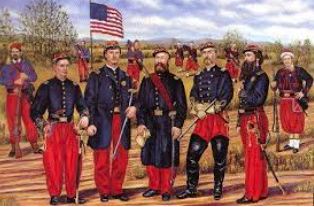
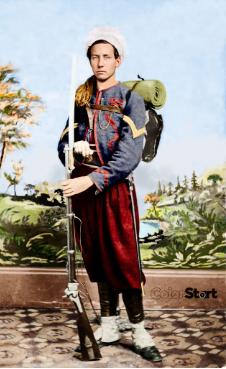
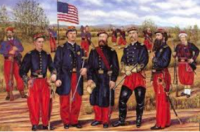
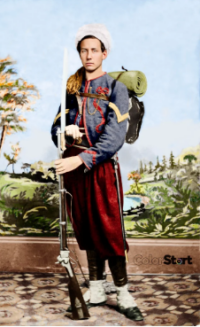
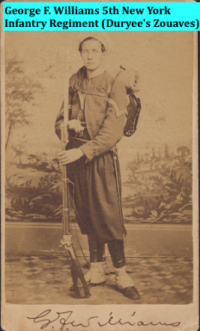
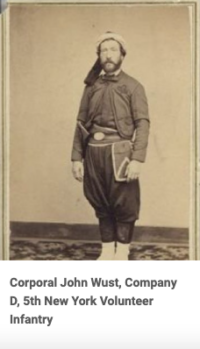
service at Fort Schuyler, New York harbor under the command of Colonel Abram Duryee, Lieutenant Colonel Gouverneur Warren and Major J. Mansfield Davies. Colonel Duryea had commanded the 7th New York State Militia before the war, which was nationally known for its crack drill and its colorful Zouave uniforms. He outfitted the Fifth New York in the same style. Enlisted men wore a dark blue Zouave jacket with a red trim over a dark blue shirt, also with red trim. Around the waist was a red Zouave sash with sky blue trim. Below were very baggy red pantaloons, white gaiters and leather leggings. The head cover was a red fez with a yellow tassel. The fezzes were often worn wrapped with a white turban. Officers wore the regulation army dark blue frock coat with shoulder straps in infantry blue with large, red trousers. Head cover was a French-style red kepi with blue bands. Gold lace indicated rank. Line officers· Company A — Captain Harmon Daniel Hull, First Lieutenant William · T Partridge, and Second Lieutenant Charles W. Torrey · Company B — Captain Robert S. DuMont, First Lieutenant. · Gouverneur Carr, and Second Lieutenant Theodore S. DuMont · Company C — Captain Henry G. Davies, First Lieutenant J. Francis · Evans, and Second Lieutenant Charles H. Seaman · Company D — Captain James L. Waugh, First Lieutenant Wilbur F. · Lewis, and Second Lieutenant John A. Cochrane · Company E — Captain Hiram Duryea, First Lieutenant George · Duryea, and Second Lieutenant Henry H. Burnett · Company F — Captain Henry A. Swartwout, First Lieutenant Oliver · Wetmore, Jr., and Second Lieutenant Carlile Boyd · Company G — Captain Abraham Denike, First Lieutenant Jacob · Duryée, and Second Lieutenant Joseph H. Bradley · Company H — Captain Judson Kilpatrick, First Lieutenant Churchill J. · Cambreleng, and Second Lieutenant James Miller · Company I — Captain Charles G. Bartlett, First Lieutenant Joseph S. · York, and Second Lieutenan. John H. Whitney · Company K — Captain Cleveland Winslow, First Lieutenant Prescott · Tracey, and Second Lieutenant William H. Hoyt. |
|
| May 23 | Left New York for Fortress Monroe, Virginia. |
| May 25 | Arrived for duty at Newport News, Virginia. Attached to |
| June 10 |
Action at Big BethelThe regiment lost 7 men killed or mortally wounded and 12 men wounded. |
| July 26 | Moved to Baltimore, Maryland and duty there attached to Dix’s Division |
| August 15 | Major Davies resigned to become colonel of the |
| August 17 | Captain Hiram Duryea of Company E was promoted to major. |
| August 31 | Colonel Abram Duryee was promoted to Brigadier General. Lieutenant Colonel
Gouverneur Warren was promoted to Colonel and Major Hiram Duryee to lieutenant colonel. |
| September 3 | Captain Harmon D. Hull of Company A was promoted to major. |
| November 14-22 | Expedition through Accomac and Northampton Counties, Virginia. |
| 1862 | |
| March | Attached to Sykes’ Infantry (Reserve), Army of the Potomac |
| April 11 |
Peninsula CampaignMoved by ship to the Virginia Peninsula. |
| April 15-May 4 |
Siege of Yorktown, Virginia.The regiment lost 2 men wounded |
| May 26 | Reconnaissance to near Hanover Court House. Attached to
3rd Brigade, Sykes’ 2nd Division, 5th Corps, Army of the Potomac |
| May 27 |
Hanover Court HouseOne man was wounded |
| May 27-29 | Operations about Hanover Court House |
| June 5 | New Bridge |
| June 13-15 | Operations against Stuart |
| June 13 | Old Church |
| June 25-July 1 |
Seven days before RichmondThe regiment lost 2 officers and 51 men killed or mortally wounded, 3 officers and 92 men wounded, and 1 officer and 14 men missing out of 450 men engaged |
| June 26 |
Battle of Mechanicsville |
| June 27 |
Battle of Gaines Mill |
| June 30 |
White Oak Swamp and Turkey Bend |
| July 1 |
Malvern Hill |
| July | Duty at Harrison’s Landing |
| August 15-28 | Movement to Fortress Monroe, then to Centreville |
| August 28-September 2 |
Pope’s Campaign in Northern Virginia |
| August 30 |
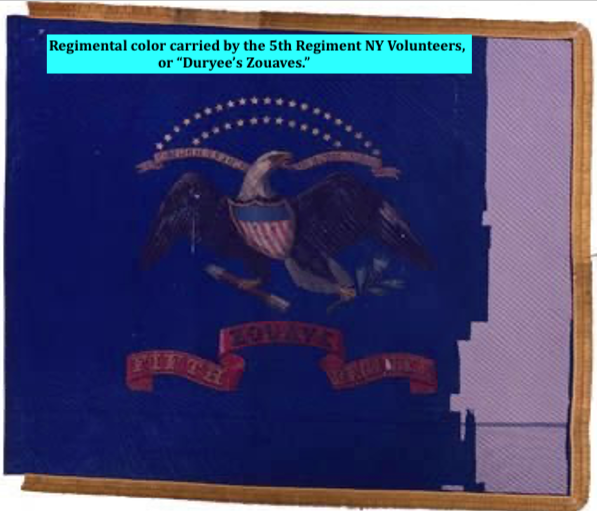
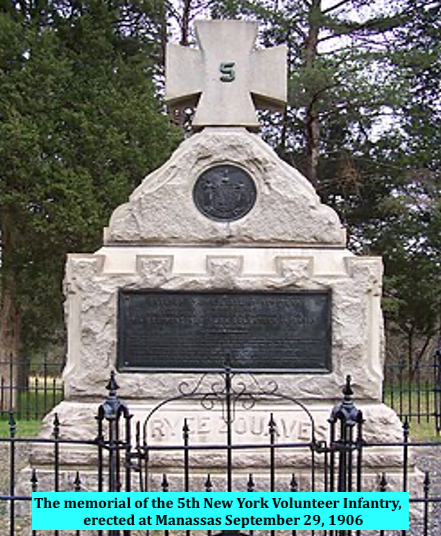
Second Battle of Bull RunThe regiment was commanded by Captain Cleveland Winslow while Colonel Gouverner Warren commanded the small two regiment brigade and Major Hiram Duryea had been forced to return home with malaria. The brigade was deployed in a sacrificial delaying act on Pope’s left flank in the face of Longstreet’s overwhelming attack. Out of 490 men engaged it lost 4 officers and 115 men killed or mortally wounded, 23 per cent of those engaged. It also lost 6 officers and 131 men wounded, and 41 men missing. “the regiment faced a musketry fire which cut down one third of its men and won praises from all who witnessed its remarkable efficiency and drill while in the thickest of that fight. It was in that battle that after having received several deadly volleys it paused at one time, while still under fire, to count off anew so that its movements might not be deranged by the absence of the fallen men.” From the monument at Manassas on New York Avenue:Here, about 4 p.m. August 30, 1862, the regiment, 482 strong, supported Hazlett’s Battery, “D” 5th U.S. Artillery, when attacked by a Division of the victorious Confederates. The Regiment stubbornly withstood this force, and checked its advance, until the Battery had withdrawn. In holding this position, the regiment suffered the greatest loss of life sustained by any infantry regiment, in any battle, during the entire Civil War. The casualties were: killed or mortally wounded, 124; wounded 223. Both color bearers, and seven out of eight of the color guard were killed; but the colors were brought with honor, off the field. Private James Webb of Company F was awarded the Medal of Honor when he “Under heavy fire voluntarily carried information to a battery commander that enabled him to save his guns from capture. Was severely wounded, but refused to go to the hospital and participated in the remainder of the campaign.” |
| September 3 | Major Hiram Duryea was promoted to lieutenant colonel |
| September 6-22 |
Maryland Campaign |
| September 16-17 |
Battle of AntietamCommanded by Captain Cleveland Winslow, the regiment was in reserve and not engaged. |
| September 20 |
Shephardstown FordOne man was wounded |
| September 29-30 | Lieutenant Colonel Hiram Duryea, still absent sick, was promoted to colonel,
Major Hull to lieutenant colonel and Captain Cleveland Winslow of Company E to major. |
| September- October | Duty in Maryland |
| October 29-November 19 | Movement to Falmouth, Va. |
| November 12 | Colonel Hiram Duryea resigned due to illness |
| December 4 | Major Winslow was promoted to colonel and Captain George Duryea of
Company I was promoted to major |
| December 12-15 |
Battle of FredericksburgThe regiment lost 2 men wounded and 3 missing |
| December 30 | Lieutenant Colonel Hull resigned to become colonel of the |
| December 31 | Major Geotge Duryea was promoted to lieutenant colonel |
| 1863 | |
| January 20-24 | “Mud March” |
| February-March | At Falmouth |
| April 27-May 6 |
Chancellorsville Campaign |
| May 1-5 |
Battle of Chancellorsville |
| May 14 | The Fifth New York Infantry Regiment was mustered out at the expiration of its
term at New York City under the command of Colonel Cleveland Winslow and Lieutenant Colonel George Duryea. Two hundred thirty recruits whose enlistments had not yet expired were assigned to 146th New York Infantry. Only about 100 men who originally enisted in 1861 were still with the regiment.Colonel Winslow went on to form the 5th Veteran Battalion. and become lieutenant colonel of the 5th New York Veteran Infantry Regiment. He was mortally wounded at the battle of Bethesda Church on June 2, 1864. |
5th Regiment, New York Veteran Infantry
Overview:
Organized into a Battalion of four Companies by consolidation of the Veterans and Recruits of the 5th New York Infantry, with those recruited for the reorganized 31st and 37th New York Infantry October 14, 1863. A Battalion of the 12th New York Infantry assigned as Companies “E” and “F,” and the Veterans and Recruits of the 94th New York Infantry assigned June 2, 1864, as Companies “G,” “H,” “I” and “K.” Left State for Washington, D. C., October 27, 1863. Attached to Garrison of Alexandria, 22nd Army Corps, Dept. of Washington, to May, 1864. 1st Brigade, 1st Division, 5th Army Corps, Army of the Potomac, to June, 1864. 1st Brigade, 2nd Division, 5th Army Corps, to June, 1865. Hart’s Island. N. Y., to August, 1865.
Service:
Duty in the Defences of Washington, D. C., till May, 1864. Ordered to join Army of the Potomac in the field May, 1864. Battles about Cold Harbor May 31-June 12; Bethesda Church June 1-3. Before Petersburg June 16-18. Siege of Petersburg June 16, 1864, to April 2, 1865. Weldon Railroad June 22-23, 1864. Mine Explosion, Petersburg, July 30 (Reserve). Weldon Railroad August 18-21. Poplar Springs Church September 29-October 2. Boydton Plank Road, Hatcher’s Run, October 27-28. Warren’s Raid on Weldon Railroad, “Hicksford Raid,” December 7-12. Dabney’s Mills, Hatcher’s Run, February 5-7, 1865. Appomattox Campaign March 28-April 9. White Oak Road March 29-31. Five Forks April 1. Fall of Petersburg April 2. Pursuit of Lee April 3-9. Appomattox Court House April 9. Surrender of Lee and his army. March to Washington, D. C., May. Grand Review May 23. Moved to Hart’s Island, N. Y., and duty there till August, 1865. Mustered out August 21, 1565.
Regiment lost during service 5 Officers and 91 Enlisted men killed and mortally wounded and 90 Enlisted men by disease. Total 189.
Predecessor units:
NEW YORK VOLUNTEERS
38th REGIMENT VETERAN INFANTRY.
Failed to complete organization. Men enlisted transferred to 5th Regiment New York Veteran Infantry October 14, 1862.
NEW YORK VOLUNTEERS
37th REGIMENT VETERAN INFANTRY.
Failed to complete organization. Men enlisted transferred to 5th Regiment New York Veteran Infantry October 14, 1863.
NEW YORK VOLUNTEERS
31st REGIMENT VETERAN INFANTRY.
Failed to complete organization. Men enlisted transferred to 5th Regiment New York Veteran Infantry, October 14, 1863.
| 5th New York Infantry Regiment | |
| Active | April 15, 1861, to May 14, 1863 |
| Country | United States |
| Allegiance | Union |
| Branch | Infantry |
| Size | 842, 792, 780 |
| Nicknames | National Zouaves, Advance Guard Zouaves, Duryée’s Zouaves |
| Equipment | Model 1842 Springfield Muskets (.69 caliber, smooth), Springfield Model 1855, Springfield Model 1861 (.58 caliber), Enfield Rifled Muskets, (.577 caliber, rifled) |
| Engagements | |
| Commanders | |
| Colonel | Abram Duryée |
| Colonel | Gouverneur K. Warren |
| Colonel | Hiram Duryea |
| Colonel | Cleveland Winslow |
| Insignia | |
| V Corps (2nd Division) badge | |
| New York U.S. Volunteer Infantry Regiments 1861-1865 | ||||
|
The 5th New York Infantry Regiment, also known as Duryée’s Zouaves, was a volunteer infantry regiment that served in the U.S. Army during the American Civil War. Modeled, like other Union and Confederate infantry regiments, on the French Zouaves of Crimean War fame, its tactics and uniforms were different from those of the standard infantry.
Organization
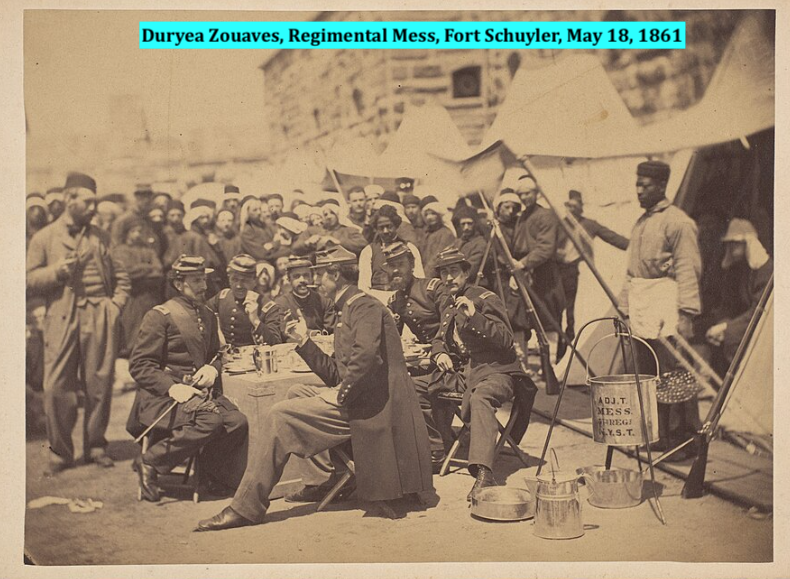
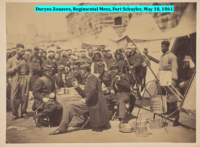
Duryea Zouaves, Regimental Mess, Fort Schuyler, May 18, 1861
The regiment was formed on April 12, 1861, by a group of military enthusiasts in Manhattan, under authority issued to Colonel Abram Duryée, and trained at Fort Schuyler at Throgs Neck, New York Harbor. On April 23, 1861, its companies were mustered into service of the State, and on April 25, the State Board confirmed the election of its field officers. The regiment was mustered into Federal service of the United States at Fort Schuyler for a term of two years by Capt. T. Seymour, US Army, two weeks later on May 9. The next day, the State Military Board formally accepted the 10th.
The majority of the soldiers were educated and above average height. The companies were recruited principally:
- A and B – New York city and Brooklyn
- C – New York city, Astoria and Poughkeepsie
- D – Fifth Ward Volunteersof New York city
- E – New York city, Brooklyn and Williamsburg
- F – New York city, Brooklyn, Fordham and Yonkers
- G – New York city, Brooklyn and New Rochelle
- H – New York city, Brooklyn, Flushing, Greenpoint, Tarrytown and West Point
- I – New York city, Brooklyn, Jamaica, Long Neck and Williamsburg, and at Perth Amboy, Plainfield and Orange, N. J.
- K – New York and Jersey City.
On April 29, 1861, the regiment withdrew 800 Model 1842 Springfield Muskets .69 caliber, smoothbore muskets from state stocks. During training the regiment acquired the following field officers: Colonel Abram Duryée, Lieut. Colonel Gouverneur K. Warren, Major J. Mansfield Davies, Adjutant Joseph E. Hamblin, Quartermaster John H. Wells, Surgeon Rufus H. Gilbert, Assistant Surgeon B. Ellis Martin, and Chaplain Rev. Gordon Winslow.
The line officers were elected as well and resulted in the following:
- Company A – Capt. Harmon Daniel Hull, 1st Lt. William T Partridge, and 2nd Lt. Charles W. Torrey
- Company B – Capt. Robert S. DuMont, 1st Lt. Gouverneur Carr, and 2nd Lt. Theodore S. DuMont
- Company C – Capt. Henry G. Davies, 1st Lt. J. Francis Evans, and 2nd Lt. Charles H. Seaman
- Company D – Capt. James L. Waugh, 1st Lt. Wilbur F. Lewis, and 2nd Lt. John A. Cochrane
- Company E – Capt. Hiram Duryea, 1st Lt. George Duryea, and 2nd Lt. Henry H. Burnett
- Company F – Capt. Henry A. Swartwout, 1st Lt. Oliver Wetmore Jr., and 2nd Lt. Carlile Boyd
- Company G – Capt. Abraham Denike, 1st Lt. Jacob Duryée, and 2nd Lt. Joseph H. Bradley
- Company H – Capt. Judson Kilpatrick, 1st Lt. Churchill J. Cambreleng, and 2nd Lt. James Miller
- Company I – Capt. Charles G. Bartlett, 1st Lt. Joseph S. York, and 2nd Lt. John H. Whitney
- Company K – Capt. Cleveland Winslow, 1st Lt. Prescoyy Tracey, and 2nd Lt. William H. Hoyt.
Service
Initial duty
On May 24, the regiment boarded a transport to reach the Virginia Peninsula. The regiment camped for a few days near Hampton Bridge, then moved to Camp Butler, Newport News, and was attached to Pierce’s brigade. The troops of the 5th led the force at the battle of Big Bethel on Monday, June 10. Captain Judson Kilpatrick took Companies E and H in advance with Colonel Duryée following with the rest the command. The 5th lost 5 killed, 16 wounded (including Kilpatrick) and 2 missing. Immediately after the battle, the regiment began making scouting expeditions.
Railroad Security
On Friday, July 26, the regiment moved to Baltimore, Maryland, to join Dix‘s Divisionwhich was tasked with protecting the Philadelphia, Wilmington and Baltimore Railroad in and out of Baltimore from Washington to Philadelphia. The 5th provided security within the city and built and garrisoned an earthen fort at the summit of Federal Hill. On Thursday, August 15, Maj. Davies resigned to take command of the 2nd New York Cavalry, and two days later, Capt. Hiram Duryea of Company was promoted as his replacement.
On August 31, Duryée was promoted to general rank, so Gouverneur Kemble Warren took over command of the regiment. Duryea moved up to Lt. Colonel, and on September 3, Hull of Company A replaced Duryea as Major.
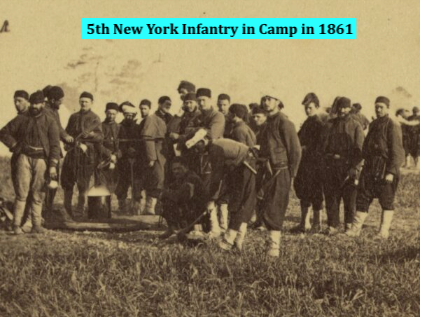
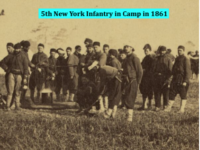
At Federal Hill, the regiment guarded the railway and the city and continuously drilled. The 5th’s duty in Baltimore was marked by occasional clashes with pro-secessionist locals, patrolling the rail lines and yards, and improving the fort on Federal Hill. With the exception of a short expedition to the Eastern Shore of Virginia, the regiment used this garrison time to continue honing its skill at its manual of arms and regimental field movements.
For twenty-three days from Wednesday, November 13 to Thursday, December 5, six companies, A, B, C, D, E, F, of the 5th left Baltimore on the steamer Pocahontas. They took part in an expedition south to the Delmarva Peninsula into Accomac and Northampton Counties. The purpose was to reassert state and Federal control over those two counties where there had been reports of secessionist activity. Despite the many Unionists in the two counties, the secessionists, who were in a slight majority in Northampton County had been actively recruiting for the Confederate army and taking reprisals against Unionists. About three thousand militia had gathered to oppose any Federal advance (some were Unionists forced into ranks), and Gen. Dix intended to send a much larger force of 5,000 to intimidate them and give support to the local Unionists. The force landed above the state line on Wednesday, November 13, a proclamation calling on the militia to lay down their arms, promising protection for Unionists, and punishment for continued disloyal activities. On Sunday, November 17, the force crossed into Virginia. Within five days, all armed units melted away, and the 5th’s companies and its colleagues in the force spread out to some of the towns to show the flag. The six companies returned to Fort Federal Hill on Thursday, December 5.
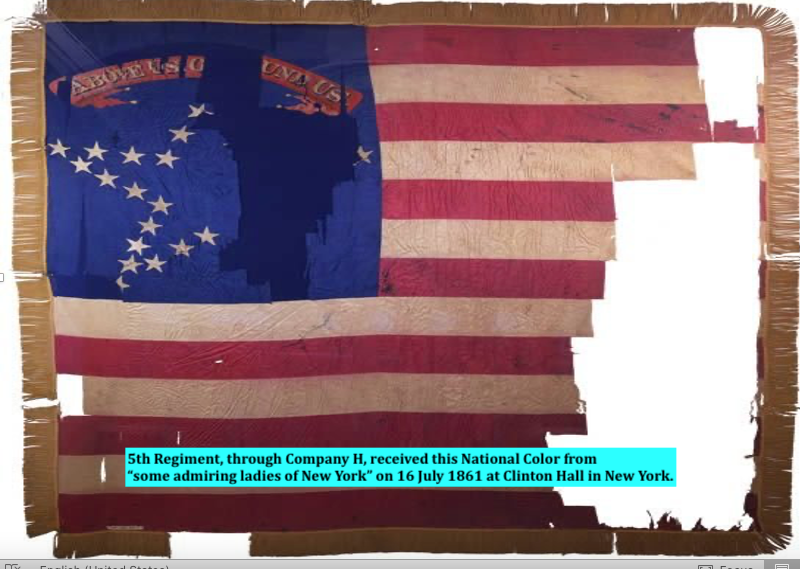
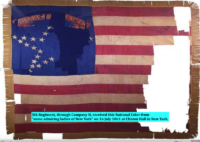
The 5th remained in garrison over the new year and on Thursday, February 6, it received a garrison flag from an association of ladies of South Baltimore. The locals around the fort had warmed to the 5th and took pride in it. To maintain discipline, punishments in garrison were harsh and in February, six members of the regiment who were chronic violators of army regulations were paraded to the “Rogue’s March,” and sent off in chains to the Washington Penitentiary and the military prison in the Dry Tortugas.[28]
The Peninsula campaign
In preparation for his upcoming offensive in the Peninsula campaign to capture Richmond, Virginia, General George McClellan ordered the regiment to join the Army of the Potomac. McClellan said that, upon seeing the colorful New York regiment, “the Fifth is the best disciplined and soldierly regiment in the Army.” After a farewell ceremony at the Fort on Friday evening, March 28, the 5th made ready to depart Baltimore.
The charge of the 5th New York Volunteer Infantry unit at Big Bethel, in a sketch by Thomas Nast.
On Monday, March 31, 1862, the 5th sailed out of Baltimore, down the Chesapeake, and landed at Hampton Roads. Upon arrival, they were attached to Sykes‘ Infantry (Reserve), Army of the Potomac.
At the Battle of Hanover Courthouse on May 27, 1862, the regiment played only a minor role. However, they fought in a more major role in the Battle of Gaines’ Mill of the Seven Days Battles. As McClellan moved his base to the James River on June 27, 1862, the regiment fought against Gregg’s South Carolina brigade. In a bayonet counterattack, the regiment defeated the initial Rebel attack driving back and routing two of the brigade’s regiments.
The Virginia campaign
In August 1862, the regiment fell under the control of General John Pope. At the Second Battle of Bull Run (also known as the Second Battle of Manassas), the 5th New York Volunteer Infantry regiment was forced to withstand the advancing forces of General James Longstreet. In underestimating the size of the Confederate army, Pope ordered the regiment to support Hazlett’s Battery. Longstreet’s soldiers easily outnumbered the small regiment, met by the 5th Texas Vol. Of the famous Texas Brigade‘s who elite soldiers accurate musket volleys quickly inflicted massive casualties in the regiment. In just 10 minutes of fighting, the 5th New York lost 332 men of the approximately 525 engaged. At least 119 of the casualties were killed outright or died of their wounds. The addition of two missing who were never accounted for would bring the death total to 121. It was the greatest battle fatality sustained by any Federal infantry unit in the war. The entire Color Guard was killed, except for one man. The only officer to survive the battle was Captain Cleveland Winslow. The regiment was effectively removed as a combat regiment, never again serving in the battle line.
The Maryland, Fredericksburg, and Chancellorsville campaigns
Later, at the Battle of Antietam, September 17, the unit was held in reserve. On December 15, the unit fought at the Battle of Fredericksburg, covering the Union retreat. At the Battle of Chancellorsville under Joseph Hooker, the unit saw its final combat.
It returned to New York on May 8, 1863, and was mustered out on the next day, its three years’ men having been transferred to the 146th New York Infantry Regiment.
During its term of service the Regiment had 2,164 men on its rolls, viz : two years’ men, of original organization, 1,026, of whom 260 were with the regiment after the battle at Chancellorsville; recruits and volunteers on reorganization, 1,138, of whom 730 returned, including only about 100 of the original members of 1861.
Affiliations, battle honors, detailed service, and casualties
Organizational affiliation
Attached to:
- Attached to Pierce’s Brigade, Newport News, Va., Dept. of Virginia, to July 1861.
- Dix’s Command, Baltimore, MD, to March 1862.
- Sykes’ Infantry (Reserve), Army of the Potomac, to May 1862
- 3rd Brigade, Sykes’ 2nd Division, V Corps, Army of the Potomac, to May 1863.
List of battles
The official list of battles in which the regiment bore a part:
- Battle of Big Bethel
- Siege of Yorktown
- Battle of Hanover Court House
- Battle of Gaines Mill
- Battle of Malvern Hill
- Second Battle of Bull Run
- Battle of Antietam
- Battle of Fredericksburg
- Battle of Chancellorsville
Detailed service
1861[31]
- Departed New York May 23
- Occupation of Newport News May 25 – July 26
- Action at Big Bethel, VA, June 10
- Moved to Baltimore, MD, July 26, and duty there till April 11, 1862.
- Expedition through Accomac and Northampton Counties, Va., November 14–22, 1861
1862
- Moved to the Peninsula, Va., April 11, 1862
- Siege of Yorktown, Va., April 15 – May 4
- Reconnaissance to near Hanover Court House May 26
- Hanover Court House May 27
- Operations about Hanover Court House May 27–29
- New Bridge June 5. Operations against Stuart June 13–15
- Old Church June 13
- Seven days before Richmond June 25 – July 1
- Battle of Mechanicsville June 26
- Battle of Gaines Mill June 27
- White Oak Swamp and Turkey Bend June 30. Malvern Hill July 1
- Duty at Harrison’s Landing till August 15
- Movement to Fortress Monroe, thence to Centreville August 15–28
- Pope’s Campaign in Northern Virginia August 28 – September 2
- Battle of Bull Run August 30
- Maryland Campaign September 6–22
- Battle of Antietam September 16–17
- Shepherdstown Ford September 20
- Duty in Maryland to October 29
- Movement to Falmouth, Va., October 29 – November 19
- Battle of Fredericksburg December 12–15
1863
- “Mud March” January 20–24, 1863
- At Falmouth till April
- Chancellorsville Campaign April 27 – May 6
- Battle of Chancellorsville May 1–5
- Mustered out May 14, 1863, expiration of term
- Recruits assigned to 146th New York Infantry.
Total strength and casualties
During its service the regiment lost by death, killed in action, 4 officers, 126 enlisted men; of wounds received in action, 2 officers, 47 enlisted men; of disease and other causes, 37 enlisted men; total, 6 officers, 210 enlisted men; aggregate, 216.
Commanders
- Colonel Abram Duryée– May 14 – September 10, 1861
- Colonel Gouverneur K. Warren– September 10, 1861 – September 26, 1862
- Colonel Hiram Duryea – September 17 – November 30, 1862
- Colonel Cleveland Winslow– December 5, 1862 – May 14, 1863
Armament & uniforms
Armament
The 5th New York were issued the Model 1842 Springfield Muskets .69 caliber, smoothbore when accepted by the state on Monday, April 29, 1861. At Fortress Monroe, companies E and K exchanged, with the Commissary General, their muskets for Sharps Model 1859 breech-loading rifles (.52 caliber). At some time prior to the Fredericksburg campaign, the regiment exchanged their 1842 Springfield smoothbores for a mix of model 1855, 1861 National Armory (NA) and contractrifle-muskets, a handful of Enfield Rifled Muskets, (.577 caliber, rifled) from stocks already in the State of New York’s possession. The regiment reported the following surveys:
Fredericksburg
- A – 35 Springfield Rifled Muskets, model 1855, 1861, NA and contract, (.58 Cal.)
- B – 32 Springfield Rifled Muskets, model 1855, 1861, NA and contract, (.58 Cal.); 1 P53 Enfield Rifled Muskets (.58 and .577 Cal.)
- C – 43 Springfield Rifled Muskets, model 1855, 1861, NA and contract, (.58 Cal.)
- D – 34 Springfield Rifled Muskets, model 1855, 1861, NA and contract, (.58 Cal.); 2 P53 Enfield Rifled Muskets (.58 and .577 Cal.)
- E – 21 Springfield Rifled Muskets, model 1855, 1861, NA and contract, (.58 Cal.); 22 Sharps Model 1859 breech-loading rifles, triangular bayonet, (.52 caliber)
- F – 41 Springfield Rifled Muskets, model 1855, 1861, NA and contract, (.58 Cal.)
- G – 38 Springfield Rifled Muskets, model 1855, 1861, NA and contract, (.58 Cal.)
- H – unreported, probably Springfield Rifled Muskets, model 1855, 1861, NA and contract, (.58 Cal.)
- I – unreported, probably Springfield Rifled Muskets, model 1855, 1861, NA and contract, (.58 Cal.); probably Sharps Model 1859 breech-loading rifles, triangular bayonet, (.52 caliber)
- K – unreported, probably Springfield Rifled Muskets, model 1855, 1861, NA and contract, (.58 Cal.)
Chancellorsville
- A – 39 Springfield Rifled Muskets, model 1855, 1861, NA and contract, (.58 Cal.)
- B – 37 Springfield Rifled Muskets, model 1855, 1861, NA and contract, (.58 Cal.); 3 P53 Enfield Rifled Muskets (.58 and .577 Cal.)
- C – 38 Springfield Rifled Muskets, model 1855, 1861, NA and contract, (.58 Cal.); 9 P53 Enfield Rifled Muskets (.58 and .577 Cal.)
- D – 37 Springfield Rifled Muskets, model 1855, 1861, NA and contract, (.58 Cal.); 3 P53 Enfield Rifled Muskets (.58 and .577 Cal.)
- E – 22 Springfield Rifled Muskets, model 1855, 1861, NA and contract, (.58 Cal.); 20 Sharps Model 1859 breech-loading rifles, triangular bayonet, (.52 caliber)
- F – 43 Springfield Rifled Muskets, model 1855, 1861, NA and contract, (.58 Cal.); 3 P53 Enfield Rifled Muskets (.58 and .577 Cal.)
- G – 38 Springfield Rifled Muskets, model 1855, 1861, NA and contract, (.58 Cal.)
- H – 34 Springfield Rifled Muskets, model 1855, 1861, NA and contract, (.58 Cal.); 4 P53 Enfield Rifled Muskets (.58 and .577 Cal.)
- I – 1 Springfield Rifled Muskets, model 1855, 1861, NA and contract, (.58 Cal.); 40 Sharps Model 1859 breech-loading rifles, triangular bayonet, (.52 caliber)
- K – 40 Springfield Rifled Muskets, model 1855, 1861, NA and contract, (.58 Cal.); 3 P53 Enfield Rifled Muskets (.58 and .577 Cal.)
Uniform
Col. Duryée had previously commanded the 7th New York Militia and under his command had earned a national reputation for its drill and uniforms, ergo, he was determined to ensure that his regiment of volunteers would also be very well-trained and equipped. At the outset, he decided to model the regiment’s uniforms on the Zouaves of the French army.
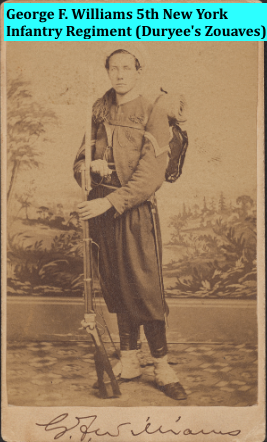
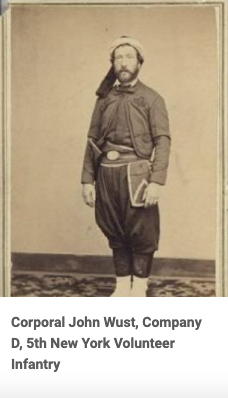
The enlisted men’s uniforms of the 5th New York’s were modeled closely on those of French Zouaves: a dark blue Zouave jacket with red trim, a dark blue shirt with red trim, a red Zouave sash with sky blue trim, extremely baggy red pantaloons, a red fez with a yellow tassel, white gaiters and leather jambières (“leggings”). The fezzes were usually worn with the white turban wrapped around them.
Officers wore the regulation dark blue frock coat with shoulder straps in infantry blue. They wore large, red trousers with unstriped outseam. Officers wore French-style red kepis with blue bands, and gold lace indicating rank.
The 165th New York Volunteer Infantry was regarded as a sister regiment and known as the “Second Battalion, Duryee Zouaves”. The 165th wore the same uniform as the 5th with the exception of the tassel of the fez, which was dark blue instead of yellow-gold. Photographic evidence suggests that later in the war the 165th was given replacement sashes that were a solid red color without the light blue trim.
Notable personnel
- Judson Kilpatrick– Captain commanding Company H from May 9 – August 12, 1861
- James Webb– Received the Medal of Honor on September 17, 1897, for actions as a Private with Company F during the Second Battle of Bull Run, August 30, 1862.
Legacy
Colonel Cleveland Winslow of the 5th organized the 5th New York Veteran Volunteer Infantry after the original 5th mustered out. After a long and difficult recruiting period, the 5th Veterans joined the V Corps and fought in the final campaigns of the Virginia front.
In the fall of 1862, officers of the 5th detailed on recruiting duty had organized the 165th New York Volunteer Infantry, or “Second Battalion Duryee’s Zouaves.” The 165th served with the XIX Corps in Louisiana, in Virginia’s Shenandoah Valley, and on occupation duty in Charleston, South Carolina, at war’s end. The 3rd Annual Report of the Bureau of Military Statistics stated “…no other New York regiment gave so many officers to other commands.”
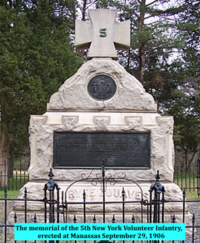
The memorial of the 5th New York Volunteer Infantry, erected at Manassas September 29, 1906.
Following the conclusion of the war, members of the 5th New York Veterans Association continued to hold monthly meetings. The veterans’ association funded the creation of a statue to General Warren, their first commander, on Little Round Top at Gettysburg. They also erected a monument to the regiment at the scene of their greatest sacrifice on the battlefield of Second Bull Run (Manassas). The association also contributed to a monument to the Army of the Potomac’s 5th Corps in Fredericksburg National Cemetery in Virginia.
Related Items
-
Id’d Civil War Camp Mirror – Lt. and Quartermaster John S. Ives 25th Connecticut Infantry
$750Id’d Civil War Camp Mirror – Lt. and Quartermaster John S. Ives 25th Connecticut InfantryDecember 24, 2021 -
1/9 Plate Ambrotype of Lt. John M. Ward Co. B 6th South Carolina Cavalry
$2,3501/9 Plate Ambrotype of Lt. John M. Ward Co. B 6th South Carolina CavalryMarch 21, 2024 -

Large Format Albumen from Glass Plate Negative by Andrew J. Russell of Confederate Fort Mahone (“Fort Damnation”) – April, 1865
$650Large Format Albumen from Glass Plate Negative by Andrew J. Russell of Confederate Fort Mahone (“Fort Damnation”) – April, 1865July 3, 2022 -

Original Regimentally Painted, Civil War Knapsack – Co. F 5th U.S. Infantry
$550Original Regimentally Painted, Civil War Knapsack – Co. F 5th U.S. InfantryDecember 10, 2021