
Civil War Razor and Razor Strop of Brevet Gen. Llewellyn G. Estes Co. A 1st Maine Cavalry, Adj. US Vols Adjutant General’s Dept., Medal of Honor RecipientFebruary 23, 2026


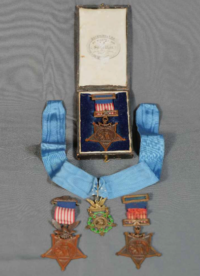
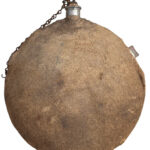
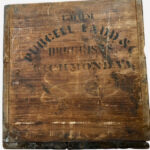
Civil War Razor and Razor Strop of Brevet Gen. Llewellyn G. Estes Co. A 1st Maine Cavalry, Adj. US Vols Adjutant General’s Dept., Medal of Honor Recipient
$750
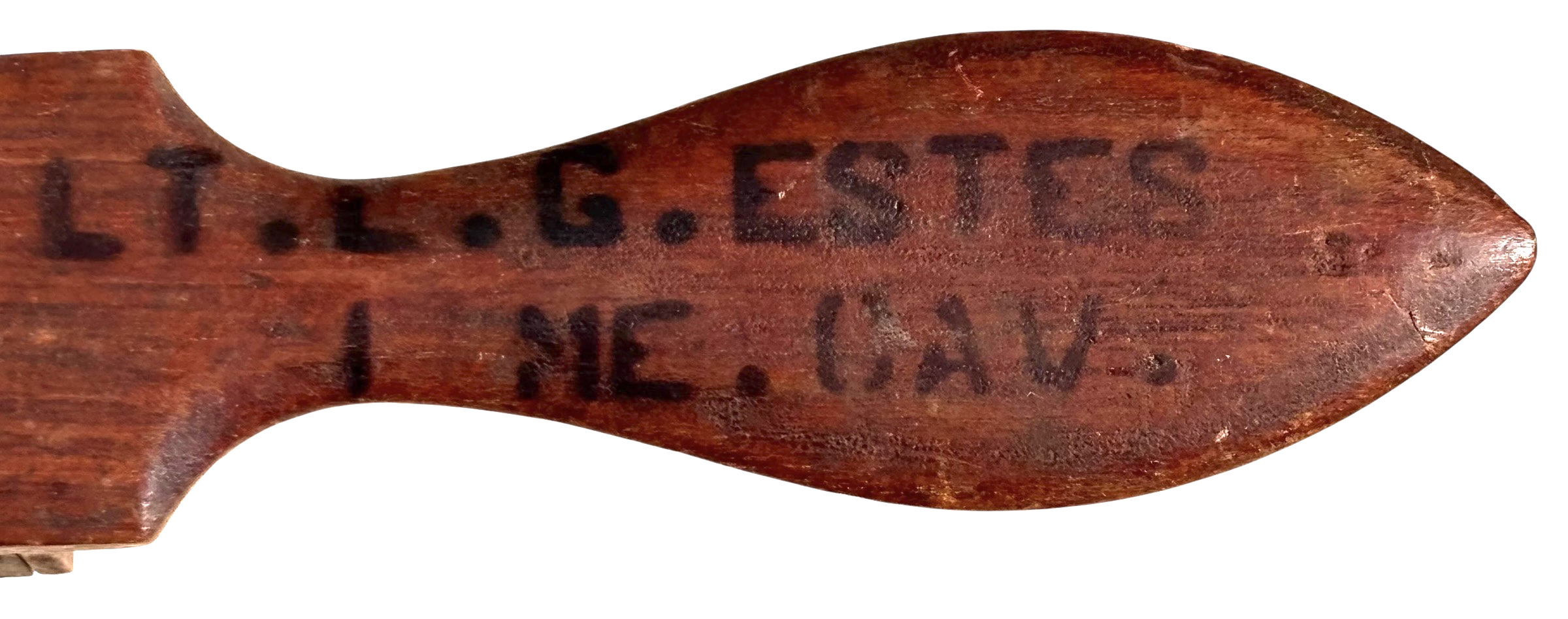
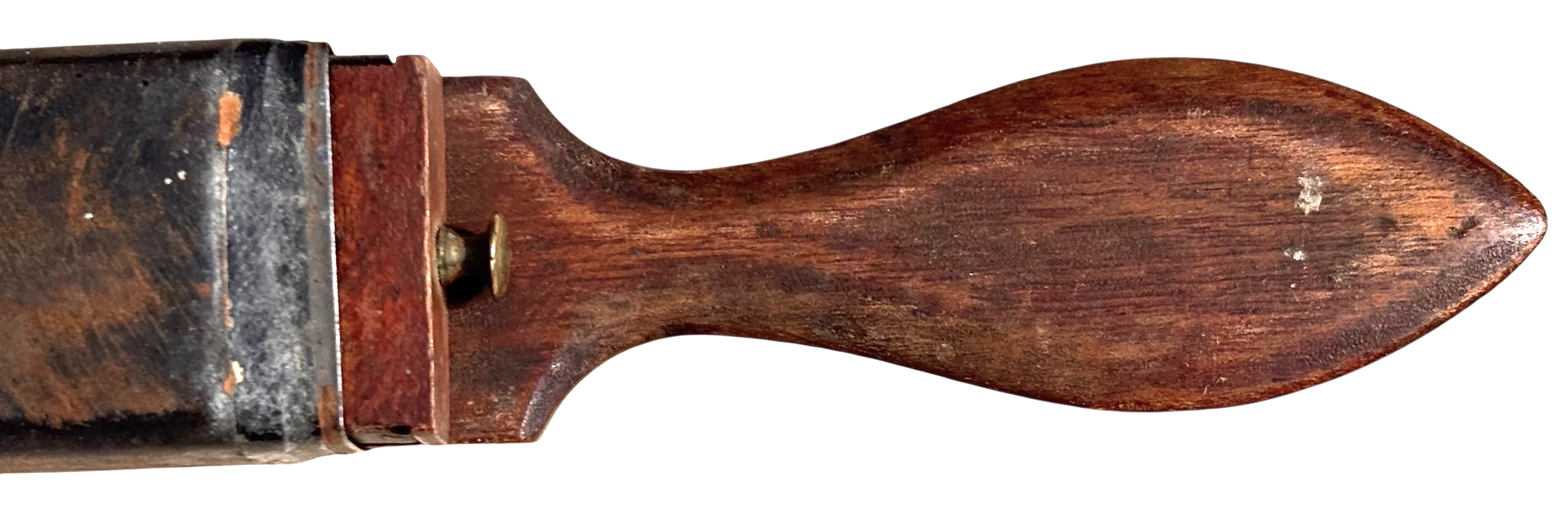
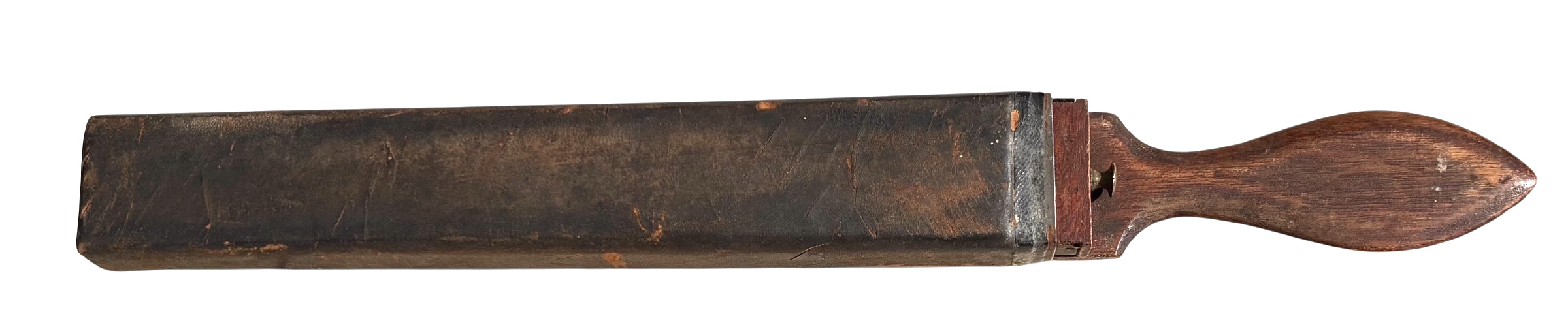
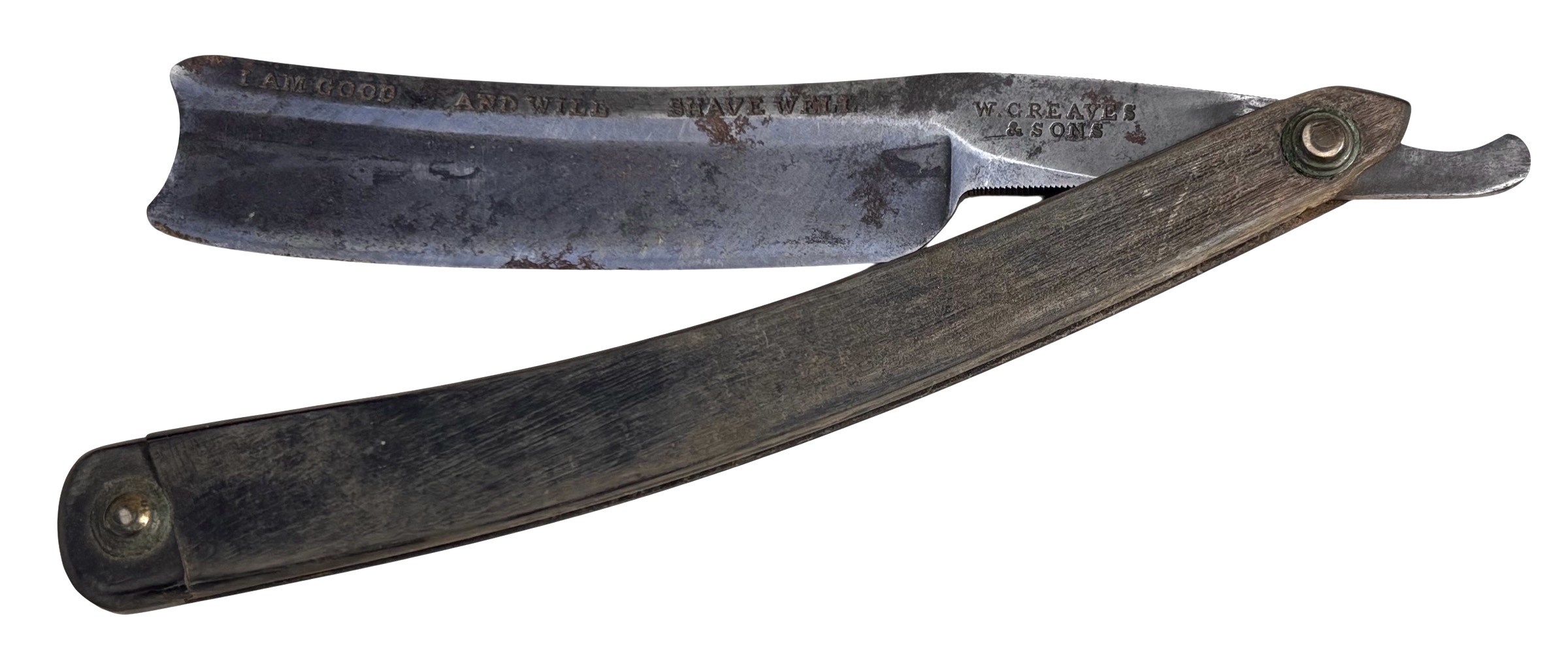
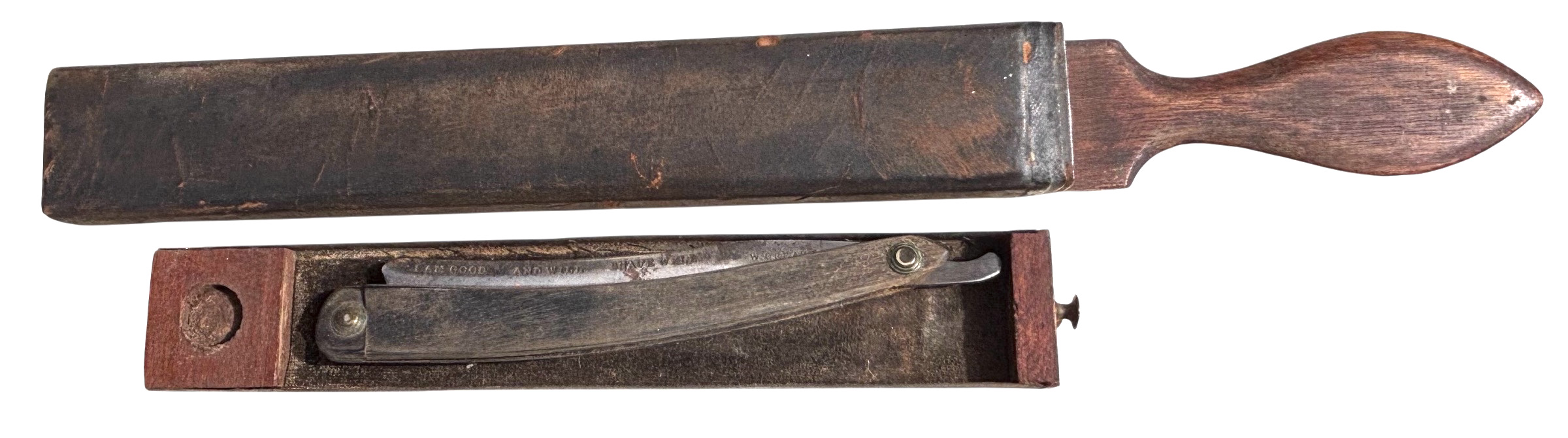
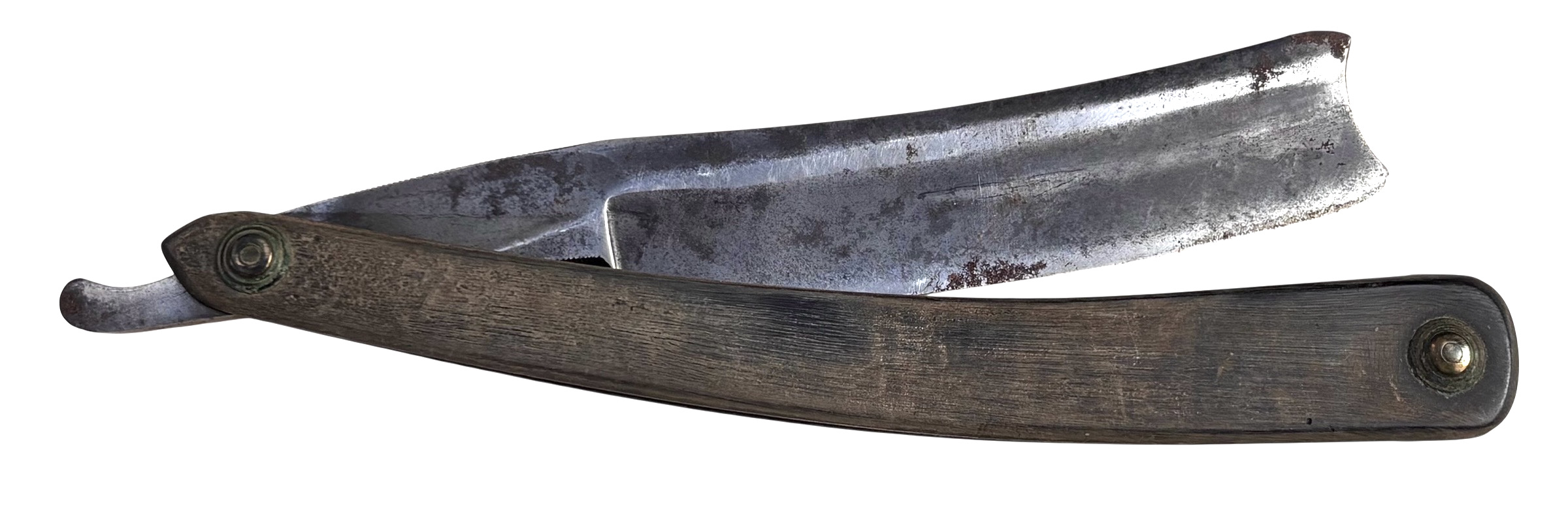
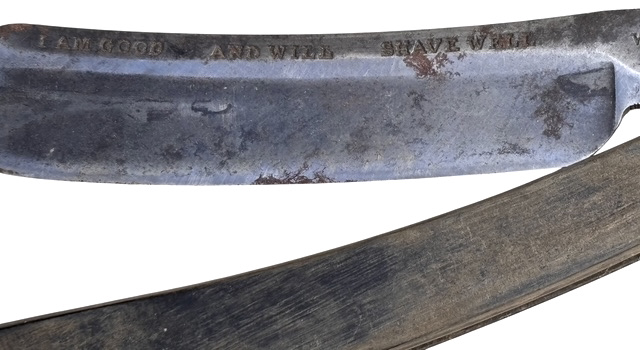
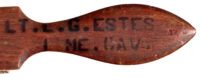
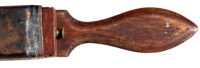
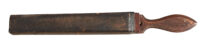
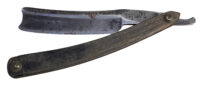
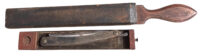
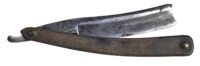
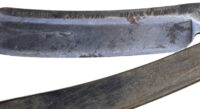
Civil War Razor and Razor Strop of Brevet Gen. Llewellyn G. Estes Co. A 1st Maine Cavalry, Adj. US Vols Adjutant General’s Dept., Medal of Honor Recipient – This is a typical razor and razor strop – the razor is housed in a pull-out tray housed within the strop. Significantly, stenciled on the wooden handle of the strop is the following:
“LT. L. G. ESTES
- CAV.”
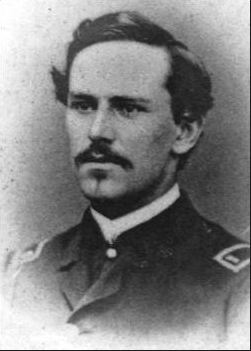
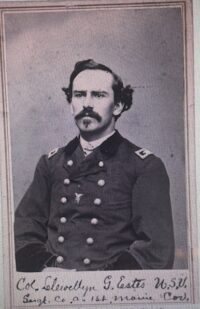
Originally from the Stillwater area of Old Town, Maine, Llewellyn G. Estes was 21 when he mustered as a sergeant with Company A, 1st Maine Cavalry Regiment in mid-October 1861. Promoted to lieutenant in March 1862, he rode with several 1st Maine companies into a deadly ambush at Middletown, Virginia on May 24. Wounded that day and captured later that summer, Estes remained a prisoner until December 21. He returned briefly to Company A before being transferred to staff duty in spring 1863. During the April incursion known as Stoneman’s Raid, Estes served as an aide to Brigadier General Judson Kilpatrick; sent with 10 cavalry troopers to carry a message through enemy lines, Estes captured 17 Confederates. Shortly afterwards his little group ran into more Confederates, who rounded up Estes and his men and started them on the road to Richmond. Up rode other Union troopers to capture Estes’ captors, and Estes escorted them into the Federal lines.
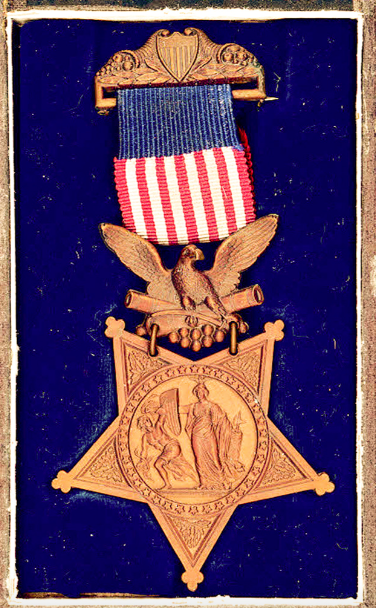
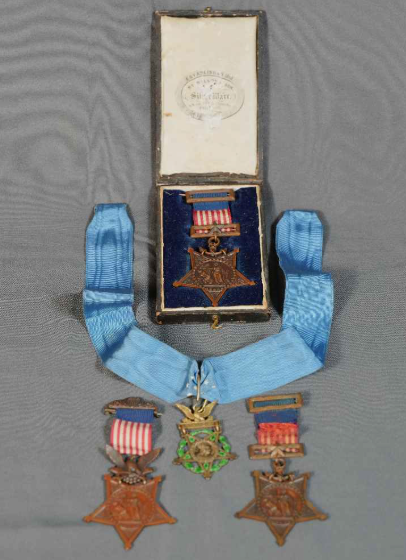
Transferred to the Western Theater in April 1864, Estes rode through Georgia and South and North Carolina with William Tecumseh Sherman. Involved in occupation duty in western North Carolina after the war, Colonel Estes submitted his resignation from the army effective September 30, 1865. He was brevetted to brigadier general that same day. He was awarded the Medal of Honor for action on 8/30/1864 at Flint River, GA.
(Voluntarily led troops in charge over burning bridge) – Medal issued August 29, 1894.
Llewellyn G. Estes
Residence Oldtown, ME; 21 years old.
Enlisted on 10/19/1861 as a Sergt.
On 10/19/1861, he mustered into “A” Co. Maine 1st Cavalry.
He was discharged for promotion on 9/4/1863
On 9/4/1863, he was commissioned into US Volunteers Adjutant Genl Depr.
He was Mustered Out on 9/29/1865
He was listed as:
- Paroled 6/15/1862 Annapolis, MD (Estimated day)
- Detailed 7/15/1863 (place not stated) (Estimated day)
- POW (date and place not stated) (1862)
Promotions:
- 1st Lieut 3/24/1862
- Capt 6/18/1863
- Capt 9/4/1863 (Captain & Asst Adjutant General)
- Major 2/2/1865
- Lt Colonel 3/13/1865 by Brevet
- Colonel 3/13/1865 by Brevet
- Brig-General 3/13/1865 by Brevet
Born 12/27/1843 in Oldtown, ME
Died 2/21/1905 in Washington, DC
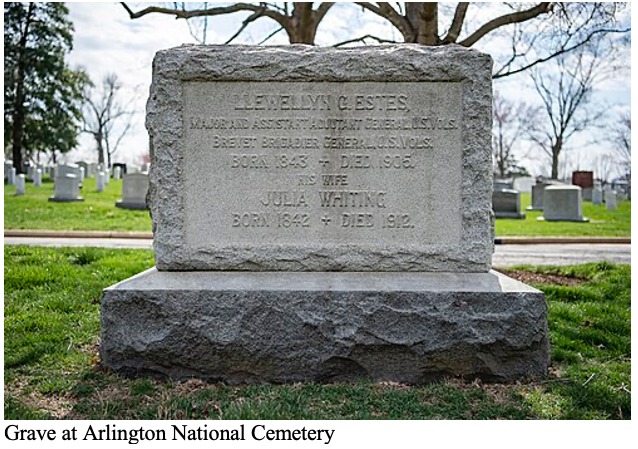
Buried: Arlington National Cemetery, Arlington, VA
Medal of Honor Information
He was awarded the Medal of Honor for action on 8/30/1864 at Flint River, GA.
(Voluntarily led troops in charge over burning bridge)
Sources used by Historical Data Systems, Inc.:
- Deeds of Valor. How our Soldier-heroes won the Medal of Honor
- Heitman: Register of United States Army 1789-1903
- Brevet Brigadier Generals in Blue
- Report of the Adjutant General of the State of Maine
- Medal of Honor Recipients 1863-1994
- Dyer: A Compendium of the War of the Rebellion
- Congress Medal of Honor Legion of the United States
Llewellyn Garrish Estes
1st ME Cavalry
Organized: Augusta, ME on 10/31/1861
Mustered out: 8/1/1865
MAINE 1ST CAVALRY (THREE YEARS) First Cavalry.-Cols., John Goddard, Samuel H. Allen, Calvin S. Douty, Charles H. Smith; Lieut.-Cols., Thomas Hight, Calvin S. Douty, Charles H. Smith, Stephen Boothby, Jonathan P. Cilley; Majs., Samuel H. Allen, David P. Stowell, Calvin S. Douty, Warren L. Whitney, Jonathan P. Cilley, Charles H. Smith, Stephen Boothby, George M. Brown, Sidney W. Thaxter, Constantine Taylor, Benjamin F. Tucker, Paul Chadbourne, Daniel S. Curtis, Joel W. Cloudman. This regiment was raised at large, consisted of twelve companies, and was mustered in at Augusta, Nov. 5, 1861, for three years. It was the equal of any in the service in the character of its men and the quality of its horses. It remained encamped at Augusta until the following spring. Companies A, D, E and F left the state for Washington on March 14, under command of Col. Allen, arriving there on the 19th. Companies B, I, H and M, under Maj. Douty, arrived on the 24th and C, G, K and L, under Maj. Stowell, on the 28th. A, B, E, H and M under Lieut.-Col. Douty, joined Gen. Banks, corps at Strasburg, Va., on May 11, and were attached to Gen. Hatch’s cavalry brigade. The other seven companies were first assigned to Gen. Abercrombie’s brigade, and soon afterwards to Gen. Ord’s division at Fredericksburg. The men participated in their first severe engagement on May 23, when Lieut.-Col. Douty with his command and two companies of the 1st Vt. cavalry, charged the enemy at Middletown, Va., covering Banks, retreat to Williamsport. The loss was 176 horses and equipments. The regiment was reunited at Warrenton, Va., on July 10, and attached to Bayard’s brigade, with which it took part in the battle of Cedar mountain. It participated in the retreat of Gen. Pope’s forces to Fairfax Court House, where it arrived on Sept. 3, and reported to Gen. Reno, having engaged the enemy at Brandy Station on Aug. 20, and been present at the second battle of Bull Run on the 30th, under Brig.-Gen. Elliott of Pope’s staff. Arriving in Washington on Sept. 4, it was attached to Burnside’s corps and engaged the enemy at Frederick, Md., on the 12th. Co. G, acting as Gen. Reno’s body-guard, took part in the battle of South mountain, Cos. M and H, under Gen. Porter, in that of Antietam. The regiment (except Cos. G, M and H) remained at Frederick from Sept. 12, to Nov. 2, up to which period it had lost in action and worn out in service nearly 700 horses. The severity of the service to which the men of this regiment were subjected may be inferred from a bare recital of the battles in which they were subsequently engaged and from data showing some of their heaviest losses. The list of battles includes, in addition to those above mentioned: Fredericksburg, Rappahannock Station, Brandy Station, Aldie, Middleburg, Upperville, Gettysburg, Shepherdstown, Sulphur Springs, Mine Run, about Richmond, Old Church, Todd’s tavern, Ground Squirrel Church, Hawes’ shop, Cold Harbor, Trevilian Station, St. Mary’s Church, Deep Bottom, Reams’ Station, Wyatt’s farm, Boydton road and Bellefield. Col. Douty was killed at Aldie, Va, while leading a gallant charge, on June 17, 1863, as was Capt. Summatt while rallying his men under a murderous fire of grape and canister. Three hundred selected men from the regiment participated in the daring raid of Gen. Kilpatrick to the vicinity of Richmond, Feb. 27 to March 12, 1864, the loss of the 1st in this famous raid being 93 men killed, wounded or missing and over 200 horses. It also moved with the cavalry corps on Gen. Sheridan’s first raid, May 9, 1864, until within 3 miles of Richmond. In the engagement at Trevilian Station, June 24, 1864, its loss was 10 officers and 58 enlisted men. During August of this year its loss in killed, wounded and missing was 49 men and 75 horses, and the total casualties during 1864 amounted to 295 officers and enlisted men. In Aug., 1864, seven companies of the 1st D. C. cavalry were transferred and assigned to the several companies of this regiment by a special order of the war department. The original members of the regiment whose term of service expired Nov. 4, 1864, were mustered out at Augusta, Me., on the 25th, while the regiment, now composed of veterans recruits and members of the 1st D. C. cavalry whose term had not expired, participated in the closing battles of the war; was mustered out of the U. S. service at Petersburg, Va., Aug., 1, 1865, and arrived in Augusta, Me., on the 9th.
| Llewellyn Garrish Estes | |
| Born | December 27, 1843
Old Town, Maine, U.S. |
| Died | February 21, 1905 (aged 61)
Washington, D.C., U.S. |
| Buried | Arlington National Cemetery |
| Allegiance | United States of America |
| Branch | United States Army Union Army |
| Service years | 1861–1865 |
| Rank | First Sergeant |
| Unit | 1st Maine Volunteer Cavalry Regiment |
| Awards | Medal of Honor |
| Signature | |
Llewellyn Garrish Estes (December 27, 1843 – February 21, 1905) was an American soldier who fought in the Civil War. Estes received the United States’ highest award for bravery during combat, the Medal of Honor, for his action at Flint River in Georgia on August 30, 1864. He was honored with the award on August 29, 1894.
Biography
Estes was born in Old Town, Maine on December 27, 1843. He joined the 1st Maine Volunteer Cavalry Regiment as a first sergeant in October 1861, and was commissioned as first lieutenant in March 1862. In May 1863, while serving on the staff of Maj. Gen. H. J. Kilpatrick, he was captured carrying a message to General Joseph Hooker. While part of a group of prisoners being escorted to Richmond, Virginia, they managed to overpower their captors during the night and instead returned with their Confederate prisoners to the Union lines.
Estes was promoted to captain in August 1863 and was appointed as assistant adjutant general the next month. Assigned with Kilpatrick’s cavalry to Sherman’s March to the Sea, he was commended by Generals Sherman and Kilpatrick for his skill in leading small raiding parties in Georgia. Part of the advance party that reached the Atlantic coast, Estes was the first to contact the Union naval forces waiting offshore. By the time he mustered out in September 1865 at the age of 21, he was a major, and had received a brevet promotion to brigadier general.
After contracting pneumonia, he died from heart failure at his home in Washington, D.C. on February 21, 1905, and his remains are interred at the Arlington National Cemetery in Virginia.
Medal of Honor citation
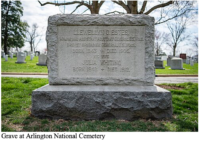
Grave at Arlington National Cemetery
His Medal of Honor action occurred while serving with the 92nd Illinois Volunteer Infantry.
The President of the United States of America, in the name of Congress, takes pleasure in presenting the Medal of Honor to Captain & Assistant Adjutant General Llewellyn Garrish Estes, United States Army, for extraordinary heroism on 30 August 1864, while serving with U.S. Volunteers, in action at Flint River, Georgia. Captain Estes voluntarily led troops in a charge over a burning bridge.
Lewellyn Garrish Estes With a good Welsh name, Estes was born at Old Town, Maine, in December 1843.
He was 17 when—taking advantage of his father’s absence from home—he enlisted in Company A of the 1st Maine as sergeant in October 1861. He gave his age as 21.
Making a quick rise, he was commissioned 1st lieutenant on March 24, 1862. During the regiment’s first campaign in the Shenandoah Valley, he was wounded at Middletown on May 24, 1862. While the regiment was involved in Pope’s withdrawal beyond the Rappahannock he was captured near Warrenton on August 22, 1862, and spent time in prison until he was exchanged and returned to the regiment on December 21.
In March 1863 the 1st Maine was called on for a brigade staff officer, and Lieutenant Colonel Smith suggested to Colonel Douty, “There’s Estes; he won’t work in harness,” so Estes was appointed acting assistant adjutant general of Kilpatrick’s 1st Brigade of the Third Division. During Stoneman’s Raid in May 1863, Kilpatrick’s Brigade was sent to the east and proceeded down the neck to Gloucester. At one point Estes volunteered to carry a message back. He and his orderlies were captured, but then captured their captors and brought them in to Kilpatrick.
Estes was actively engaged at Brandy Station and the advance to Upperville as Kilpatrick’s principal staff member, and he became Third Division a.a.a.g. when Kilpatrick was promoted to brigadier general and given command. At Gettysburg on July 2 he led a wild saber charge through Hunterstown. The next day, he joined in the unfortunate charge that Kilpatrick ordered Gen. Farnsworth to make on the left, emerging safely, unlike Farnsworth. Later in the campaign he captured a Confederate battle flag, probably during Kilpatrick and Custer’s charge at the Battle of Falling Waters on July 14.
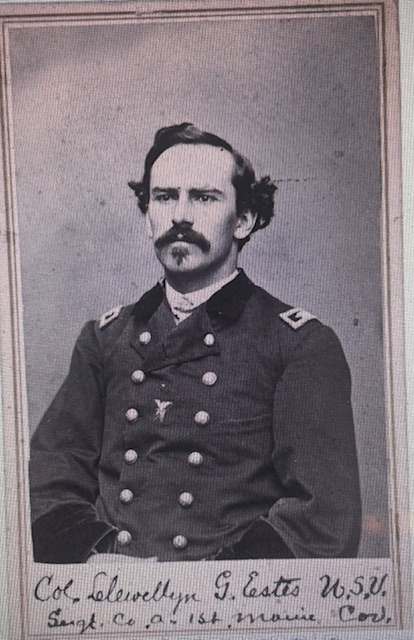
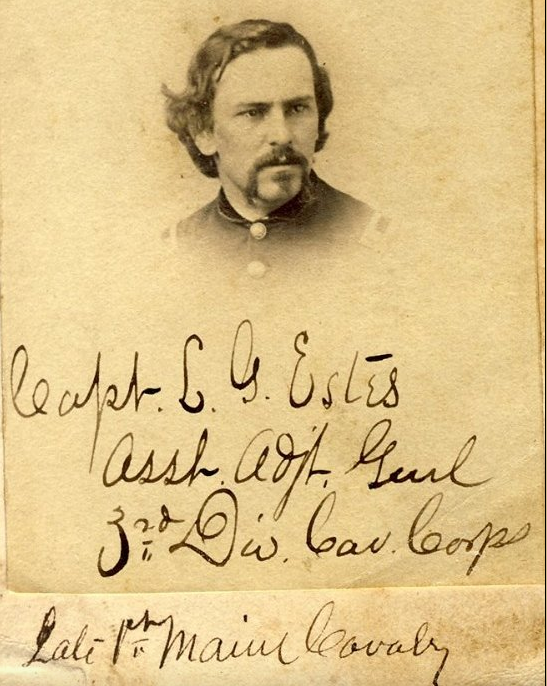
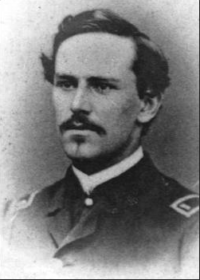
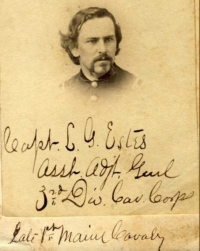
Promoted to captain of Company A on June 18, 1863, he remained on detached duty and was officially separated from the 1st Maine when he was assigned as an assistant adjutant general of volunteers in December 1863—when he turned 20. This cdv was probably taken about that time, and he also appears in a photograph of Kilpatrick sitting on the porch of Rose Hill, Kilpatrick’s headquarters at Stevensburg.
During the Kilpatrick-Dahlgren Raid, Estes seized the telegraph station at Beaver Dam before a warning could be sent to Richmond. He was at the very front when Kilpatrick got cold feet and decided not to dash into Richmond. And as Kilpatrick’s column retired down the Peninsula, Estes commanded his old company of the 1st Maine in a charge on the Confederate cavalry that stalked the column.
In April 1864 Estes went with Kilpatrick to the west and became adjutant general of cavalry in the Military Division of the Mississippi. Kilpatrick’s cavalry was sent with Gen. Howard’s infantry to cut the railroads into Atlanta in August 1864. As they approached the Flint River near Jonesboro, Estes was commanding the cavalry brigade on the right flank. When Howard asked him to drive the Confederates across the river so the infantry could obtain water, Estes scattered them with a mounted charge, then offered to take the bridge. Dismounted, he led two companies across the stringers of the dismantled bridge to secure the crossing.
Commissioned major in September 1864, he was heavily engaged in the running battles with Wheeler’s and Hampton’s cavalry across South and North Carolina. In November and March, Wheeler and Hampton twice overran Kilpatrick’s camp and Kilpatrick fled in his drawers. Estes escaped capture because, rather than staying the house with Kilpatrick, he bunked in the ambulance that carried his adjutant general papers. In March 1865 he was commissioned lieutenant colonel and colonel by brevet.
During the negotiations between Sherman and Johnston that resulted in the surrender in late April 1865, Estes was a messenger. During the interim, he seems to have emulated his commander by taking a female companion, who dressed in male clothing and called herself “Frank.” As adjutant general of western North Carolina, he supervised activities in 41 counties of North Carolina from April through September 1865.
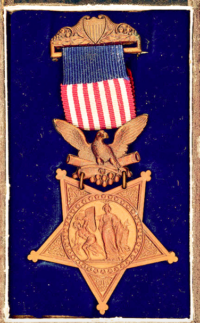
Estes was breveted brigadier general on September 30, 1865, and resigned from the army, settling in North Carolina. In 1894 he was awarded a Congressional Medal of Honor for his action at the Flint River. Llewellyn G. Estes died in 1905 and is buried at Arlington National Cemetery.
Awarded the Medal of Honor for leading a charge over a burning bridge at Flint River, Ga., 30 August 1864. Medal issued August 29, 1894.
Estes died on February 1, 1905 and was buried in Section 3 Grave 1437 of Arlington National Cemetery.
His wife, Julia Whiting Estes (1842-1912), is buried with him.
U.S. Civil War – U.S. Army
Lewellyn Garrish Estes
Details
- Rank: Captain & Assistant Adjutant General (Highest Rank: Brevet Brigadier General)
- Conflict/Era: U.S. Civil War
- Unit/Command:
U.S. Volunteers - Military Service Branch: U.S. Army
- Medal of Honor Action Date: August 30, 1864
- Medal of Honor Action Place: Flint River, Georgia, USA
Citation
Voluntarily led troops in a charge over a burning bridge.
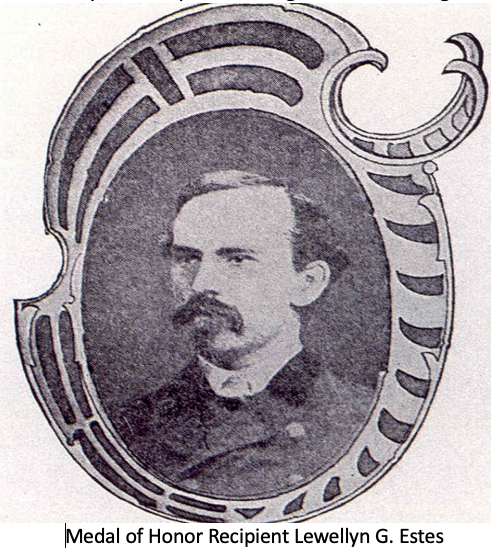
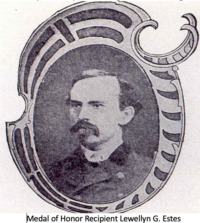
Medal of Honor Recipient Lewellyn G. Estes
Additional Details
- Accredited to: Oldtown, Penobscot County, Maine
- Awarded Posthumously: No
- Presentation Date & Details: August 29, 1894
- Born: December 27, 1843, Oldtown, Penobscot County, Maine, United States
- Died: February 21, 1905, Washington, District of Columbia, United States
- Buried: Arlington National Cemetery (3-1437), Arlington, Virginia, United States
Biography – Llewellyn Garrish Estes was an American soldier during the Civil War. Llewellyn was a Brevet Brigadier General in the Union Army. For his gallant conduct at Jonesboro, Georgia, Jones was awarded the Medal of Honor.
Llewellyn Estes was awarded the Medal of Honor.
Lewellyn was born in 1843. He was the son of Barzilla Estes and Phebe Ann Coombs.
Llewellyn married Julia Whiting on Aug 21, 1866 in New York, New York.
He passed away in 1905 and is buried at Arlington National Cemetery Arlington, Virginia.
- Civil War Union Brevet Brigadier General, Medal of Honor Recipient.
- He served in the Civil War first as Captain of Company A, 1st Maine Volunteer Cavalry, then as Major and Assistant Adjutant General on the staff of Major General Judson Kilpatrick.
- He was awarded the CMOH for his bravery at Flint River, Georgia on August 30, 1864, with his citation reading “Voluntarily led troops in a charge over a burning bridge”. He had been ordered by Major General Oliver O. Howard to drive away rebel troops who were blocking Union Army’s advance on Jonesboro, Georgia. This he did, leading his men under heavy fire across a burning bridge armed with only a revolver. His leadership in the charge cleared the way for the Union troops, saved the bridge for them to cross, and won glowing praise from General Howard in his official reports. His Medal was issued on August 29, 1894. He was brevetted Brigadier General, US Volunteers on March 13, 1865 for “faithful and meritorious services”.
Related Items
-
Renown Richmond Sculptor Edward V. Valentine’s Personal Photographs of General Robert E. Lee Utilized by Valentine When Sculpting a Statuette of Lee
$4,200Renown Richmond Sculptor Edward V. Valentine’s Personal Photographs of General Robert E. Lee Utilized by Valentine When Sculpting a Statuette of LeeMarch 29, 2024 -
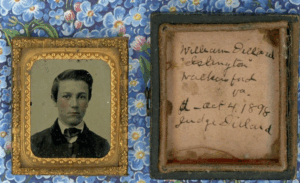
1/16 PLATE RUBY AMBROTYPE OF VMI CADET WILLIAM T. DILLARD WOUNDED IN THE BATTLE OF NEW MARKET
$1,8501/16 PLATE RUBY AMBROTYPE OF VMI CADET WILLIAM T. DILLARD WOUNDED IN THE BATTLE OF NEW MARKETDecember 18, 2023 -
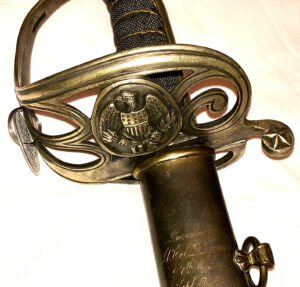
Model 1850 Non-regulation Field and Staff Officers Sword Presented to Lt. Col. Luke Lyman 27th Massachusetts Infantry in 1861
Model 1850 Non-regulation Field and Staff Officers Sword Presented to Lt. Col. Luke Lyman 27th Massachusetts Infantry in 1861March 7, 2023 -
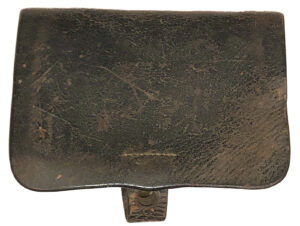
Id’d Civil War .44 Cal. Pistol Cartridge Box
$425Id’d Civil War .44 Cal. Pistol Cartridge BoxJanuary 4, 2024