Civil War Period Parker’s Patent Tin Snuff Box with Engraved Regimental Attribution on the Cover – 1st Vermont CavalryNovember 22, 2026
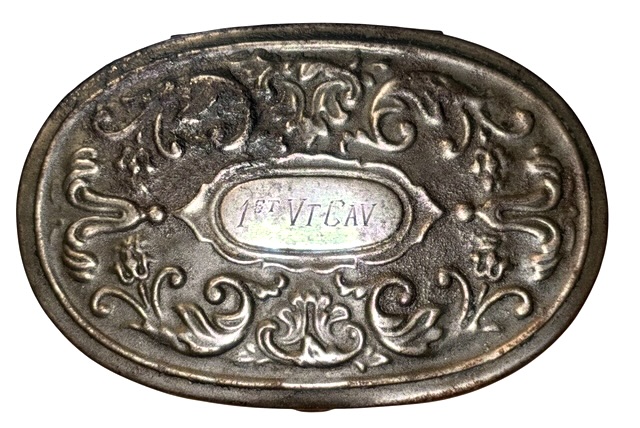
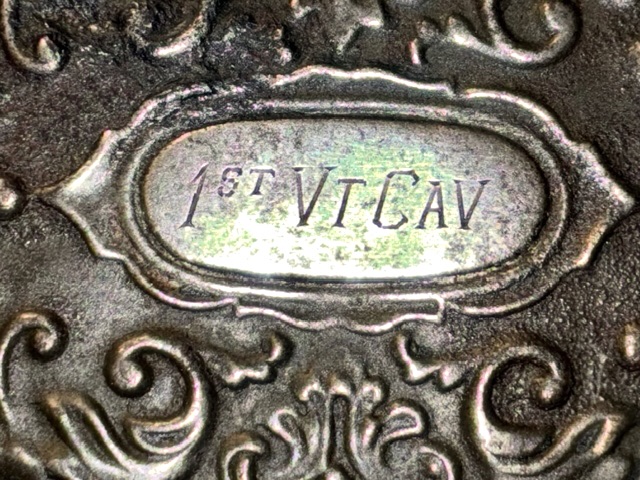
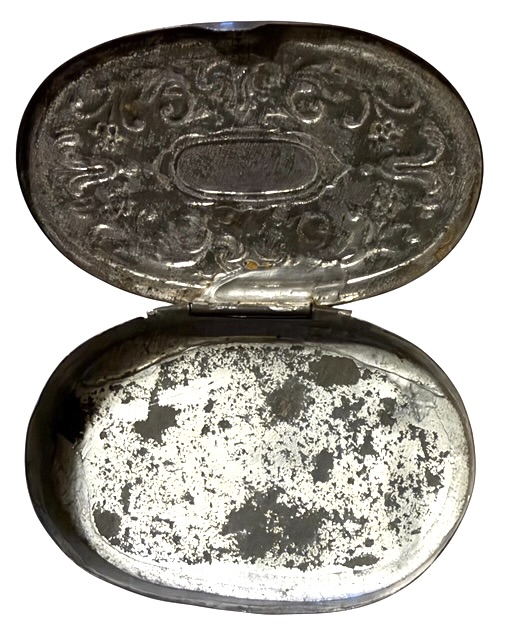
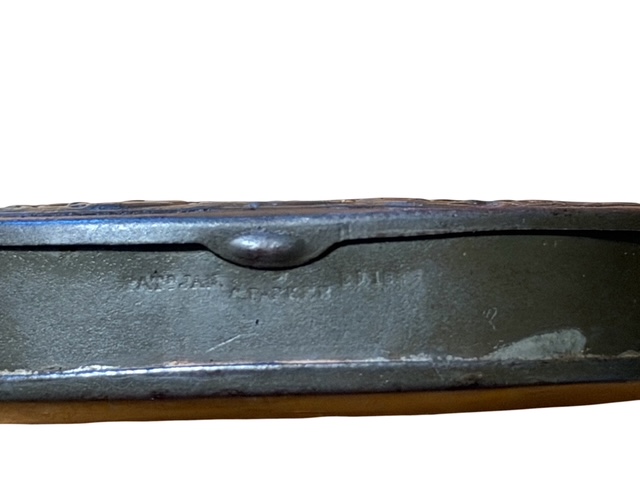
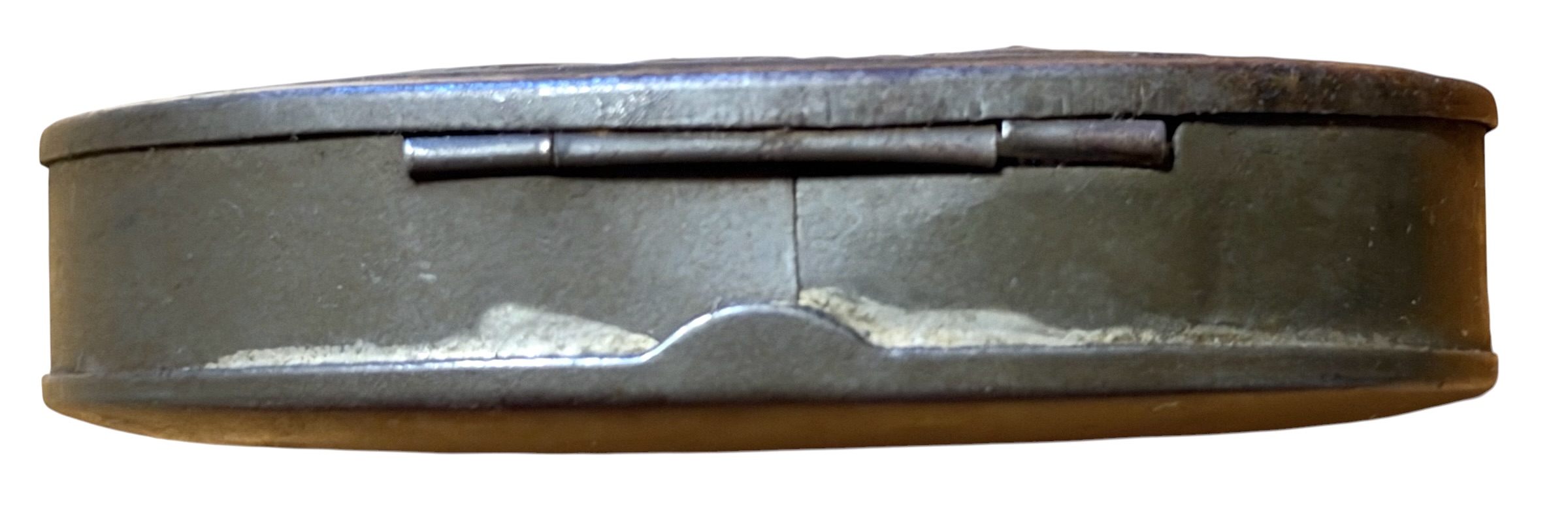
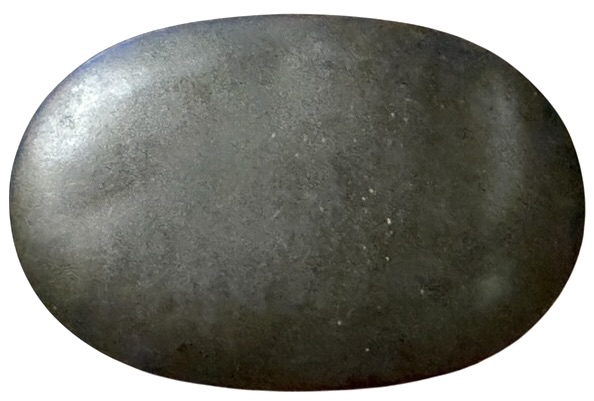
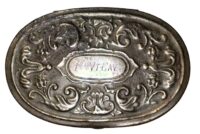
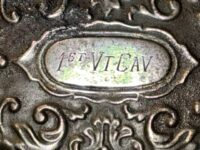
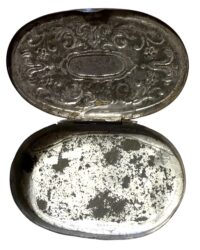
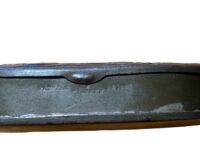
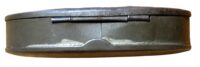
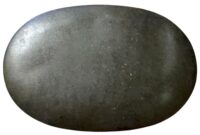
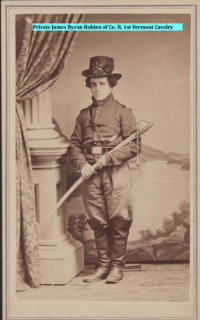
Civil War Period Parker’s Patent Tin Snuff Box with Engraved Regimental Attribution on the Cover – 1st Vermont Cavalry – This is a typical Civil War period, decoratively embossed, oval shaped, tin snuff box, made by Parker – impressed patent date of 1861 on the front of the box. In the oval panel on the top of the box is engraved:
“1st VT CAV”
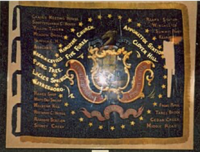
The 1st Vermont Cavalry originated in 1861 and would be heavily engaged throughout the entire war. This is the first of these Parker snuff boxes that we have had with a regimental identification engraved on the box.
1st Vermont Cavalry Regiment
The 1st Vermont Cavalry Regiment mustered 44 officers and 1,130 enlisted men as original members and gained 1,118 recruits and 12 transfers from other units, for a total of 2,304 men who served during the American Civil War.
The regiment lost 8 officers and 64 enlisted men killed, 2 officers and 38 enlisted men mortally wounded, and 2 officers and 112 enlisted men who died of disease. Of the 699 men who were captured 1 officer and 158 enlisted men died in Confederate prisons. Two officers and 5 enlisted men died in accidents, for a total of 392 deaths. A total of 302 men were wounded but survived.
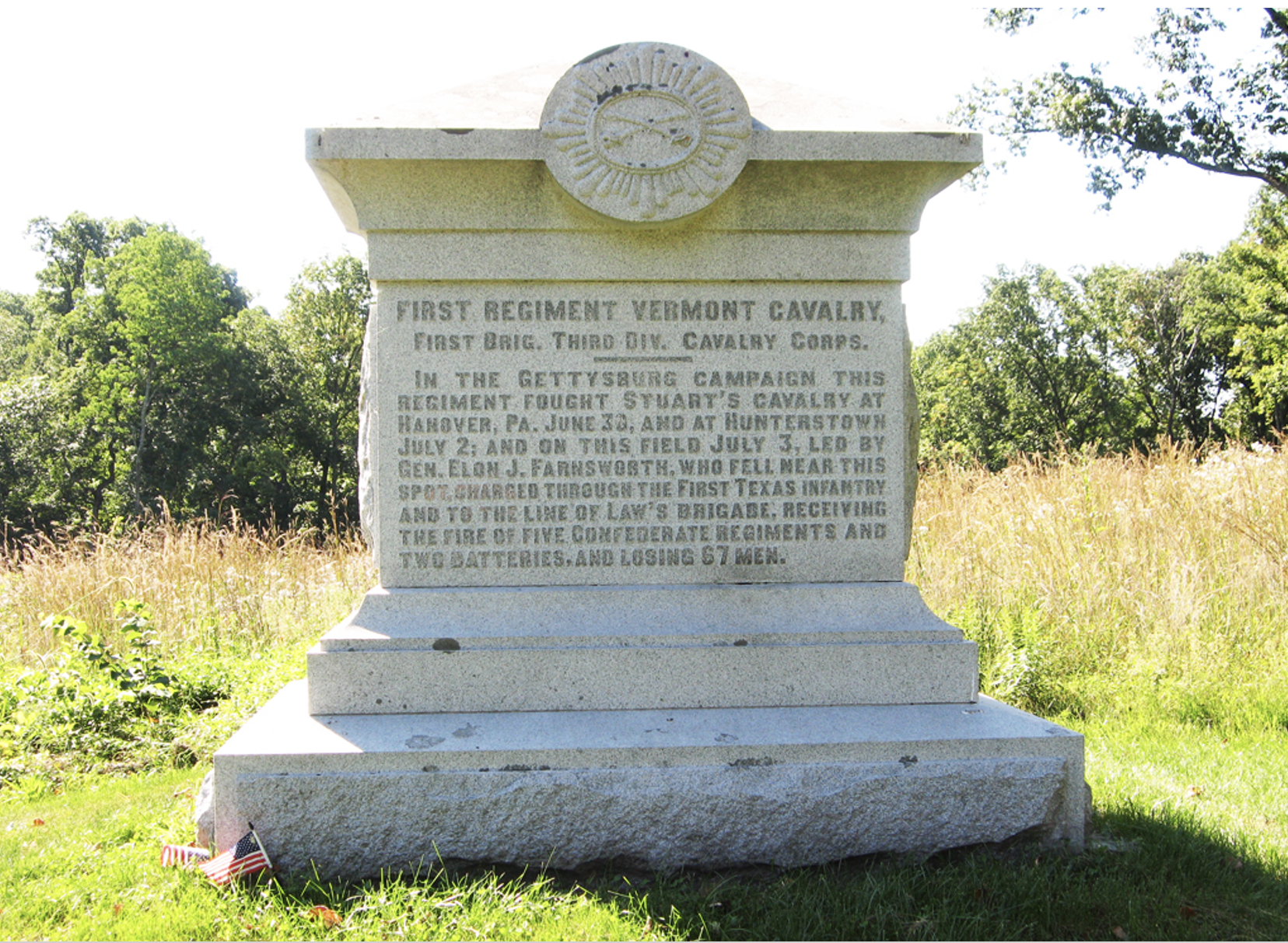
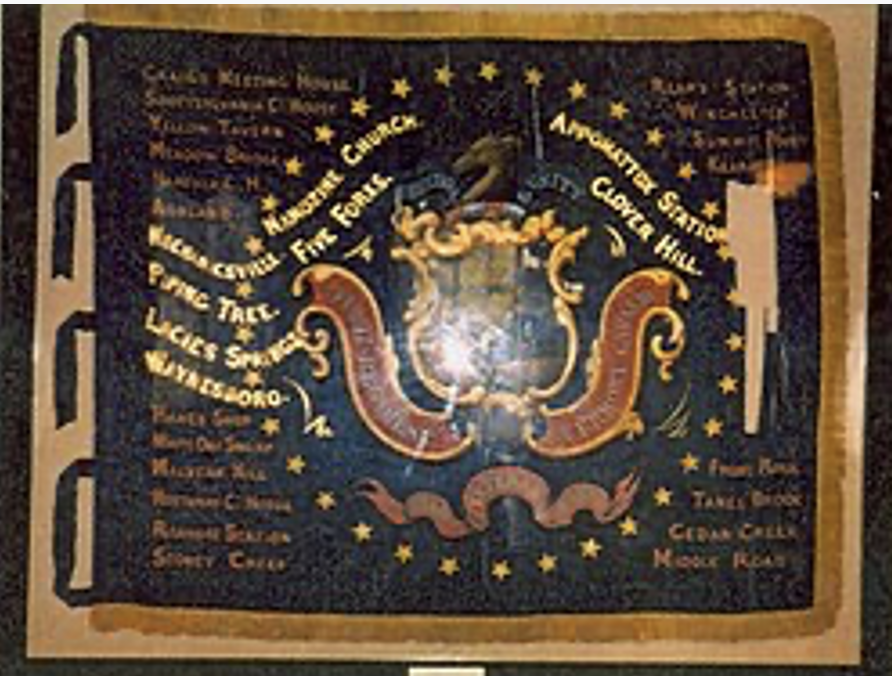
The 1st Vermont Cavalry is honored by two monuments on the Gettysburg battlefield. From the main monument: “Took part in the battles of Gettysburg, Wilderness, Yellow Tavern, Winchester, Cedar Creek, Waynesboro, Five Forks, Appomattox Station and 67 other battles and engagements.”
| 1861 | |
| Organized at Burlington under the command of Colonel Lemuel B. Platt and Lieutenant Colonel George B. Kellogg and Majors William D. Collins and John D. Bartlett.
Organization of the Regiment · Company A – Captain Frank A. Platt · Company B – Captain George P. Conger · Company C – Captain William Wells · Company D – Captain Addison W. Preston · Company E – Captain Samuel P. Rundlett · Company F – Captain Josiah Hall · Company G -Captain James A. Sheldon · Company H – Captain Selah G. Perkins · Company I – Captain Edward B. Sawyer · Company K – Captain Franklin Moore |
|
| November 19 | Ten companies were mustered in for three years United States service. |
| December 14 | Left Vermont for Washington, D.C. Five trains consisting of a total of 153 cars were needed. |
| December 25 | Moved to Annapolis, Md. and duty there |
| 1862 | |
| January 9-10 | Moved to Washington, D. C.
Attached to Banks’ Division, Army of the Potomac |
| February 14 | Colonel Lemuel Platt resigned. He was replaced by Colonel Jonas P. Holliday (West Point Class of 1850). |
| March 12-13 | To Rockville, Md., and Edward’s Ferry. Attached to Hatch’s Cavalry Brigade, Banks’ 5th Army Corps, Army of the Potomac.Captain James A. Sheldon of Company D resigned. |
| March 28 | Moved to Harper’s Ferry, W. Va. |
| April 1 | To Middletown |
| April 4 | Assigned to Department of the Shenandoah, Hatch’s Cavalry Command |
| April 5 | Colonel Jonas P. Holliday committed suicide. |
| April 10 | First Lieutenant George H. Bean was promoted to Captain of Company G. |
| April 16 | Advanced up the Valley past Strasburg and Edinburg. They were opposed by Ashby’s Confederate cavalry, the regiment’s first encounter with Confederate forces. |
| April 17 | Advanced to Mt. Jackson with the 5th Ohio Infantry. They charged through the village and drove Ashby’s men for a mile, to the bridge over the North Branch of The Shenandoah River. Ashby set fire to the bridge in order to escape, but part of the regiment dashed across the burning bridge while the rest used their feed bags to form a bucket brigade to put it the fire. |
| April 24 | Colonel Charles H. Tompkins was assigned to command the 1st Vermont Cavalry. Tompkins was a member of the West Point Class of 1851 but resigned in 1849 and did not graduate. |
| April 25 | First Lieutenant Henry Flint was promoted to Captain of Company I. |
| April 27 | McGaheysville (Companies A, D and K) |
| May 7 | Somerville Heights (Company B) |
| May 15-June 17 | Operations in Shenandoah Valley |
| May 23 | Colonel Charles Tompkins joined the regiment in the field. |
| May 24 | Middletown
Captain George H. Bean of Company G was taken prisoner. |
| May 25 | Battle of Winchester |
| May 25-26 | Retreat to Williamsport |
| May 30 | Major William D. Bartlett was captured, but was recaptured later that day. |
| June 18-19 | Near Winchester; attached to Cavalry Brigade, 2nd Corps, Army of Virginia |
| June 29-30 | Reconnaissance from Front Royal to Luray |
| June 30 | Luray Court House |
| July 12 | Culpeper Court House |
| July 14 | Captain Franklin Moore of Company K resigned. First Lieutenant John S. Ward was promoted to Captain of Company K. |
| July 17 | Gordonsville |
| July 18 | Lieutenant Colonel George B. Kellogg and Captain Frank A. Platt of Company A resigned. First Lieutenant John B. Erhardt was promoted to Captain of Company A. |
| August 2 and 13 | Orange Court House |
| August 16-September 2 | Pope’s Campaign in Northern Virginia |
| August 17 | Captain George H. Bean of Company G was paroled from Confederate captivity. |
| August 21-23 | Fords of the Rappahannock |
| August 21 | Kelly’s Ford |
| September 1 | Liberty Bridge. Attached to Price’s Cavalry Brigade, Defenses of Washington |
| September 5 | Aquia Creek |
| September 9 | Colonel Charles H. Tompkins resigned. |
| September 12 | Captain George P. Conger of Company B resigned. |
| September 15 | Conrad’s Ferry |
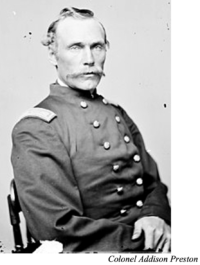
| September 16 | Major Edward B. Sawyer was promoted to Colonel, the regiment’s fourth Colonel in one year. Captain Addison W. Preston of Company D was promoted to Lieutenant Colonel. |
| September 21 | Orange Court House |
| September 22 | Ashby’s Gap
Captain Selah G. Perkins of Company H was killed. |
| September 29 | Company L was organized at St. Albans under the command of Captain Henry C. Parsons. |
| October | Duty in the Defenses of Washington
Headquarters was at Alexandria and detachments were posted to Annandale, Dranesville, Lewinsville and other points. |
| October 4 | Captain Josiah Hall of Company F was promoted to Major and First Lieutenant Robert Scofield was promoted to Captain of Company F. |
| October 11 | Captain George H. Bean of Company G was dishonorably discharged. |
| October 30 | · Captain William Wells of Company C was promoted to Major.
· First Lieutenant William M. Beeman was promoted to Captain of Company B · First Lieutenant Henry M. Page was promoted to Captain of Company C · First Lieutenant John W. Bennett was promoted to Captain of Company D · First Lieutenant Franklin Huntoon was promoted to Captain of Company H |
| November 8 | Warrenton |
| November 18 | Captain George H. Bean of Company G was restored to command as Captain of Company G. |
| November 19 | Captain John S. Ward of Company K resigned. |
| December 28 | Annandale |
| December 30 | Company M was organized at Burlington under the command of Captain John W. Woodward. |
| 1863 | |
| January 9 | Fairfax Court House |
| February 1 | First Lieutenant Andrew J. Grover of Company E was promoted to Captain of Company K. |
| February 6, 9, 13 and 14 | Dranesville |
| February 7 | Captain Joel B. Erhardt of Company A resigned and First Lieutenant Ellis B. Edwards was promoted to Captain of Company A. |
| February 16 | Goose Creek |
| February 19 | Leesburg |
| March 2 | Aldie
Captain Franklin T. Huntoon of Company H was captured and would be honorably discharged. |
| March 17 | Moseby’s Raid on Herndon Station
Colonel John Moseby’s daring raid with 40 of his partisan rangers captured a detachment of 25 men from the 1st Vermont Cavalry commanded by Lieutenant Alexander Watson of Company H. The detachment had been joined by Major William Wells and two other officers, who had come to investigate reports that the men were stealing from local farmers. Moseby’s men wore Union overcoats over their Confederate uniforms and were mistaken for the regularly scheduled relief of the outpost until it was too late. After the Vermonters were rounded up at the station it was noted that four “finely-equipped” horses were outside the house of Nat and Kitty Hannah. The officers had been invited to lunch there after their investigation had concluded, and Moseby’s men quickly surrounded the house. Lieutenant Watson and one of the other officers ran outside while Wells and the fourth officer went upstairs to the attic. The first two officers were immediately captured. One of the raiders called up to the others to surrender and fired throught the ceiling, causing Major Wells to fall through the ceiling to the floor below. He was unhurt except for his dignity. Major William Wells, First Lieutenant Alexander G. Watson of Company H and Lieutenants William L Greenleaf and Willard Farrington of Company L were taken prisoner along with the 25 enlisted men. All were marched to Culpeper and the officers then sent by train to Richmond. Wells remarked that he was grateful that Moseby allowed the officers to ride their own horses to Culpeper instead of making them walk. The enlisted men were paroled the next day, the officers on May 5 after a stay in Libby Prison. Captain Samuel P. Rundlett of Company E resigned, and First Lieutenant Oliver T. Cushman was promoted to Captain of Company E. |
| April | Attached to 3rd Brigade, Stahel’s Cavalry Division, 22nd Corps |
| April 1 | Broad Run, Dranesville
Captain Henry C. Flint of Company I led a detachment which unsuccessfully tried to capture Colonel Moseby near Broad Run. Captain Flint, First Lieutenant Charles A. Woodbury of Company B and seven enlisted men were killed or mortally wounded, 22 men were wounded and 82 men captured. First Lieutenant Charles A. Adams was promoted to Captain of Company H, and First Lieutenant Josiah Grout, Jr. was wounded, but was promoted to Captain of Company I. |
| April 25 | Major William D. Collins resigned. Captain Edward B. Sawyer of Company I was promoted to Major. |
| April 28 | Major Edward B. Sawyer resigned. Captain George H. Bean of Company G was dismissed the service. First Lieutenant Frank Ray was promoted to Captain of Company G. |
| May 7 | Major William D. Collins resigned. |
| May 5 | Major William Wells and Lieutenant Alexander G. Watson were paroled. |
| May 11 | Warrenton
Captain Frank Ray of Company G was wounded. |
| May 23 | Warrenton |
| May 30 | Near Greenwich
Moseby was routed by a charge led by Lieutenant Hazleton of Company H, which captured Moseby’s artillery piece. The regiment lost one man killed and 7 wounded. It would be the regiment’s last encounter with Moseby. |
| May 31 | Warrenton |
| June 28 | Gettysburg Campaign
Assembled at Fairfax Court House and attached to 1st Brigade, 3rd Division, Cavalry Corps, Army of the Potomac. |
| June 1 | Captain John W. Bennett of Company D was promoted to Major and First Lieutenant William G. Cummings was promoted to Captain of Company D. |
| June 30 | Hanover, Pennsylvania |
| July 2 | Hunterstown |
| July 3 | Battle of Gettysburg
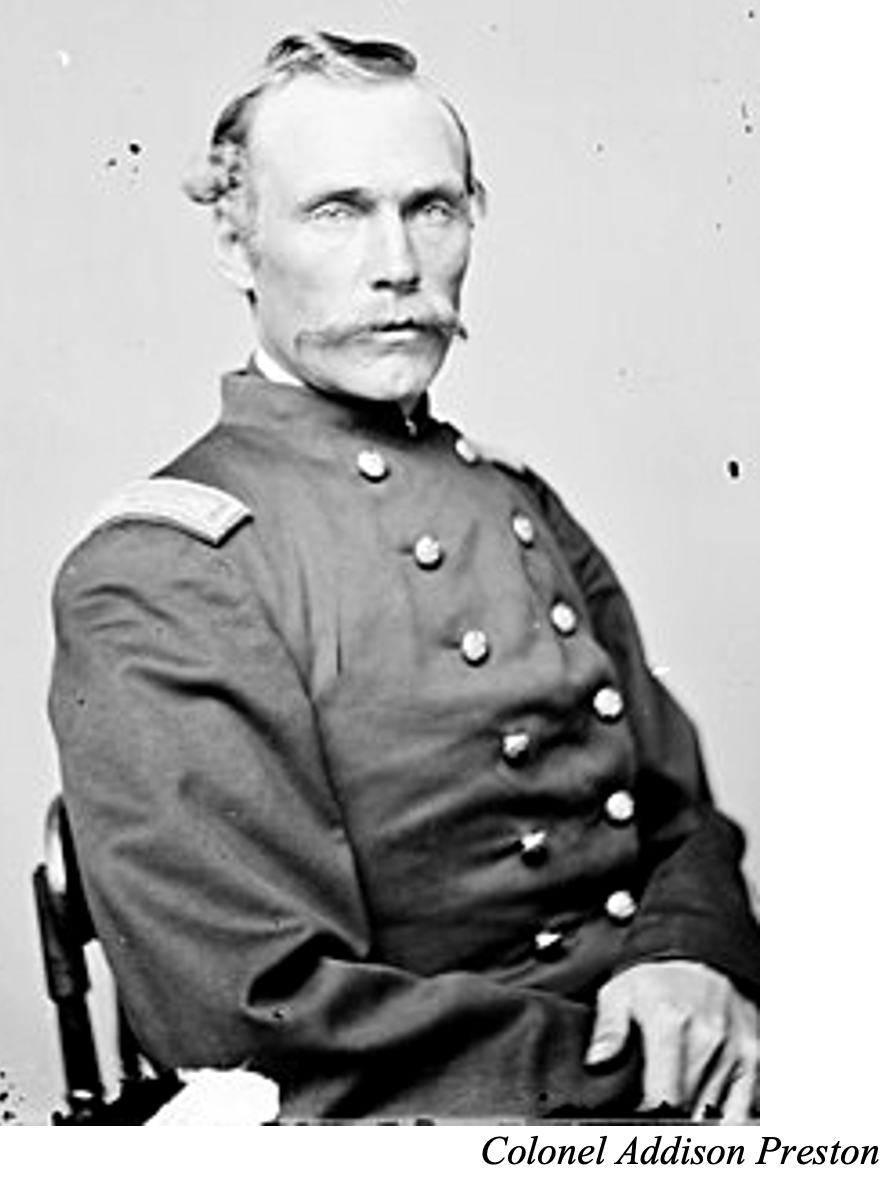
The regiment was commanded by Lieutenant Colonel Addison W. Preston. It brought 687 men to the field, From the Slyder Field monument: In the Gettysburg campaign this regiment fought Stuart’s Cavalry at Hanover, Pa. June 3d, and at Hunterstown July 2d; and on this field July 3, led by Gen. Elon J. Farnsworth, who fell near this spot, charged through the First Texas Infantry and to the line of Law’s Brigade, receiving the fire of five Confederate regiments and two batteries, and losing 67 men. From the monument to the 1st Vermont Cavalry on Confederate Avenue: At 5 p.m. July 3 the 2nd Battalion 1st Vermont Cavalry led by Major William Wells, General Farnsworth commanding the brigade riding by his side crossed Plum Run near this point charging over stone walls amid rocks and through woods till they encountered five regiments of Law’s Confederate Brigade near the spot where the regimental monument stands. The 1st Battalion and part of the 3rd Lt. Col. A.W. Preston commanding were ordered to the lane and struck Law’s Brigade in the flank. The onset was terrific sabres and bayonets revolvers and muskets being freely used after a struggle the hill was carried by the 1st Vermont and the prisoners captured sent to the rear. The three battalions united soon came under the fire of the 4th Alabama Infantry and presently of the 9th Georgia Infantry finding no exit to the south they turned to the east and charged the 15th Alabama Infantry which answered a summons to surrender by a destructive musketry fire. Those unhurt escaping mostly to the south. This memorial signalizes the valor of the officers and the men of the First Vermont Cavalry who here paid to the nation the uttermost tribute of devotion. The 1st Vermont Cavalry lost 13 men killed, 25 wounded and 27 missing. Captain John W. Woodward of Company M was killed. Captain Henry C. Parsons of Company L was wounded and would be discharged. Captains Henry M. Page of Company C, Oliver T. Cushman of Company E, Charles Adams of Company H and First Lieutenant Emmet Mather of Company H were wounded. Major William Wells was awarded the Medal of Honor at Gettysburg for when he ““led the second battalion of his regiment in a daring charge.” |
| July 4 | Monterey Gap |
| July 5 | Smithburg, Md., |
| July 6 | Hagerstown
Captain John W. Woodward of Company M was killed. Major William Wells, First Lieutenant Gilbert Steard of Company G and First Lieutenant Jonas R. Rice of Company K were wounded. Captain John H. Hazelton became Captain of Company M. |
| July 8 | Boonsboro |
| July 11-13 | Hagerstown
Sergeant William L Greenleaf of Company L was wounded. |
| July 14 | Falling Water |
| August | Attached to 2nd Brigade, 3rd Division, Cavalry Corps, Army of the Potomac |
| August 25 | King George Court House |
| September 1 | Lamb’s Creek Church |
| September 1-3 | Expedition to Port Conway |
| September 13-17 | Advance from the Rappahannock to the Rapidan |
| September 13 | Culpeper Court House
Major William Wells and First Lieutenant ALvah R. Haswell were wounded. |
| September 14 | Somerville Ford |
| September 21-23 | Reconnaissance across the Rapidan |
| September 26 | Richard’s Ford |
| October 1 | Captain Josiah Grout of Company I was discharged for disability and First Kieutenant Eben Grant was promoted to Captain of Company I. |
| October 4 | Captain Josiah Hall of Company F was promoted to Major. |
| October 9-22 | Bristoe Campaign
Captain Frank Ray of Company G was killed. First Lieutenant Alvah R. Haswell was promoted to Captain of Company G. |
| October 10 | James City and Bethesda Church |
| October 11-12 | Brandy Station and near Culpeper
Mayor Josiah Hall was wounded and taken prisoner and Captains William M. Beeman of Company B and Charles A. Adams of Company H were taken prisoner. |
| October 14 and 19 | Gainesville |
| October 17-18 | Groveton |
| October 19 | Catlett’s Station and Buckland’s Mills |
| October 30 | Captain William Wells of Company C was promoted to Major. |
| November 4 | Falmouth |
| November 7-8 | Advance to the Rappahannock |
| November 18 | Captain Ellis B. Edwards of Company A mustered out. Second Lieutenant Harris B. Mitchell was promoted to Captain of Company A. |
| November 26-December 2 | Mine Run Campaign |
| November 26 | Morton’s Ford |
| November 26-27 | Raccoon Ford |
| December 10 | Captain Beeman of Company B was paroled and would be discharged. |
| 1864 | |
| January 4 | First Lieutenant John W. Newton was promoted to Captain of Company L. |
| February 6-7 | Demonstration on the Rapidan |
| February 27 | Captain John W. Newton of Company L resigned. First Lieutenant Alexander G. Watson was promoted to Captain of Company L. |
| February 28-March 4 | Kilpatrick’s Raid on Richmond |
| March 1 | Fortifications of Richmond and near Atlee’s |
| March 2 | Old Church |
| May-June | Campaign from the Rapidan to the James |
| May 4 | Near Chancellorsville |
| May 5 | Craig’s Meeting House
Captain Andrew J. Grover of Company F was wounded. |
| May 5-7 | Battle of the Wilderness (Company M) |
| May 5-6 & May 7-8 | Todd’s Tavern
Captain Andrew J. Grover of Company K and First Lieutenant Henry O. Wheeler of Company A were wounded. |
| May 8 | Alsop’s Farm, Spotsylvania |
| May 9-24 | Sheridan’s Raid from Todd’s Tavern to James River |
| May 9 | North Anna River |
| May 11 | Ground Squirrel Church and Yellow Tavern
Captain Alexander G. Watson of Company H was wounded. |
| May 12 | Brook Church or Richmond Fortifications |
| May 26-28 | Line of the Pamunkey |
| May 27 | Demonstration on Little River |
| May 27 | Salem Church |
| May 28-31 | On line of the Totopotomoy |
| May 30 | Ashland |
| May 31 | Mechump’s Creek |
| May 31-June 1 | Cold Harbor |
| June 1 | Ashland
Captain Emmer Mather of Company H and First Lieutenant Clark P. Stone of Company F were taken prisoner. |
| June 2 | Gaines’ Mill and Totopotomoy |
| June 3 | Haw’s Shop
Colonel Addison W. Preston and Captain Oliver T. Cushman of Company E were killed. |
| June 3 | Sumner’s Upper Bridge |
| June 4 | Salem Church
· Major William Wells was promoted to Colonel. · Major John W. Bennett was promoted to Lieutenant Colonel. · First Lieutenant Hiram H. Hall was promoted to Captain of Company E. |
| June 12 | White Oak Swamp |
| June 13 | Riddell’s Shop |
| June 15 | Malvern Hill
First Lieutenant John Williamson of Company K was mortally wounded. |
| June 21 | Captain Ebenezer K. Sibley of Company B transferred to Company C. |
| June 22-30 | Wilson’s Raid on South Side & Danville Railroad |
| June 22 | Ream’s Station |
| June 23 | Near Nottaway Court House and Black and White Station
· Captain Hiram H. Hall of Company E was killed · Second Lieutenant William L Greenleaf of Company L was wounded · Second Lieutenant Edward H. Higley of Company K was wounded and taken prisoner |
| June 25 | Staunton Bridge or Roanoke Station |
| June 28-29 | Sappony Church or Stony Creek
First Lieutenant Gilbert Steward was mortally wounded. |
| June 29 | Ream’s Station |
| July-August | Siege of Petersburg |
| July 7 | · Captain Henry M. Page of Company C and Captain Andrew J. Grover of Company K were promoted to Major.
· First Lieutenant Mason A. Stone of Company M was promoted to Captain of Company C. · First Lieutenant ALexander B. Chandler was promoted to Captain of Company E. |
| August 28 | Colonel Addison Preston
Colonel Edward B. Sawyer resigned. Lieutenant Colonel Addison W. Preston was promoted to Colonel. |
| August 7-November 28 | Sheridan’s Shenandoah Valley Campaign
Transferred to Army of the Shenandoah, Cavalry Corps, Third Division, Second Brigade |
| August 17 | Winchester |
| August 25 | Kearneysville |
| September 7 | Near Brucetown and Winchester |
| September 19-20 | Third Battle of Winchester (Battle of Opequan) and Near Cedarville |
| September 21 | Front Royal |
| September 22 | Milford |
| September 22 | Fisher’s Hill |
| September 26 | Colonel William Wells took command of the brigade as senior colonel and Lieutenant Colonel John W. Bennett took command of the regiment. |
| September 29 | Waynesboro |
| October 7 | Columbia Furnace
Posted to rear guard on the Back Road, near Strasburg. |
| October 8-9 | Tom’s Brook, “Woodstock Races”
The regiment captured two pieces of artillery and a number of prisoners, pursuing the Confederate over ten miles. |
| October 9 | Mount Olive |
| October 19 | Battle of Cedar Creek
Began the day guarding the fords across Cedar Creek on the right flank of the army. When the attack started the regiment’s brigade under Colonel Wells was ordered at first to cover the camp, then to guard the right flank of the army while the bulk of the cavalry moved to the extreme left of the army. As the infantry slowly fell back the brigade kept in line with it, which halted after about an hour. After several hours of skirmishing General Custer returned with his brigade and the cavalry on the right flank attacked and regained their former positions. Custer then took the 1st Vermont Cavalry and the 5th New York Cavalry to the other side of the battlefield to join the left flank. They launched a charge against the flank and rear of the Confederate infantry. Combined with a furious frontal attack by Union infantry, the Confederate lines collapsed and fled to the rear. The Union infantry stopped the charge when they reached their original camps, but the cavalry continued to pursue. A huge mass of stalled Confederate artillery, supply wagons, and ambulances were taken at the blocked bridge west of Strasburg, and the regiment kept up its pursuit until mearly midnight. The 1st Vermont Cavalry captured 161 prisoners, including a general, colonel and lieutenant colonel, three battle flags, 23 guns, 14 caissons, 17 army wagons, 6 ambulances, 98 horses and 69 mules. Captain Alexander G. Watson of Company H was wounded. Sergeant Erid Davidson Woodbury was awarded the Medal of Honor when “During the regiment’s charge when the enemy was in retreat, Sgt. Woodbury encountered four Confederate infantrymen retreating. He drew his saber and ordered them to surrender, overcoming by his determined actions their willingness to further resist. They surrendered to him together with their rifles and 12th North Carolina (C.S.A.) regimental flag.” Corporal Frederick A. Lyon and Private James Sweeney were awarded the Medal of Honor when they “Captured the state flag of a North Carolina regiment, three officers, and an ambulance with its mules and driver.” |
| October 22 | Twelve officers and 270 enlisted men were sent home to Vermont to muster out at the end of their terms of enlistment.Captain William G. Cummings of Company D was promoted to Major and took command of the 400 reenlisted Veterans and recruits of the regiment. |
| November 10 | Near Kernstown |
| November 12 | Newtown and Cedar Creek |
| November 18-19 | Major Josiah Hall was promoted to Lieutenant Colonel. Captain Robert Scofield of Company F and Captain Charles A. Adams of Company H were promoted to Major. |
| November 22 | Rude’s Hill, near Mt. Jackson |
| December 19-22 | Expedition to Lacy Springs |
| December 21 | Lacy Springs |
| December – February | In winter quarters near Winchester. |
| 1865 | |
| February 9 | First Lieutenant Ebenezer K. Sibley was promoted to Captain of Company B. |
| February 27-March 25 | Sheridan’s Raid
Marched for 21 days to join the main army near Petersburg. |
| March 2 | Waynesboro |
| March 2 | Occupation of Staunton |
| March 3 | Occupation of Charlottesville |
| March 28-April 9 | Appomattox Campaign
Returned to Grant’s main army around Petersburg near Hancock Station on the Military Railroad and assigned to Army of the Potomac, Cavalry Corps, Third Division, Second Brigade |
| March 30-31 | Dinwiddie Court House |
| April 1 | Five Forks |
| April 2 | Skirmiish at Scott’s Corners |
| April 3 | Namozine Church (Battle of Winticomack Creek)
The 1st Vermont Cavalry and the 8th New York Cavalry charged Confederate defenses near Namozene Curch, capturing their only gun, taking many prisoners, and driving them eight miles. |
| April 6 | Sailor’s Creek |
| April 8 | Appomattox Station
The 1st Vermont Cavalry captured eight guns, some of which belonged to the Washington Artillery of New Orleans, which had heretofore never lost a gun. The Battle of Appomattox Station wayside marker at Appomattox Court House mentions “Twenty-nine-year-old First Lieutenant Willard Farrington of company… suffered a shell wound during the battle.” The marker also features a photograph and a quote from Dartmouth College graduate Eri Woodbury, age 27, Adjutant of the 1st Vermont Cavalry “Custer’s Division, as usual, went in on a charge. We had a thick piece of woods to get through to reach their artillery…. In this woods we received the most terrible fire of canister that ever I saw. It was getting dark and the woods were constantly lightened up with the flashing of their cannon and then that awful shrieking as the shell and canister came ploughing and tearing through the trees…. Suddenly I felt a blow and a numbing sustain across my breast, & found myself turning a double summer set (fault) off into the bushes…. Getting up I found where I was wounded: my fingers were completed knocked out and hanging over the back of the hand by a little shred of skin.” |
| April 9 | Appomattox Court House
Surrender of Lee and his army. The First Battalion of the regiment was in the process of charging Lee’s wagon train when it received the word of the flag of truce. |
| April 14 | · First Lieutenant Clark P. Stone was promoted to Captain of Company F
· First Lieutenant Emmet Mather was promoted to Captain of Company H · Second Lieutenant Edward H. Higley was promoted to Captain of Company K |
| April 24-29 | Expedition to Danville to join General Sherman. As soon as the regiment learned of General Johnsron’s surrender they turned around and returned to Petersburg. |
| May 9 | First Lieutenant Horace K. Idle was promoted to Captain of Company D. |
| May 10-15 | March to Washington, D.C. |
| May 19 | Colonel William Wells was promoted to Brigadier General. |
| May 23 | Grand Review. Lieutenant Colonel Josiah Hall was promoted to Colonel, Major William G. Cummings was promoted to Lieutenant Colonel, and Captain John H. Hazelton of Company H was promoted to Colonel. |
| June to August | Men whose terms of enlistment were to expire before October were mustered out, and the regiment consolidated to six companies. Served in frontier duty at St. Albans, Vt. and Champlain, N.Y. |
| August 9 | The 1st Vermont Cavalry Regiment mustered out |
| 1st Vermont Cavalry Regiment | |
| Active | November 19, 1861 to August 9, 1865 |
| Disbanded | August 9, 1865 |
| Allegiance | United States Union |
| Branch | United States Army Union Army |
| Type | Cavalry |
| Engagements | |
The 1st Vermont Cavalry Regiment was a three years’ cavalry regiment in the Union Army during the American Civil War. It served in the Eastern Theater from November 1861 to August 1865, in the Cavalry Corps, Army of the Potomac.
History
The regiment was mustered into Federal service on November 19, 1861, at Burlington, Vermont. Its first commander was Colonel Lemuel B. Platt, and the first lieutenant colonel was George Bradley Kellogg. Platt’s appointment was an honor sometimes afforded to an individual who aided in raising and equipping a regiment; subsequent commanders included Jonas P. Holliday, Charles Henry Tompkins, Edward B. Sawyer, Addison W. Preston, William Wells, and Josiah Hall.[4]
It was engaged in, or present at 76 engagements during the course of the war, from Mount Jackson on April 16, 1862, to Appomattox Court House, on April 9, 1865, including the 1862 and 1864 Shenandoah Valley campaigns, the Gettysburg campaign, the Overland Campaign and the Siege of Petersburg, plus many skirmishes not connected to a particular campaign, such as the Skirmish at Miskel Farm.
The regiment most notably participated in BG Elon Farnsworth‘s unsuccessful attack on the Confederate right flank on the third day of the Battle of Gettysburg. The 1st Vermont Cavalry’s Maj William Wells led a battalion in that attack, with Farnsworth by his side. Lieut: Col Addison W. Preston commanded the regiment. The regiment’s monument stands on the Slyder Field, near the site where BG Evander Law‘s brigade repelled the Union attack. According to Albert Drury of the 1st Vermont, “In the afternoon of the same day July 3d we charge upon the Enemy a secnd time, which proves to be a rather foolish move. We charge upoon a Brigage of Infantry fortified by stone walls on all sides. Genl Farnsworth is Killed….”
The regiment lost during service: 112 killed and mortally wounded, 159 died in Confederate prisons, 7 died from accidents and 114 died by disease; total loss 392.
The regiment mustered out of service on August 9, 1865.
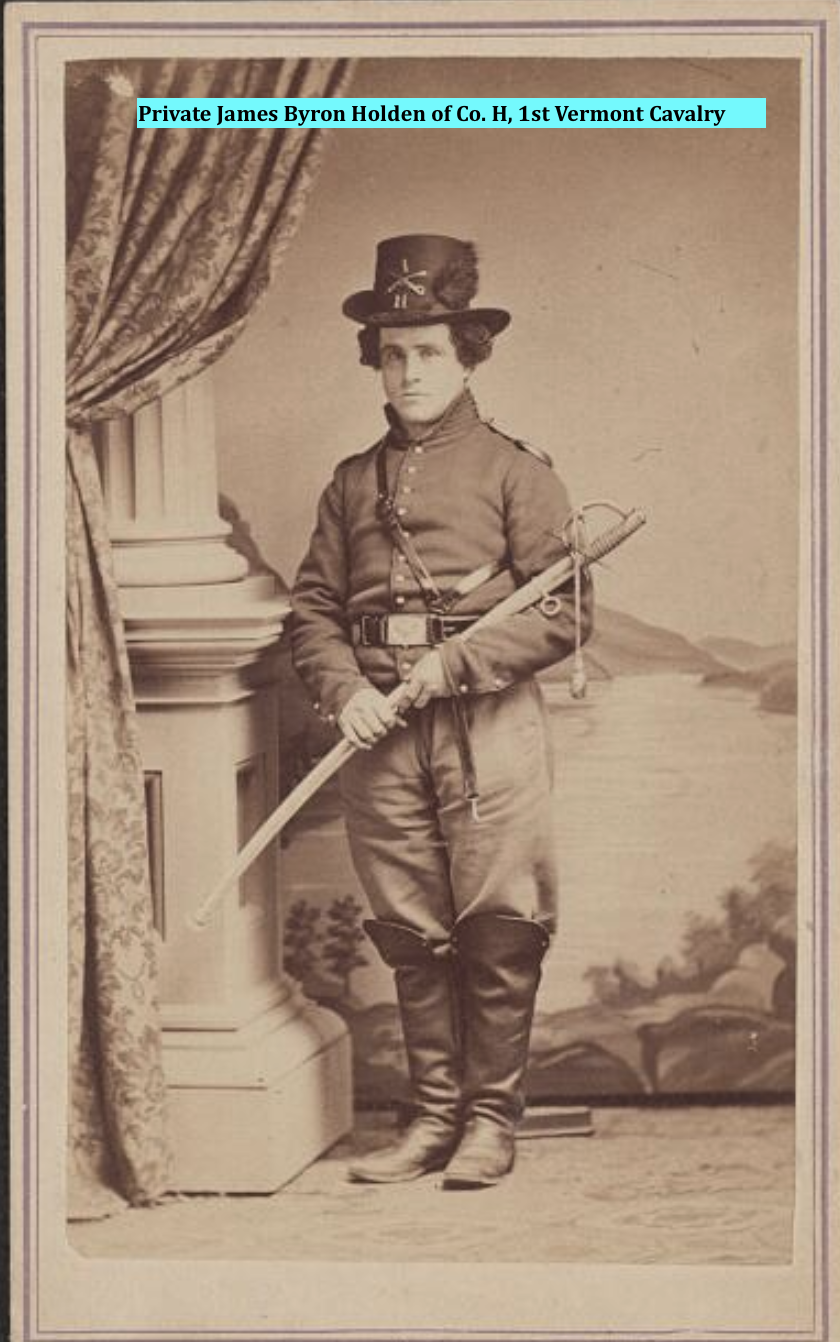
The regiment’s heritage continues to be celebrated to this day with a state legislative decree naming the Corps of Cadets at Norwich University, the Military College of Vermont, as members of the regiment. Members of the NUCC wear the crossed sabers on all of their uniforms and their insignia.
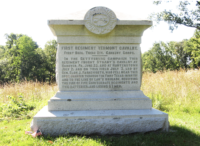
There are two monuments to the 1st Vermont Cavalry Regiment at Gettysburg. The main monument is in the Slyder field on the south end of the battlefield near Confederate Avenue. It was dedicated by the State of Vermont in 1889. (Bushman Hill & Slyder Farm tour map) A second monument is nearby on South Confederate Avenue, but is generally seen as a monument to Major (later Major General) William Wells, and is shown on another page.
Monument to the 1st Vermont Cavalry at Gettysburg
About the 1st Vermont Cavalry at Gettysburg
The 1st Vermont Cavalry was commanded at the Battle of Gettysburg by Lieutenant Colonel Addison W. Preston. It brought 687 men to the field, losing 13 killed, 25 wounded and 27 missing.
| Major (later Major General) WIlliam Wells earned the Medal of Honor on July 3rd for “extraordinary heroism while serving with 2d Battalion, 1st Vermont Cavalry, in action at Gettysburg, Pennsylvania. Major Wells led the second battalion of his regiment in a daring charge.” |
Text from the front of the monument in Slyder Field:
First Regiment Vermont Cavalry
First Brig. Third Div. Cavalry Corps
—-
In the Gettysburg campaign this
regiment fought Stuart’s Cavalry at
Hanover, Pa. June 3d, and at Hunterstown
July 2d; and on this field July 3, led by
Gen. Elon J. Farnsworth, who fell near this
spot, charged through the First Texas Infantry
and to the line of Law’s Brigade, receiving
the fire of five Confederate regiments and
two batteries, and losing 67 men.
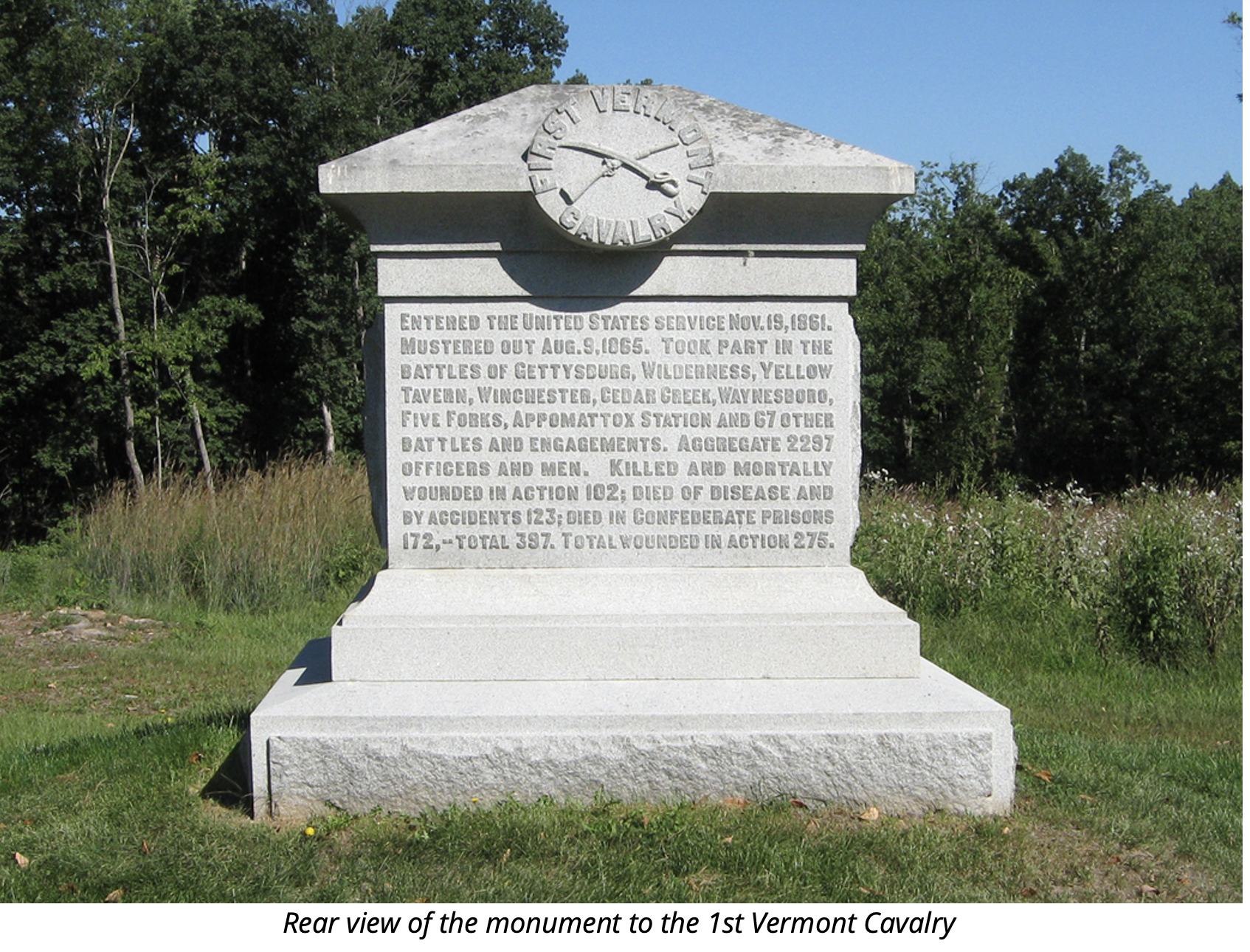
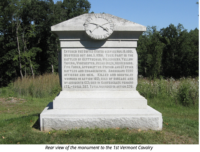
Rear view of the monument to the 1st Vermont Cavalry
Text from the rear of the monument:
Entered the United States service Nov. 19, 1861.
Mustered out Aug. 9, 1865. Took part in the
battles of Gettysburg, Wilderness, Yellow
Tavern, Winchester, Cedar Creek, Waynesboro,
Five Forks, Appomattox Station and 67 other
battles and engagements. Aggregate 2297
officers and men. Killed and mortally
wounded in action 102; died of disease and
by accidents 123; died in Confederate prisons
172, – total 397. Total wounded in action 275.
The regiment was mustered into Federal service on November 19, 1861, at Burlington, Vermont. Its first commander was Colonel Lemuel B. Platt, and the first lieutenant colonel was George Bradley Kellogg. Platt’s appointment was an honor sometimes afforded to an individual who aided in raising and equipping a regiment; subsequent commanders included Jonas P. Holliday, Charles Henry Tompkins, Edward B. Sawyer, Addison W. Preston, William Wells, and Josiah Hall.
It was engaged in, or present at 76 engagements during the course of the war, from Mount Jackson on April 16, 1862, to Appomattox Court House, on April 9, 1865, including the 1862 and 1864 Shenandoah Valley campaigns, the Gettysburg campaign, the Overland Campaign and the Siege of Petersburg, plus many skirmishes not connected to a particular campaign, such as the Skirmish at Miskel Farm.
The regiment most notably participated in BG Elon Farnsworth‘s unsuccessful attack on the Confederate right flank on the third day of the Battle of Gettysburg. The 1st Vermont Cavalry’s Maj William Wells led a battalion in that attack, with Farnsworth by his side. Lieut: Col Addison W. Preston commanded the regiment. The regiment’s monument stands on the Slyder Field, near the site where BG Evander Law‘s brigade repelled the Union attack. According to Albert Drury of the 1st Vermont, “In the afternoon of the same day July 3d we charge upon the Enemy a secnd time, which proves to be a rather foolish move. We charge upoon a Brigage of Infantry fortified by stone walls on all sides. Genl Farnsworth is Killed….”
The regiment lost during service: 112 killed and mortally wounded, 159 died in Confederate prisons, 7 died from accidents and 114 died by disease; total loss 392.
The regiment mustered out of service on August 9, 1865.
The regiment’s heritage continues to be celebrated to this day with a state legislative decree naming the Corps of Cadets at Norwich University, the Military College of Vermont, as members of the regiment. Members of the NUCC wear the crossed sabers on all of their uniforms and their insignia.
Related Items
-
New Research Regarding Marines’ Image on the Brandywine – Extremely Rare 1862 Albumen Image of the Crew of the USS Brandywine Joined on Deck by Full Dress U.S. Marines
$2,150New Research Regarding Marines’ Image on the Brandywine – Extremely Rare 1862 Albumen Image of the Crew of the USS Brandywine Joined on Deck by Full Dress U.S. MarinesNovember 28, 2020 -
Id’d Civil War .44 Cal. Pistol Cartridge Box
$425Id’d Civil War .44 Cal. Pistol Cartridge BoxJanuary 4, 2024 -
High Quality Civil War Id’d Officer’s Traveling Mess Utensils in Original Case
$1,150High Quality Civil War Id’d Officer’s Traveling Mess Utensils in Original CaseSeptember 25, 2022 -
Civil War Period Leather Satchel Id’d to a Connecticut Citizen
$375Civil War Period Leather Satchel Id’d to a Connecticut CitizenMay 18, 2024