
Albumen of the 5th Wisconsin Regimental Band – Image Taken at Camp Griffin, Va. in 1861December 31, 2025

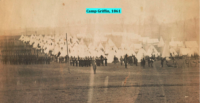
Albumen of the 5th Wisconsin Regimental Band – Image Taken at Camp Griffin, Va. in 1861
SOLD
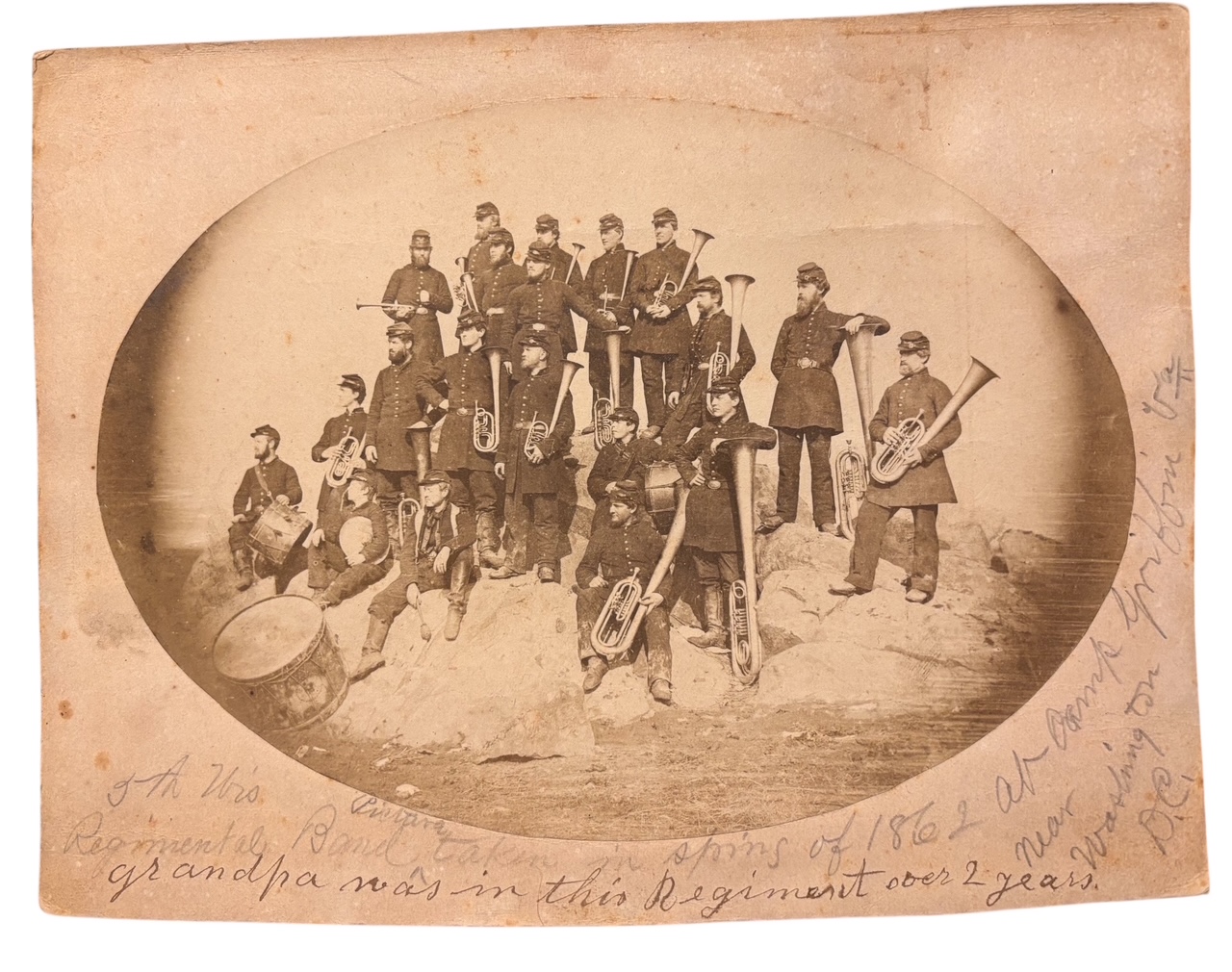
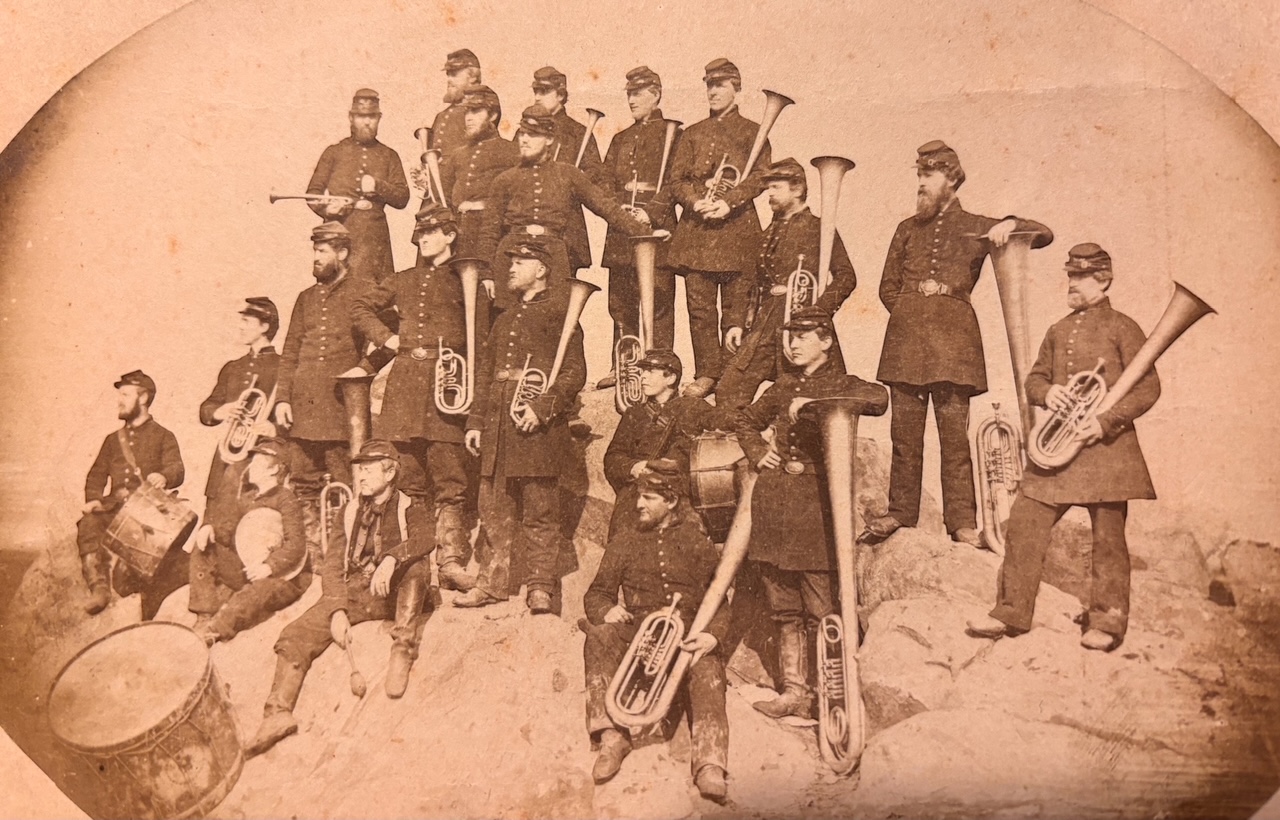
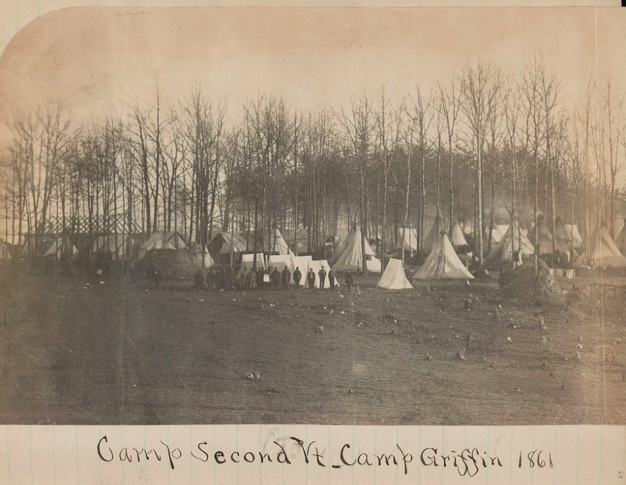
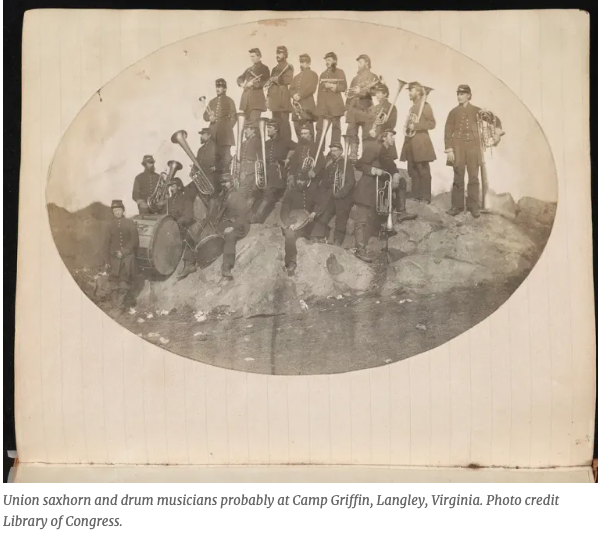
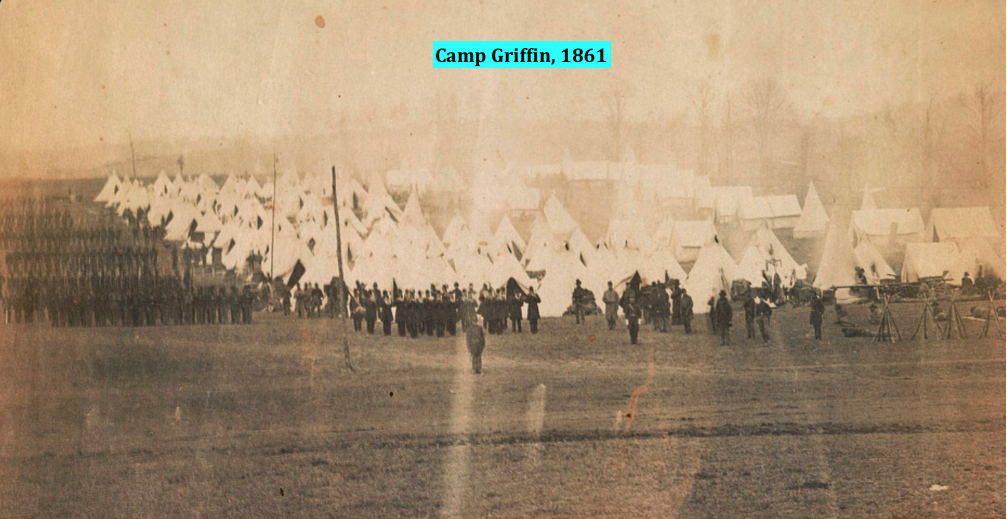
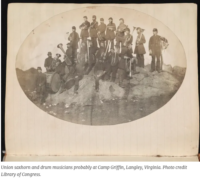
Albumen of the 5th Wisconsin Regimental Band – Image Taken at Camp Griffin, Va. in 1861 – This interesting albumen was produced at the onset of the Civil War when numerous Union regiments camped and trained at Camp Griffin, located in the area of Langley, Virginia. Camp Griffin was a significant, Union Army camp from late 1861 to early 1862; troops stationed here, as raw recruits, experienced drilling, trained in responsibilities entailed in picket duty and participated in Grand Reviews (including one with President Lincoln). During this period, the 5th Wisconsin Infantry was at or near Camp Griffin to assist in defending Washington, D.C., before moving to the Peninsula Campaign. This rare image depicts the entire 5th Wisconsin regimental band, at Camp Griffin; of note is the 19th century, pencil and pen inscription at the bottom of the image that states the following:
“5th Wis
Regimental Band picture taken in spring of 1862
at Camp Griffin near Washington D.C.
Grandpa was in this Regiment over 2 years.”
The oval shaped image is mounted on its original, pasteboard backing. The image remains in excellent condition, with great clarity and resolution. Band members are standing on what appears to be a large boulder; all wear their full uniforms and hold their personal instruments. This image depicts the regimental band of a unit that saw extensive action throughout the entire war, when the component soldiers were essentially raw recruits and regimental bands were common, noncombatant accompanying components. This same image appears to be in the collection of the Library of Congress.
Measurements: Sight size of image – W – 7.25”; Ht. – 5.25”
5th Wisconsin Infantry
The 5th Wisconsin Infantry, a notable Union regiment, served near Camp Griffin (also “Big Chestnut”) in Langley, VA, during late 1861/early 1862, primarily on picket duty & drills before the Peninsular Campaign, but while the 5th WI had camp life & bands, detailed records specifically linking their regimental band to “Camp Griffin” are scarce in general histories, though music was vital for morale, focusing on major engagements like Antietam & Gettysburg.
About the 5th Wisconsin & Camp Griffin
- Camp Griffin: A significant Union encampment in Langley, Virginia, from late 1861 to early 1862, used for drilling, picket duty, & Grand Reviews (including one with President Lincoln).
- 5th Wisconsin’s Presence: The regiment was at or near Camp Griffin during this period, defending Washington, D.C., before moving to the Peninsular Campaign.
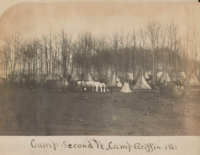
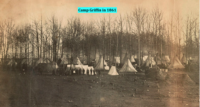
Civil War Camp Griffin was a major Union training and staging ground near Langley, Virginia, in 1861-62, named for artillery officer Charles Griffin, housing troops like the Vermont regiments, serving as a crucial base before campaigns like the Peninsula, and leaving behind many documented scenes captured by photographers like G. H. Houghton. It was a bustling, temporary city with huts, drill grounds, and a lively social scene, often documented in photos showing soldiers preparing for war.
Location & Name
- Location: Situated in Langley, Virginia, behind the defensive ring of forts protecting Washington D.C..
- Origin: Initially called “Camp Big Chestnut” due to a large tree, it was renamed Camp Griffin in late 1861 for Captain Charles Griffin, who distinguished himself at the First Battle of Bull Run.
Purpose & Inhabitants
- Training Hub: A key muster-in and training site for numerous Union infantry and artillery units.
- Notable Units: Hosted regiments from Vermont (2nd, 3rd, 4th, 5th, 6th), the 47th Pennsylvania, and others.
- Staging Area: Troops here marched out to battle, including the first Union victory at Dranesville in December 1861.
Life & Documentation
- Camp Life: Soldiers lived in tents and wooden huts, drilled, performed picket duty, and interacted with locals, all while eagerly awaiting battle.
- Photography: Became famous through photographs by G.H. Houghton and others, showing camp scenes, troops, and even unique winter huts.
5th Regiment, Wisconsin Infantry
Overview:
Organized at Madison, Wis., and mustered in July 12, 1861. Ordered to Washington, D. C., July 24. Attached to King’s Brigade, McDowell’s Division, Army of the Potomac, to October, 1861. Hancock’s Brigade, Smith’s Division, Army of the Potomac, to March, 1862. 1st Brigade, 2nd Division, 4th Army Corps, Army of the Potomac, to May, 1862. 1st Brigade, 2nd Division, 6th Army Corps, Army of the Potomac, to February, 1863. Light Division, 6th Army Corps, to May, 1863. 3rd Brigade, 1st Division, 6th Army Corps, to January, 1864. 3rd Brigade, 2nd Division, 6th Army Corps, to February, 1864. 3rd Brigade, 1st Division, 6th Army Corps, Army of the Potomac, to August. Army of the Shenandoah, Middle Military Division, to December, 1864, and Army of the Potomac to July, 1865.
Service:
Camp on Meridian Hill till September 3, 1861. Detached to construct Fort Marcy on north bank of the Potomac. At Camp Griffin, near Washington, D. C., till March 9, 1862. Lewinsville, Va., September 10, 1861. (Cos. “B,” “C” and “G”). Reconnoissance to Lewinsville September 25. March to Flint Hill March 9, 1862, thence to near Alexandria March 16, and moved to Fortress Monroe March 23-25. Reconnoissance to Warwick Court House March 27. Advance from Newport News to Warwick River and toward Yorktown April 4-5. Siege of Yorktown April 5-May 4. Reconnoissance toward Yorktown April 16. Lee’s Mills, Burnt Chimneys. April 16. Battle of Williamsburg May 5. Duty at White House till May 18. March to near Richmond May 24 and picket duty on the Chickahominy till June 5. Seven days before Richmond June 25-July 1. Garnett’s Farm June 27. Savage Station June 29. White Oak Swamp and Glendale June 30. Malvern Hill July 1. At Harrison’s Landing till August 16. Moved to Alexandria August 16-24, thence march to Centreville August 29-30. Maryland Campaign September 6-22. Sugar Loaf Mountain September 10-11. Crampton’s Pass, South Mountain, September 14. Battle of Antietam September 16-17. At Williamsport September 18-22. Expedition to intercept Stuart’s Cavalry October 11. At Hagerstown October 13-31. March to Aquia Creek November 8-18. Battle of Fredericksburg, Va, December 12-15. At White Oak Church till April, 1863. “Mud March” January 20-24. Chancellorsville Campaign April 27-May 6. Operations about Franklin’s Crossing April 29-May 2. Maryes Heights, Fredericksburg, May 3. Salem Heights May 3-4. Banks¿ Ford May 4. Gettysburg (Pa.) Campaign June 11-July 24. Battle of Gettysburg , Pa., July 2-4. Near Fairfield, Pa., July 5. About Funkstown, Md., July 10-13. Detached duty at New York, Albany and Troy August-September during draft disturbances. Bristoe Campaign October 9-22. Advance to line of the Rappahannock November 7-8. Rappahannock Station November 7. Mine Run Campaign November 26-December 2. Duty at Brandy Station till April, 1864. Campaign from the Rapidan to the James River May 4-June 15. Battles of the Wilderness May 5-7; Spottsylvania May 8-12; Spottsylvania Court House May 12-21. Assault on the Salient, “Bloody Angle,” May 12. North Anna River May 23-26. On line of the Pamunkey May 26-28. Totopotomoy May 28-31. Cold Harbor June 1-12. Before Petersburg June 17-18. Siege of Petersburg till July 9. Weldon Railroad June 22-23. Moved to Washington, D. C., July 9-12. Repulse of Early’s attack on Washington July 12. Non-veterans ordered to Wisconsin July 16 and mustered out August 3, 1864. Veterans consolidated to a Battalion of three Companies. Sheridan’s Shenandoah Valley Campaign August 7-November 28. Battle of Opequan , Winchester, September 19. Provost duty at Winchester, Va., and at Cedar Creek, Va., till December. Seven new companies organized September, 1864, and left State for Winchester, Va., October 2. At Alexandria till October 20, then joined Regiment at Cedar Creek. Moved to Petersburg, Va., October 1-4. Siege of Petersburg December 4, 1864, to April 2, 1865. Dabney’s Mills, Hatcher’s Run , February 5-7, 1865. Appomattox Campaign March 28-April 9. Assault on and fall of Petersburg April 2. Pursuit of Lee April 3-9. Sailor’s Creek April 6. Appomattox Court House April 9. Surrender of Lee and his army. March to Danville April 28-27, thence to Richmond, Va., and Washington, D. C., May 18-June 2. Corps Review June 8. Mustered out June 24 (three Companies) and July 11, 1865 (Regiment).
Regiment lost during service 15 Officers and 180 Enlisted men killed and mortally wounded and 2 Officers and 132 Enllsted men by disease. Total 329.
5th Wisconsin Infantry Regiment
| 5th Wisconsin Infantry Regiment | |
| Flag of Wisconsin | |
| Active | July 12, 1861 – July 11, 1865 |
| Country | United States |
| Allegiance | Union |
| Branch | Infantry |
| Size | Regiment |
| Engagements | American Civil War |
| Commanders | |
| Colonel | Amasa Cobb |
| Colonel | Thomas S. Allen |
| Wisconsin U.S. Volunteer Infantry Regiments 1861-1865 | ||||
|
The 5th Wisconsin Infantry Regiment was a volunteer infantry regiment that served in the Union Army during the American Civil War. The regiment was engaged in many of the critical battles of the eastern theater of the war, including Antietam and Gettysburg. Immediately after Gettysburg, the regiment was detached from frontline duty and sent north to put down the New York City draft riots. Suffering from attrition in August 1864, the regiment was reorganized as an independent battalion of three companies for the remainder of their service.
Service
The 5th Infantry was assembled at Camp Randall, in Madison, Wisconsin on July 12, 1861.It left Wisconsin for Washington, D.C., on July 24, 1861. During the war it moved through Virginia, Maryland, Pennsylvania, and New York (helping to quell that city’s famous draft riots). It participated in the battles of Williamsburg, Antietam, Fredericksburg, Gettysburg, the Battles of the Wilderness, and the surrender of Gen. Robert E. Lee and his army.
The non-veterans were ordered home to Wisconsin on July 16, 1864, and mustered out of service on August 3. The veterans were consolidated to a battalion of three companies who continued to serve until June 24, 1865; the remainder of the regiment was mustered out of service on July 11, 1865.
Detailed service timeline
July 24, 1861 King’s Brigade, McDowell’s Division, Army of the Potomac, to October, 1861
Ordered to Washington, D.C July 24, 1861
Camp on Meridian Hill until September 3, 1861
October, 1861 Hancock’s Brigade, Smith’s Division, Army of the Potomac, to March, 1862
Lewinsville, Va., September 10, 1861. (Cos. “B,” “C” and “G”). Reconnaissance to Lewinsville September 25, 1861
Detached to construct Fort Marcy on north bank of the Potomac. At Camp Griffin, near Washington, D. C., until March 9, 1862
March, 1862 1st Brigade, 2nd Division, 4th Army Corps, Army of the Potomac, to May, 1862
March to Flint Hill March 9, 1862
March to near Alexandria March 16, 1862
Moved to Fortress Monroe March 23–25, 1862
Reconnaissance to Warwick Court House March 27, 1862
Advance from Newport News to Warwick River and toward Yorktown April 4–5, 1862
Reconnaissance toward Yorktown April 16, 1862
Siege of Yorktown April 5 – May 4, 1862
Battle at Lee’s Mills, Burnt Chimneys, April 16, 1862
Battle of Williamsburg May 5, 1862
May, 1862 1st Brigade, 2nd Division, 6th Army Corps, Army of the Potomac, to February, 1863
Duty at White House until May 18, 1862
March to near Richmond May 24, 1862
Picket duty on the Chickahominy until June 5, 1862
Richmond June 25
Battle at Gaines’ Mill, Virginia 27 June 1862
Battle at Goldings Farm June 27, 1862
Battle at Garnett’s Farm June 27, 1862
Savage Station June 29, 1862
White Oak Swamp and Glendale June 30, 1862
Malvern Hill July 1, 1862
At Harrison’s Landing until August 16, 1862
Moved to Alexandria August 16–24, 1862
March to Centreville August 29–30, 1862
Maryland Campaign September 6–22, 1862
Sugar Loaf Mountain September 10–11, 1862
Crampton’s Pass, South Mountain, September 14, 1862
Battle of Antietam, Maryland September 16–17, 1862
At Williamsport September 18–22, 1862
Expedition to intercept Stuart’s Cavalry October 11, 1862
At Hagerstown October 13–31, 1862
March to Aquia Creek November 3–18, 1862
Battle of Fredericksburg, Va., December 12–15, 1862
“Mud March” January 20–24, 1863
February, 1863 Light Division, 6th Army Corps, to May, 1863
At White Oak Church until April, 1863
Chancellorsville Campaign April 27 – May 6, 1863
Operations about Franklin’s Crossing April 29-May 2, 1863
May, 1863 3rd Brigade, 1st Division, 6th Army Corps, to January, 1864
Battle at Maryes Heights, Fredericksburg, Va May 3, 1863
Battle at Salem Heights May Fredericksburg, Va 3-4, 1863
Battle at Fredericksburg, Va May 5, 1863
Banks’ Ford May 4, 1863
Battle at Orangeville, Ohio June 4, 1863
Gettysburg (Pa.) Campaign June 11 – July 24, 1863
Battle of Gettysburg, Pa., July 2–4, 1863
Near Fairfield, Pa., July 5, 1863
About Funkstown, Md., July 10–13, 1863
Detached duty at New York, Albany and Troy August–September 1863 during draft disturbances
Bristoe Campaign October 9–22, 1863
Advance to the line at Rappahannock Station, Va November 7–8, 1863
Battle of the Rappahannock Station, Va November 7, 1863
Battle at Rapidan, Virginia, on 20 November 1863
Mine Run Campaign November 26-December 2, 1863
January, 1864 3rd Brigade, 2nd Division, 6th Army Corps, to February, 1864
February, 1864 3rd Brigade, 1st Division, 6th Army Corps, Army of the Potomac, to August, 1864
Duty at Brandy Station until April, 1864
Campaign from the Rapidan to the James River May 4 – June 15, 1864
Battle of the Wilderness May 5–7, 1864;
Battle of Spotsylvania May 8–12, 1864;
Battle of the Spotsylvania Court House May 12–21, 1864
Assault on the Salient, “Bloody Angle,” May 12, 1864
North Anna River May 23–26, 1864
On line of the Pamunkey May 26–28, 1864
Totopotomoy May 28–31, 1864
Battle at Cold Harbor June 1–12, 1864
Before Petersburg June 17–18, 1864
Weldon Railroad June 22–23, 1864
Siege of Petersburg until July 9, 1864
Moved to Washington, D.C., July 9–12, 1864
Repulse of Early’s attack on Washington July 12, 1864
Non-veterans ordered to Wisconsin July 16 and mustered out August 3, 1864
August 1864, Army of the Shenandoah, Middle Military Division, to December, 1864
Veterans consolidated to a Battalion of three Companies
Battle of Shenandoah Valley Campaign August 7 – November 28, 1864
Battle of Opequan, Winchester, September 19, 1864
Provost duty at Winchester, Va., and at Cedar Creek, Va., until December 1864
December, 1864 and Army of the Potomac to July, 1865
Seven new companies organized September, 1864, and left State for Winchester, Va., October 2, 1864
At Alexandria until October 20, 1864, then Joined Regiment at Cedar Creek
Moved to Petersburg, Va., October 1–4, 1864
Siege of Petersburg December 4, 1864, to April 2, 1865
Battle at Dabney’s Mills, February 5, 1865
Battle at Hatcher’s Run February 5–7, 1865
Appomattox Campaign March 28-April 9, 1865
Assault on and fall of Petersburg April 2, 1865
Pursuit of Lee April 3–9, 1865
Battle at Sailor’s Creek, Va April 5–6, 1865
Appomattox Court House April 9, 1865
Surrender of Lee and his army
March to Danville April 23–27, 1865, thence to Richmond, Va., and Washington, D.C., May 18 – June 2, 1865
Corps Review June 8, 1865
Mustered out June 24 (three Companies) and July 11, 1865 (Regiment)
Commanders
Col. Thomas S. Allen
- ColonelAmasa Cobb (May 28, 1861 – December 25, 1862) resigned his commission due to his election to the United States House of Representatives. He later returned to military service as colonel of the 43rd Wisconsin Infantry Regiment. After the war, he was elected mayor of Lincoln, Nebraska, and became chief justice of the Nebraska Supreme Court.
- Colonel Thomas S. Allen(December 25, 1862 – August 20, 1865) began the war as captain of Co. I, 2nd Wisconsin Infantry Regiment, and rose to the rank of lieutenant colonel. Joined the 5th Wisconsin Infantry as colonel. He mustered out with the regiment and later served as the 9th secretary of state of Wisconsin.
Total enlistments and casualties
The 5th Wisconsin Infantry initially mustered 1108 men and later recruited an additional 832 men, for a total of 1940 men.The regiment suffered 15 officers and 180 enlisted men killed in action or who later died of their wounds, plus another 2 officers and 132 enlisted men who died of disease, for a total of 329 fatalities.
| 5th Wisconsin Infantry, Company Organization[3][4] | |||
| Company | Original Moniker | Primary Place of Recruitment | Captain(s) |
| A | Manitowoc Guards | Manitowoc County and Dunn County | Temple Clark (resigned) Horace M. Walker Wilson S. Goodwin (resigned) |
| B | Milwaukee Zouaves | Milwaukee County | Elisha C. Hibbard (resigned) Robert Ross (resigned) Joseph B. Oliver (resigned) George W. Madison (discharged) |
| C | Milwaukee German Turners | Milwaukee County | William F. Behrens (promoted) Charles F. Herrmann (resigned) Charles W. Kempf (transferred) |
| D | Beaver Damn Rifles | Dodge County and Wood County | Theodore B. Catlin (promoted) James Ordway Samuel White (DOW) |
| E | Janesville Light Guard | Rock County | Horace M. Wheeler (promoted) Henry R. Clum (resigned) Asa W. Hathaway (resigned) |
| F | Waukesha Union Guard | Waukesha County and Dunn County | Irving McCollough Bean (resigned) Enoch Totten (promoted) Miles L. Butterfield (transferred) |
| G | Berlin Light Guard | Waukesha County, | William A. Bugh (promoted) Louis G. Strong George E. Hilton (DOW) William H. Kees (mustered out) |
| H | Richland County Scott Guard | Richland County | Robert Crosset Hawkins (resigned) Jeremiah J. Turner John McMurtrey (DOW) George E. Bissell (mustered out) |
| I | North Star Rifles | Fon du lac County and Calumet County | Richard H. Emerson (resigned) Jacob H. Cook (transferred) |
| K | Dunn County Pinery Rifles | Dunn County | William Evans John Milton Mott (died–disease) |
| 5th Wisconsin Reorganized Company Organization] | |
| Company | Captain(s) |
| A | Charles W. Kempf (promoted) John B. Doughty Evan R. Jones (mustered out) |
| B | Jacob H. Cook (discharged) Charles D. Moore (mustered out) |
| C | Miles L. Butterfield (mustered out) |
| D | John W. Van Myers (mustered out) |
| E | Charles R. Neavitt (mustered out) |
| F | William Bremmer (mustered out) |
| G | Henry L. Walker (discharged) Henry Curran (mustered out) |
| H | Charles T. Wyman (mustered out) |
| I | Thomas Flint (mustered out) |
| K | Shedrach A. Hall (mustered out) |
The 5th Wisconsin Infantry, a renowned Civil War regiment, participated in major campaigns like Gettysburg and Antietam, suffering significant casualties but earning distinction for bravery, with veterans later consolidated and serving until 1865; while a dedicated regimental band isn’t a primary focus of general histories, such bands were vital for morale, with details often found in unit histories or specialized PetersPioneers records detailing bandleaders and activities, as seen with the 5th’s overall heroic service.
Key Details about the 5th Wisconsin Infantry:
- Organized: July 12, 1861, at Camp Randall, Madison, Wisconsin.
- Service: Fought in key battles including Williamsburg, Antietam, Gettysburg, The Wilderness, and at the surrender at Appomattox.
- Campaigns: Part of the Army of the Potomac, involved in the Peninsular Campaign, Maryland Campaign, and Overland Campaign.
- Casualties: Lost 329 men (15 officers, 180 enlisted killed/mortally wounded; 2 officers, 132 enlisted from disease).
- End of Service: Veterans consolidated and mustered out July 11, 1865.
Related Items
-

Original Regimentally Painted, Civil War Knapsack – Co. F 5th U.S. Infantry
$550Original Regimentally Painted, Civil War Knapsack – Co. F 5th U.S. InfantryDecember 10, 2021 -
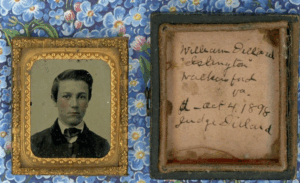
1/16 PLATE RUBY AMBROTYPE OF VMI CADET WILLIAM T. DILLARD WOUNDED IN THE BATTLE OF NEW MARKET
$1,8501/16 PLATE RUBY AMBROTYPE OF VMI CADET WILLIAM T. DILLARD WOUNDED IN THE BATTLE OF NEW MARKETDecember 18, 2023 -
Civil War Period Shipboard Trunk and CDV of Lieutenant Charles H. Swasey, Mortally Wounded
$1,150Civil War Period Shipboard Trunk and CDV of Lieutenant Charles H. Swasey, Mortally WoundedNovember 10, 2021 -
Id’d Civil War Camp Mirror – Lt. and Quartermaster John S. Ives 25th Connecticut Infantry
$750Id’d Civil War Camp Mirror – Lt. and Quartermaster John S. Ives 25th Connecticut InfantryDecember 24, 2021