
Id’d Carved Bone Cravat or Neckerchief Slide – Private David Zimmerman Co. E 129th Pa. Infantry – KIA at ChancellorsvilleDecember 10, 2025
Id’d Carved Bone Cravat or Neckerchief Slide – Private David Zimmerman Co. E 129th Pa. Infantry – KIA at Chancellorsville
SOLD
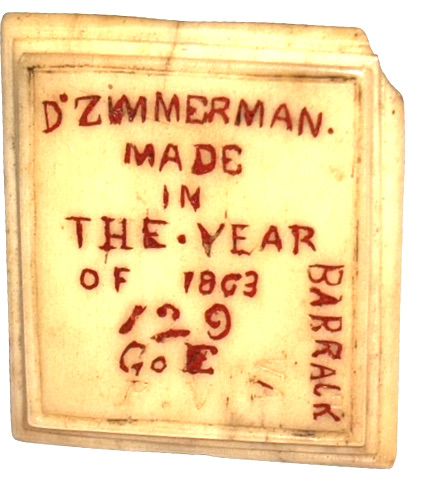
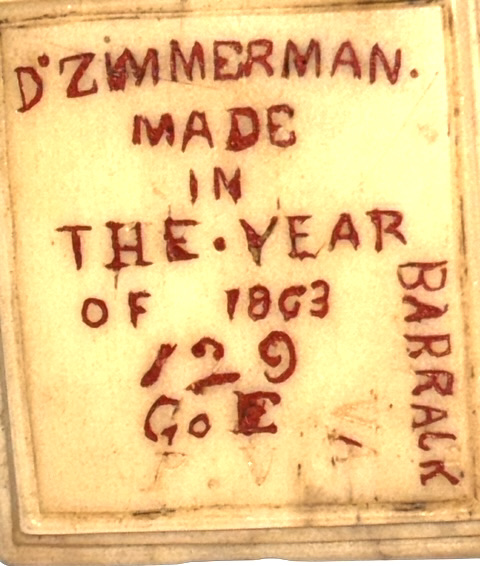
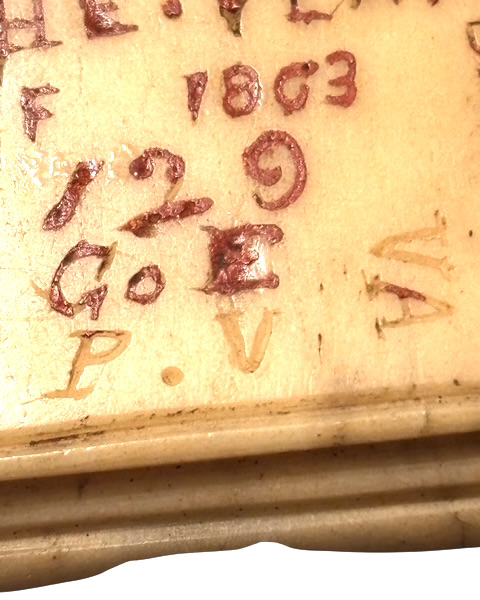
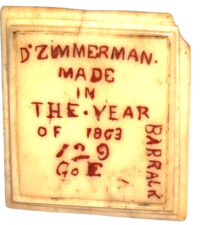
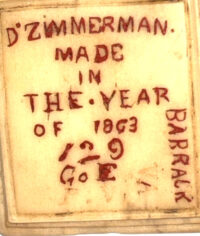
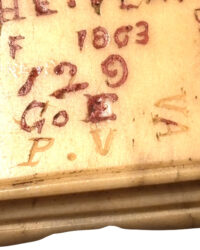
Id’d Carved Bone Cravat or Neckerchief Slide – Private David Zimmerman Co. E 129th Pa. Infantry – KIA at Chancellorsville – We have only had one other cravat slide that has the soldier / maker’s name on the slide; this example exhibits the name and regiment of the soldier who undoubtedly made the slide. Carved into the face of the slide, filled in with red and blue paraffin, with one inscription unfilled, is the following:
“D Zimmeran
MADE
IN
THE YEAR
OF 1863
129
Co E
- V.
VA
BARRACK”
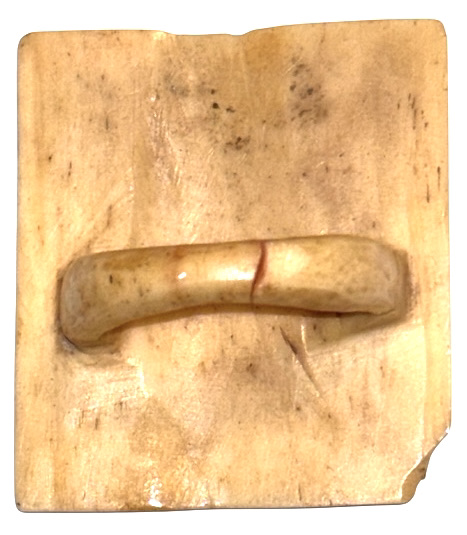
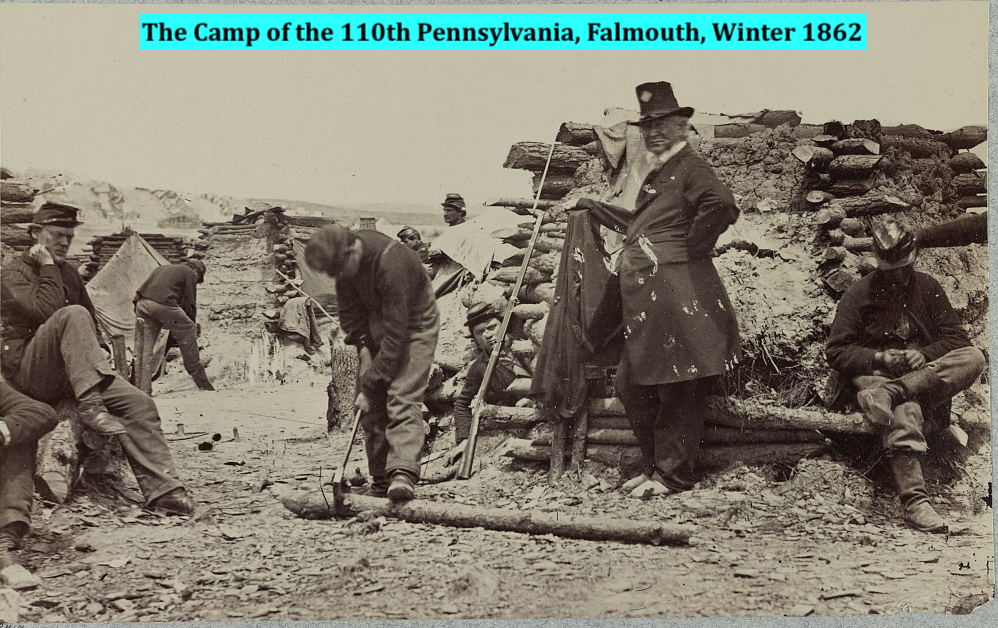
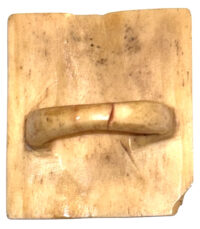
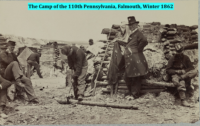
David Zimmerman, a resident of Schuylkill County, PA., enlisted into Co E, of the 129th Pennsylvania Infantry, in August 1862. With his regiment, Zimmerman would see action at Antietam, Fredericksburg, participate in the “Mud March” and sustain mortal wounds in action at Chancellorsville. The cravat slide remains in excellent condition, with a minor chip visible out of the upper right corner; the cravat ring on the back of the slide appears to have been cracked a long time ago. Zimmerman’s carving of his unit’s state of origin, is shallow and not filled with a colored paraffin. We are not sure what the significance of the vertically carved word “BARRACK” is on the face of the slide, although it may be a reference to his hut site during the winter of 1862-1863. The 129th Pennsylvania Infantry, part of the Army of the Potomac’s V Corps, spent the winter of 1862-1863 around Falmouth, Virginia, near the Rappahannock River, after the devastating Battle of Fredericksburg, digging in for winter quarters amidst mud and hardship while facing Confederates just across the river, a prelude to the Chancellorsville Campaign.
Key Locations & Activities:
- Falmouth/Fredericksburg Area (VA): Following the disastrous Union assault at Fredericksburg in December 1862, the Army of the Potomac established winter camps across the river from the Confederates, with the 129th PA in the V Corps.
- Mud & Huts: Like other units, they endured cold, disease, and terrible conditions, building crude log huts and living in trenches, a stark contrast to the “comfortable” winter camps often imagined.
- Opposite the Enemy: They faced Confederate troops under General Lee across the Rappahannock River, with skirmishes and artillery duels common, all while waiting for spring and the next campaign.
Context:
- The regiment was newly formed and saw its first major action at Fredericksburg, experiencing heavy losses and the ensuing winter misery.
- This period was characterized by low morale, disease (influenza, typhoid), and constant readiness, leading into the spring of 1863 and the Chancellorsville Campaign.
David Zimmerman
Residence Schuylkill County, PA.
Enlisted on 8/14/1862 as a Priv.
On 8/14/1862, he mustered into “E” Co. Pennsylvania 129th Infantry.
He was Killed on 5/3/1863 at Chancellorsville, VA
129th PA Infantry
Organized: Camp Curtin, Harrisburg, PA on 8/15/1862
Mustered out: 5/18/1863
PENNSYLVANIA ONE HUNDRED and TWENTY NINTH INFANTRY (Nine Months) One Hundred and Twenty-ninth Infantry. – Col., Jacob G. Frick; ; Lieut.-Col., W. H. Armstrong; Maj., Joseph Anthony. Volunteers from Schuylkill, Northampton and Montgomery counties rendezvoused at Camp Curtin, Harrisburg, and were mustered into the U. S. service on Aug. 15, 1862, for a nine months’ term, forming the 129th infantry. The regiment was ordered to Wash- ington the next day, one detachment of two companies was posted at Bull Run, across which it was to rebuild and guard a bridge, and the remainder acted as escort to an ammunition train as far as Centerville. On its return the regiment was assigned to the 1st brigade, 3d division, 5th corps, which on Sept. 14, started for Antietam, but arrived after the battle had been fought. At Fredericksburg, the first battle of the regiment, the men joined bravely in a gallant but futile charge upon the heights and were highly praised by Gen. Tyler. In this action the 129th lost 142 in killed and wounded, many of its dead lying close to the impregnable stone wall. Winter quarters were es- tablished near Falmouth, which were occupied until the battle of Chancellorsville except during the “Mud March.” On May 3, the regiment was closely engaged at Chancellorsville and the loss was heavy. Gen. Tyler said of the 129th in this battle that “No one ever saw cooler work on field drill than was done by this regiment.” It returned to Harrisburg soon after and was there mustered out of the service on May 18, 1863.
129th Pennsylvania Infantry Regiment
| 129th Pennsylvania Volunteer Infantry | |
| Active | August 15, 1862 to May 18, 1863 |
| Country | United States |
| Allegiance | Union |
| Branch | Infantry |
| Engagements | Battle of Antietam Battle of Fredericksburg Battle of Chancellorsville |
The 129th Pennsylvania Volunteer Infantry was an infantry regiment that served in the Union Army during the American Civil War.
Service
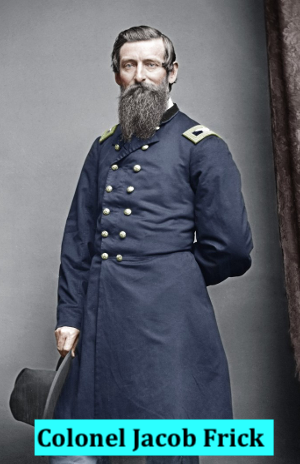
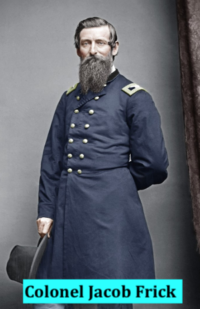
The 129th Pennsylvania Infantry was organized at Camp Curtin near Harrisburg, Pennsylvania, and mustered in August 15, 1862 under the command of Colonel Jacob Gellert Frick.
The regiment was attached to 1st Brigade, 3rd Division, V Corps, Army of the Potomac.
The 129th Pennsylvania Infantry mustered out May 18, 1863.
Detailed service
Moved to Washington, D.C., August 16, and duty there until September 12. Moved to Sharpsburg, Md and duty there until October 30. Reconnaissance from Sharpsburg to Smithfield, Va., October 16–17. Movement to Falmouth, Va., October 30 – November 19. Battle of Fredericksburg, Va., December 12–15. Burnside’s 2nd Campaign, “Mud March,” January 20–24, 1863. At Falmouth until April. Chancellorsville Campaign April 27 – May 6. Battle of Chancellorsville May 1–5.
Casualties
The regiment lost a total of 83 men during service; 3 officers and 37 enlisted men killed or mortally wounded, 1 officer and 42 enlisted men died of disease.
Commanders
- Colonel Jacob Gellert Frick
Notable members
- Private Charles F. Chidsey– First mayor of Easton, Pennsylvania, member of the Pennsylvania House of Representatives
- Colonel Jacob Gellert Frick – Medal of Honorrecipient for action at the Battle of Chancellorsville
129th Regiment, Pennsylvania Infantry
Overview:
Organized at Harrisburg August, 1862. Moved to Washington, D. C., August 16. and duty there till September 12. Moved to Sharpsburg, Md., and attached to 1st Brigade. 3rd Division, 5th Army Corps, Army of the Potomac. Duty at Sharpsburg, Md., till October 30. Reconnoissance from Sharpsburg to Smithfield, W. Va., October 16-17. Movement to Falmouth, Va., October 30-November 19. Battle of Fredericksburg, Va., December 12-15. Burnside’s 2nd Campaign, “Mud March,” January 20-24, 1863. At Falmouth till April. Chancellorsville Campaign April 27-May 6. Battle of Chancellorsville May 1-5. Mustered out May 18, 1863.
Regiment lost during service 3 Officers and 37 Enlisted men killed and mortally wounded and 1 Officer and 42 Enlisted men by disease. Total 83.
129th Pennsylvania Volunteer Infantry Regiment
The 129th Pennsylvania Volunteer Infantry Regiment lost 3 officers and 37 enlisted men killed and mortally wounded and 1 officer and 42 enlisted men to disease during the Civi War.
| 1862 | |
| August | Organized at Harrisburg for nine months service under Colonel Jacob G. Frick (formerly lieutenant colonel of the 96th Pennsylvania Infantry), Lieutenant Colonel William H. Armstrong and Major Joseph Anthony. Companies, A, B, E, G, & H were recruited in Schuylkill county, Companies C, F, & K in Northampton, and Company, I, was recruited in Montgomery. |
| August 16 | Moved to Washington, D.C. and duty there |
| August 18 | Went into camp at Alexandria. |
| September 12 | Left Washington attached to 1st Brigade. 3rd Division, 5th Army Corps, Army of the Potomac. |
| September 14 | Reached the Monocacy River outside Frederick. |
| September 17 | Resumed march west over South Mountain to the sound of heavy artillery fire |
| September 18 | Arrived on the Antietam battlefield |
| September-October | Duty at Sharpsburg, Maryland. Engaged in drill and “unimportant duty.” |
| October 16-17 | Reconnaissance from Sharpsburg to Smithfield, W. Va. |
| October 30- November 19 |
Movement to Falmouth, Va. |
| October 30 | Crossed the Potomac into the Valley of Virginia. |
| December 12-15 |
Battle of Fredericksburg |
| 1863 | |
| January 20-24 | Burnside’s 2nd Campaign, “Mud March” |
| February – April | At Falmouth |
| April 27-May 6 | Chancellorsville Campaign |
| May 3 |
Battle of ChancellorsvilleThe regiment was closely engaged in line of battle in the wood in front of the Union batteries for nearly two hours. The right flank of the division was turned when its ammunition was exhausted. The division retired to unmask the Union batteries to the flanking Confederates. The 129th was the rearguard in the withdrawal, and in hand to hand combat the colors were seized twice but regained, and brought safely off. |
| May 12 | The term of the regiment expired and it returned to Harrisburg. |
| May 18 | Mustered out |
129th Pennsylvania Infantry
Organized: Camp Curtin (Harrisburg), PA; mustered in 8/15/1862
Disbanded/Mustered out: Harrisburg, PA 5/18/1863
Commanding Officer on the Antietam Campaign:
Col. Jacob G. Frick
This Regiment’s Chain of Command:
Army – Army of the Potomac
Corps – Fifth Army Corps
Division – 3rd Division, 5th Corps
Brigade – 1st Brigade, 3rd Division, 5th Corps
Unit history
A 9-month regiment, five companies, A, B, E, G, and H, were recruited in Schuylkill county, four, C, F, and K, in Northampton, and one company, I, was recruited in Montgomery. They rendezvoused at Camp Curtin, where, on the 15th of August, 1862, a regimental organization was effected, with the following field officers:
– Jacob G. Frick, of Schuylkill county, Colonel;
– William H. Armstrong, of Northampton county, Lieutenant Colonel
– Joseph Anthony, of Schuylkill county, Major.
Colonel Frick had served with credit as Lieutenant in the Mexican War, and as Lieutenant Colonel of the Ninety-sixth Pennsylvania Regiment, until the 29th of July, 1862.
On the day following its organization, after having been hastily armed and equipped, it was hurried away to Washington, and on the 18th went into camp in the neighborhood of Alexandria. Company and regimental drill was early commenced, and by the active and intelligent efforts of its Colonel, the regiment rapidly attained a marked degree of efficiency.
On the Antietam Campaign
On the morning of the 14th, the brigade started on the march through Maryland, arrived at the Monocacy on the 16th, where it was halted, and on the 17th resumed the march to the sound of heavy cannonading, arriving early on the following morning on the field of Antietam. But the enemy had by this time retired, and the command soon after went into camp, where for six weeks, with the exception of an expedition up the Shenandoah Valley with the division, the regiment remained engaged in drill and unimportant picket duty.
Battlefield Tablets for this Unit
Tablet #19: Humphreys’ Division, Fifth Army Corps – 14 Sep, 6 AM to 18 Sep, 7 AM
Tablet #33: Fifth Army Corps – 15 Sep, 2 PM to 16 Sep, 12 PM
After the Antietam Campaign
The Regiment was heavily engaged at the Battles of Fredericksburg and Chancellorsville (though the time of many of the men had already expired by then), Col Frick later being awarded the Medal of Honor for those actions.
On the 12th, its term of service having fully expired, it returned to Harrisburg, where on the 18th of May it was mustered out. The return of companies to Easton and Pottsville was marked by flattering and enthusiastic demonstrations on the part of the citizens.
Regiment Pennsylvania Volunteer Infantry at Fredericksburg
Bethlehem Moment: December 13, 1862
Bethlehem’s Moravian history is well known and its preserved buildings – the Gemeinhaus, Single Sisters house, Single Brethren house, and the Colonial Industrial Quarter, to name a few — have earned the Moravian Historic District the distinction of consideration as a World Heritage Site. Bethlehem’s place in the Revolution is enshrined in the patriot graves memorialized in the Tomb of the Unknown Revolutionary War Soldier. The Moravians were pacifists in principle – and were recognized as such by the Continental Congress. Most of the men paid a fine rather than fight. During the winters of 1776 – 1777 and 1777 – 1778 Bethlehem’s residents provided care to sick and wounded soldiers. The Sun Inn hosted many Continental Army general officers and members of the Continental Congress.
By the time of the Civil War, attitudes had changed and many a Bethlehem boy – willing to fight against a rebellion against constitutional authority — stepped forward to serve in the Union army. The Synod of the Church passed several resolutions indirectly supporting the Union cause, effectively making it a just war. The firing on Ft. Sumter in April 1861, led to Lincoln’s call for 75,000 volunteers to serve 90 days and Co. “A”, 1st Regiment Pennsylvania Volunteer Infantry, drawn from Bethlehem, was quickly formed and sent to Washington to protect the Capitol. Pennsylvania answered Lincoln’s call for additional troops as the war progressed, and the conflict widened by filling three-year regiments and shorter term nine-month regiments. Among those regiments was the 129th Regiment Pennsylvania Volunteer Infantry.
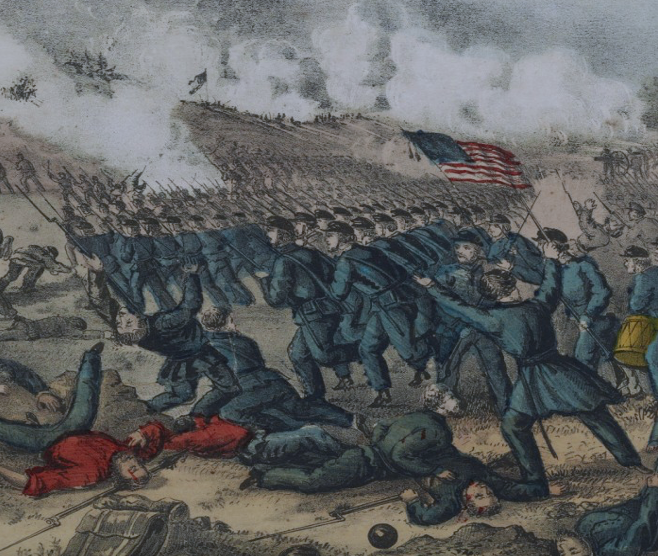
Company “C” of the 129th Regiment was recruited in Northampton County and included many Bethlehem men. The Regiment was organized on August 15th, 1862, to serve for nine months. Politicians wanted to avoid a draft at all costs and calculated that shorter service commitments would be easier to fill than “three years or during the war.” After being hastily armed and equipped, Company “C” entrained to Alexandria, Virginia, arriving on August18th. Two weeks later it was under fire during the battle of Second Bull Run but not really engaged in combat. Two weeks after that, the 129th marched to Sharpsburg, Maryland, arriving on the field along Antietam Creek, but too late to participate in the fighting. At the end of October, the 129th marched into Virginia until it arrived opposite Fredericksburg. On December 13th, the Regiment crossed the Rappahannock River with its division marching through the town to its assault position in full view of an open field. Advancing, the brigade that included the 129th Regiment halted in low, open ground and was ordered to lie down, where it came under artillery fire. Rising up, the division formed in line of battle with the brigade in two lines, and the 129th Regiment on the left front.
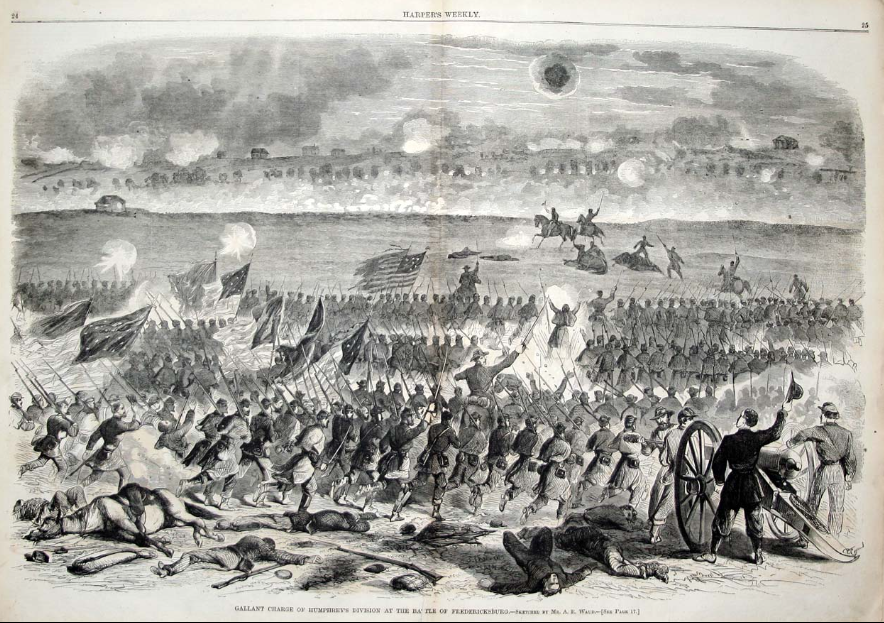
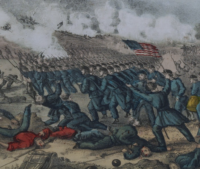
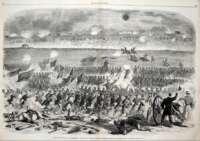
This was the Regiment’s trial by fire (experiencing serious action for the first time) as it advanced over open ground, over the bodies of the dead and wounded, in the face of incessant musketry and artillery fire toward an enemy behind a stone wall. In a matter of minutes, the Regiment lost 142 killed and wounded. Among them were the sons of old Bethlehem families such as Benner and Luckenbach. We should pause to consider the courage it took to make that charge knowing full well that the five previous charges were driven back with heavy losses. They went forward with fixed bayonets without waiting to load their muskets, intent on giving the Confederates “the cold steel.” The division succeeded in getting closer to the stone wall than any other Federal assault. Caps from the 129th’Regiment were found within a few yards of that stone wall. Those “Bethlehem Boys” had “seen the elephant” and showed their mettle. Retreating in semidarkness into the town, the Regiment re-crossed the river under fire and went into camp.
After suffering the misery of Burnside’s “Mud March” in January 1863, the 129th took part in the battle of Chancellorsville, fighting on May 1st, 2nd and 3rd, even though the term of service of many of the men had expired. The Regiment’s term of service having fully expired on May 6th, the remnants of Company “C” arrived in Easton on May 18th to the welcoming cheers of its citizens.
Later that summer of 1863, the Federal troops at Gettysburg, crouched behind a stone wall on Cemetery Ridge, cried out “Fredericksburg! Fredericksburg!” as Pickett’s Division advanced across an open field into a storm of bullets and artillery fire. The butcher’s bill was repaid.
Colonel Jacob Frick and the 129th Pennsylvania at the Battle of Fredericksburg | December 1862
Posted on December 12, 2024by Jake Wynn
In 1862, Colonel Jacob Frick organized a regiment of soldiers from Schuylkill County and other Coal Region communities for the US Army to fight in the Civil War.
The 129th Pennsylvania was born and in December 1862 it received its baptism by fire at Fredericksburg, Virginia in the fight at Marye’s Heights on December 13, 1862. The 129th Pennsylvania and the rest of General Ambrose Burnside’s Army of the Potomac were unable to dislodge Confederate forces from a ridgeline near Fredericksburg in one of the bloodiest military defeats in US history.
Major Joseph Anthony summed up the unit’s experience and the actions of Colonel Frick during the Battle of Fredericksburg:
How the bullets whistled and hissed about our heads, and the shell exploded right in our midst. Nothing could withstand that withering line of fire. Men fell around me on all sides, and it seemed and it seemed almost a miracle that I was untouched.
The line was kept in as good order as possible under the circumstances. We advanced to within a short distance of the wall-perhaps 50 or 75 yards-and then flesh and blood could stand it no longer. The line began to waver and part-our advance was checked. We could not keep the gaps in the ranks filled up.
The officers did their best to urge the men forward, but it was worse than useless as nothing but death stared them in the face… From the time we first started on the charge to the time we returned, was scarcely more than 15 or 20 minutes; yet in that short time 137 of our men had fallen either killed wounded, or afterwards discovered to be among the missing. Nine officers of the regiment were either killed or wounded, and so far as I know there was not one who faltered or hung back.
Our Colonel exposed himself fearlessly, keeping the line in good order, and cheering the men forward in that fearful advance; and afterwards when we were compelled to retire, restored the lines once more, so as to be prepared for any movement of the enemy.
For these actions, and those at the Battle of Chancellorsville in May 1863, the Federal government awarded Frick the Medal of Honor.
He returned to the Coal Region after the Civil War. He died in 1902 and is buried at Pottsville’s Presbyterian Cemetery on Howard Avenue.
The 129th Pennsylvania Infantry Regiment Battle Hardened Veterans
After the failure of General George McClellan’s Peninsular campaign from March thru early July 1862 President Lincoln was confronted with a problem. Where was he to get more troops for the renewal of the war? In 1861 the call to the colors was answered by over 630,000 men. By all rights everyone thought that this many troops could bring a rapid end to this rebellion and by April 1862 all recruiting was put to the halt. This was a terrible mistake. More men were needed to finish this conflict. Lincoln actually thought he needed an Army of one million men. On July 2, 1862 he called for an additional 300,000 men for three years, and again on August 4th for a draft of 300,000 men for nine months.
When the recruiting began in earnest, the marching off to war and joining the colors seemed to have flagged; patriotism, lust for adventure and the general excitement of battle could no longer be counted on except here in Schuylkill County.
Under this call Pennsylvania Governor Andrew Curtin issued a proclamation on July 21, 1862: Part of which reads: To sustain the Government in times of common peril by all his energies, his means, and his life if need be, is the first duty of every loyal citizen. The President of the United States has made a requisition on Pennsylvania for twenty-one new regiments, and the regiments already in the field must be recruited. Under the words of the full proclamation Schuylkill County was required to set a quota of five full companies for the state. A war meeting was held in the Court House and on Tuesday July 29, 1862 the order was enthusiastically responded to by the people of Schuylkill County. Speeches were made and a series of 6 resolutions were passed. War meeting were held in other towns in Schuylkill also, all rallying to the flag.
After the speeches and the patriotic meetings Schuylkill County would furnish the following men and companies: The 129th regiment would supply the most men with 523, 127th, 57 men, 137th, 27 men, 151st , 61 men Captain Wellington Jones Company of Provost Guards 100 and in other nine month regiments a total of 18 men for grand total of 786 men for nine months service.
Now anyone with any kind of knowledge of military operations would know that it takes time to train and equip men for battle. The 129th Regiment the main subject of this story included men from Tamaqua, Port Carbon, Ashland, Pottsville, and Minersville. The remaining companies in the regiment coming from Northampton and Montgomery Counties. All lead by Colonel Jacob Frick.
The point I am trying to make is these short term men were brought together and formed into a cohesive fighting force and in just 277 days of active service were subjected to two of the biggest battles of the Civil War, The Battle of Fredericksburg, and Chancellorsville. The first part of the story deals with the Fredericksburg Battle.
The men were brought to an efficient fighting force by the officers of the regiment lead by the fearless Col. Jacob Frick. At the fierce battle of Fredericksburg the regiment would suffer 15 enlisted men KIA, 90 WIA and 23 missing out of this number Schuylkill County suffered 5 men KIA, 19 men seriously wounded and 1 man missing. Co. H had 9 men captured and then paroled, Co. E, 1 man captured, Co. B one man captured and presumed dead.
Related Items
-
Id’d Civil War .44 Cal. Pistol Cartridge Box
$425Id’d Civil War .44 Cal. Pistol Cartridge BoxJanuary 4, 2024 -
Fine Civil War Officer’s Autograph Book – 3rd NY Infantry – Close to 40 Signatures
$850Fine Civil War Officer’s Autograph Book – 3rd NY Infantry – Close to 40 SignaturesApril 23, 2021 -
Civil War Period Shipboard Trunk and CDV of Lieutenant Charles H. Swasey, Mortally Wounded
$1,150Civil War Period Shipboard Trunk and CDV of Lieutenant Charles H. Swasey, Mortally WoundedNovember 10, 2021 -
Renown Richmond Sculptor Edward V. Valentine’s Personal Photographs of General Robert E. Lee Utilized by Valentine When Sculpting a Statuette of Lee
$4,200Renown Richmond Sculptor Edward V. Valentine’s Personal Photographs of General Robert E. Lee Utilized by Valentine When Sculpting a Statuette of LeeMarch 29, 2024