
CDV of a Civilian Picked Up Off the Battlefield of Antietam / Sharpsburg on September 17, 1862 by Sergeant Albert H. Roller Co. I 28th Va. InfantryApril 8, 2026
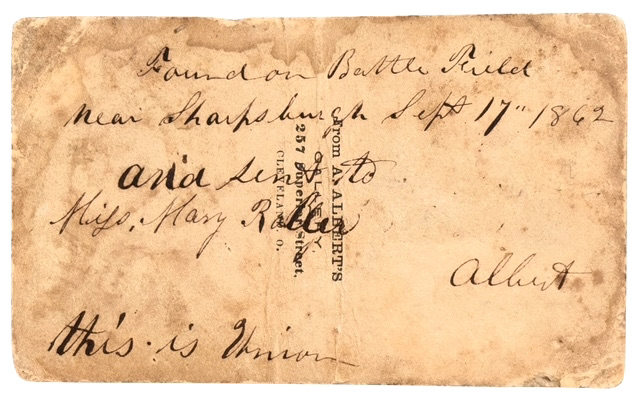
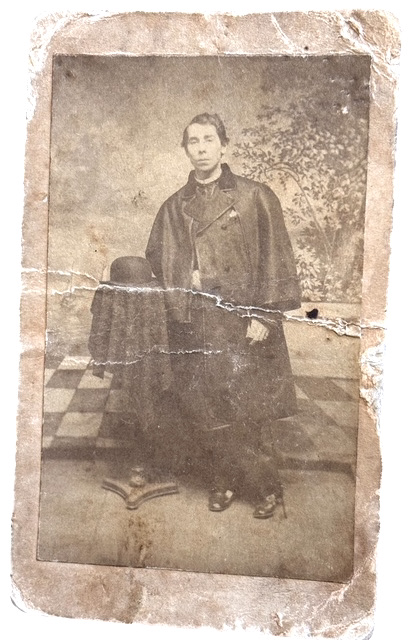
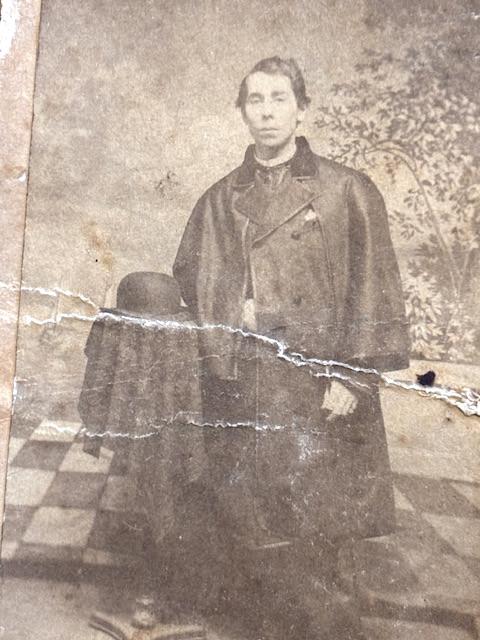
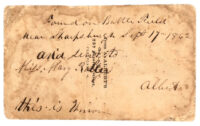
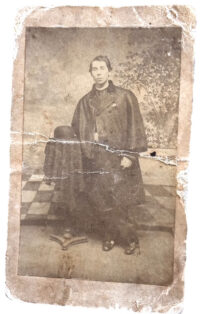
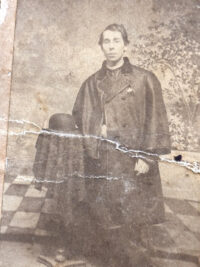
CDV of a Civilian Picked Up Off the Battlefield of Antietam / Sharpsburg on September 17, 1862 by Sergeant Albert H. Roller Co. I 28th Va. Infantry – This CDV depicts an adult male civilian attired in a caped greatcoat, with a derby style hat sitting on a photographer’s prop table; behind the sitter is an outdoor balcony style backdrop. Hand-inked on the back of the CDV is the following:
“Found on Battle Field
Near Sharpsburgh Sept 17th 1862
and Sent to
Miss Mary Roller
Albert
This is Union”
The photographer’s back mark is:
“From A. ALBERT’S
GALLERY
257 Superior Street.
CLEVELAND. O.”
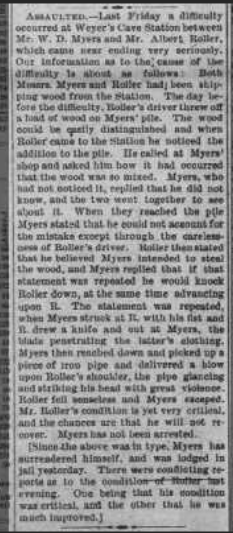
Albert Roller enlisted in Co. I of the 28th Va. Infantry, in May 1861 as a private; he would ultimately rise to the ranks of 1st Sergeant in August 1862, then 1st Lieutenant in April 1863. He would remain with his regiment throughout the war, returning to his home in Weyer’s Cave, Va. after the war. During his tenure in the 28th Va., Roller would be present at numerous engagements, to include the Battle of Antietam, on September 17, 1862, when he apparently picked this CDV up, as a souvenir, then sending it to sister, Mary Jane Roller. Shortly after his promotion to the rank of 1st Sergeant in August 1862, Roller and the 28th Va., as part of Garnett’s Brigade, were engaged, on Sept. 17, 1862, at Antietam, in the northern section of the battlefield, in the area from the Boonesboro Pike to the Lower Bridge Road. The Brigade was spread out from 200 yards east of the Lutheran Church, extending south to just east of the town spring. The 28th only had 77 men present on the field and of those present, 6 were killed and 43 were wounded. Albert Roller was present with his company on that fateful day. The CDV is in fair condition, with a single fold crease across the center of the image; the resolution remains fine, although there is some toning and minor creasing on the pasteboard mount. This is a most interesting and significant battlefield pickup.
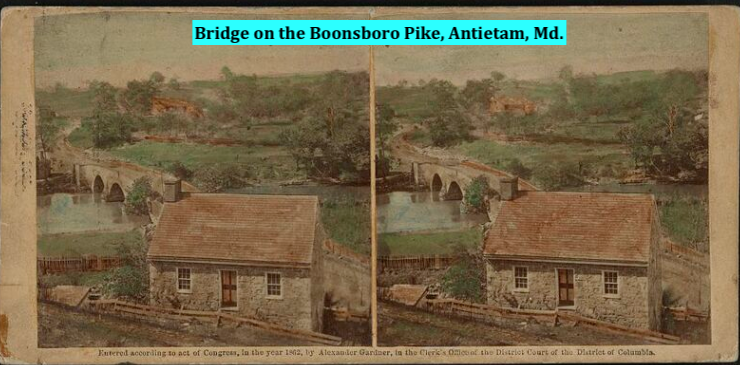
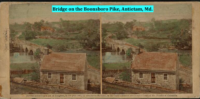
We presume that the CDV’s subject, with a Cleveland, Ohio photographer’s back mark, was probably in an Ohio regiment; Ohio troops were significantly engaged at Antietam, two regiments were engaged at the Boonesboro Pike. Ohio troops, primarily part of the Kanawha Division in the Union’s Ninth Corps (under Maj. Gen. Ambrose Burnside), played a key role in the afternoon assault on September 17, 1862, advancing across Antietam Creek and moving toward the Boonesboro Pike south of Sharpsburg. They reached a position near a stone fence, threatening to cut off the Confederate retreat, before being forced to fall back.
Key Ohio Positions and Actions at the Boonesboro Pike:
- The Kanawha Division (Ewing’s and Crook’s Brigades): Commanded by Col. Eliakim P. Scammon (with Gen. Jacob D. Cox leading the Corps), this division was part of the final push. Crook’s brigade crossed the Burnside Bridge about 2 p.m. and pushed toward the pike, while Ewing’s brigade crossed further south at Snavely’s Ford to turn the Confederate right.
- 12th and 23rd Ohio Infantry: These units advanced to the vicinity of the Boonesboro Pike (south of town) on the afternoon of September 17. The 12th Ohio moved from the extreme left, enduring a severe flank fire to reach its position, which it held for the remainder of the day. ***The 12th Ohio Infantry was formed at Camp Dennison, near Cleveland – it is conceivable that the CDV was dropped by a soldier in this regiment.
- 23rd Ohio Infantry: The 23rd crossed the Antietam and occupied an exposed position in the same sector (near the present-day Branch Avenue and Burnside Bridge Road intersection), where it held its ground until the close of the battle.
- 28th Ohio Infantry: Under Gen. Crook, this regiment performed a reconnaissance above the bridge on the morning of September 17 and later charged, helping drive the enemy from the lower bridge.
- The Final Line: The division reached a line defined by a stone fence that ran southeast of the Boonesboro Pike, with its right at this point and its left extending 535 yards southwest, before being forced to withdraw due to the arrival of A.P. Hill’s Confederate division
Albert H. Roller
Residence Salem, VA.
Enlisted on 5/13/1861 at Salem, Roanoke County, VA as a Priv.
On 5/13/1861, he mustered into “I” Co. Virginia 28th Infantry.
(Date and method of discharge not given.)
He was listed as:
- On rolls 12/15/1864 (place not stated)
Promotions:
- 1st Sergt 8/1/1862
- 2nd Lieut 4/1/1863 (Estimated date)
Died 8/31/1921 in Weyer’s Cave, VA
(Parents: John W. & Susan Roller. Married Ann Carpenter)
After the war, he lived in Weyer’s Cave, VA
| Name | Albert H Roller |
| Birth Place | Augusta County, Virginia |
| Enlistment Date | 13 May 1861 |
| Enlistment Place | Salem, Roanoke County, Virginia |
| Enlistment Rank | Private |
| Muster Date | 13 May 1861 |
| Muster Place | Virginia |
| Muster Company | I |
| Muster Regiment | 28th Infantry |
| Muster Regiment Type | Infantry |
| Muster Information | Enlisted |
| Rank Change Date | 1 Aug 1862 |
| Rank Change Rank | 1st Sergeant |
| Side of War | Confederacy |
| Survived War? | Yes |
| Residence Place | Salem, Virginia |
| Last Known Residence Place | Weyer’s Cave, Virginia |
| Death Date | 31 Aug 1921 |
| Death Place | Weyer’s Cave, Virginia |
| Notes | 1864-12-15 On rolls |
| Additional Notes | Parents: John W. & Susan Roller. Married Ann Carpenter |
| 28th Virginia Infantry Regiment | |
| Flag of Virginia, 1861 | |
| Active | June 1861 – April 1865 |
| Disbanded | April 1865 |
| Country | Confederacy |
| Allegiance | Confederate States of America |
| Branch | Confederate States Army |
| Type | Infantry |
| Engagements | First Battle of Manassas Peninsula Campaign Seven Days’ Battles Battle of Williamsburg Battle of Seven Pines Battle of Gaines Mill Battle of Glendale Second Battle of Bull Run Battle of South Mountain Battle of Antietam Battle of Fredericksburg Siege of Suffolk Battle of Gettysburg Battle of Cold Harbor Siege of Petersburg Battle of Five Forks Battle of Sailor’s Creek Appomattox Campaign |
The 28th Virginia Infantry Regiment was an infantry regiment raised in Virginia for service in the Confederate States Army during the American Civil War. It fought mostly with the Army of Northern Virginia. The 28th Virginia completed its organization at Lynchburg, Virginia, in June, 1861. Its members were raised in the counties of Botetourt, Craig, Bedford, Campbell, and Roanoke.
After fighting at First Manassas, the unit was assigned to General Pickett‘s, Garnett‘s, and Hunton‘s Brigade, Army of Northern Virginia. It was active in the campaigns of the army from Williamsburg to Gettysburg except when it served with Longstreet at Suffolk. The 28th moved to North Carolina, then was on detached duty at Richmond. It fought at Cold Harbor, endured the battles and hardships of the Petersburg trenches, and was engaged in various conflicts around Appomattox.
The regiment totaled 600 men in April, 1862, and reported 40 casualties at Williamsburg, and 47 at Seven Pines. It lost 12 killed and 52 wounded at Second Manassas, had 8 killed and 54 wounded during the Maryland Campaign, and, of the 333 engaged at Gettysburg, half were disabled. Also at Gettysburg, the regiment’s battle flag was captured by the 1st Minnesota Infantry Regiment. Many were captured at Sayler’s Creek, but 3 officers and 51 men survived to surrender on April 9, 1865.
Battle flag
Among the losses was its regimental flag which was taken by the 1st Minnesota Regiment at Gettysburg and still resides in the Minnesota Historical Society. Private Marshall Sherman of the First Minnesota Infantry captured the regiment’s battle flag at Gettysburg. He was subsequently awarded the Congressional Medal of Honor.
Notable veterans
The field officers were Colonels Robert C. Allen, Robert T. Preston, and William Watts; Lieutenant Colonels Samuel B. Paul and William L. Wingfield; and Majors Michael P. Spesard and Nathaniel C. Wilson. Company officers: Henry S. Trout.
28th Regiment, Virginia Infantry
Overview:
28th Infantry Regiment completed its organization at Lynchburg, Virginia, in June, 1861. Its members were raised in the counties of Botetourt, Craig, Bedford, Campbell, and Roanoke. After fighting at First Manassas the unit was assigned to General Pickett’s, Garnett’s, and Hunton’s Brigade, Army of Northern Virginia. It was active in the campaigns of the army from Williamsburg to Gettysburg except when it served with Longstreet at Suffolk. The 28th moved to North Carolina, then was on detached duty at Richmond. It fought at Cold Harbor, endured the battles and hardships of the Petersburg trenches, and was engaged in various conflicts around Appomattox. The regiment totalled 600 men in April, 1862, and reported 40 casualties at Williamsburg at 47 at Seven Pines. It lost 12 killed and 52 wounded at Second Manassas, had 8 killed and 54 wounded during the Maryland Campaign, and, of the 333 engaged at Gettysburg, half were disabled. Many were captured at Sayler’s Creek, and 3 officers and 51 men surrendered on April 9, 1865. The field officers were Colonels Robert C. Allen, Robert T. Preston, and William Watts; Lieutenant Colonels Samuel B. Paul and William L. Wingfield; and Majors Michael P. Spesard and Nathaniel C. Wilson.
| Name | Albert Henry Roller |
| Gender | Male |
| Birth Date | 3 Nov 1837 |
| Death Date | 31 Aug 1921 |
| Death Place | Augusta County, Virginia, United States of America |
| Cemetery | Edgewood Cemetery |
| Burial or Cremation Place | Weyers Cave, Augusta County, Virginia, United States of America |
| Has Bio? | N |
| Father | John W. Roller |
| Mother | Susan Roller |
| Spouse | Ann Elizabeth Roller |
| Children | Lucy Ella RawlingsHerbert Hawes RollerEdgar Jerome RollerJohn Wilmer Roller |
Related Items
-

Large Format Albumen from Glass Plate Negative by Andrew J. Russell of Confederate Fort Mahone (“Fort Damnation”) – April, 1865
$650Large Format Albumen from Glass Plate Negative by Andrew J. Russell of Confederate Fort Mahone (“Fort Damnation”) – April, 1865July 3, 2022 -
Id’d Civil War .44 Cal. Pistol Cartridge Box
$425Id’d Civil War .44 Cal. Pistol Cartridge BoxJanuary 4, 2024 -
Civil War Period Leather Satchel Id’d to a Connecticut Citizen
$375Civil War Period Leather Satchel Id’d to a Connecticut CitizenMay 18, 2024 -
Large Format Salt Print of Captain Robin Jones 1st SC Cavalry KIA at Brandy Station
$3,000Large Format Salt Print of Captain Robin Jones 1st SC Cavalry KIA at Brandy StationMay 26, 2024