
Id’d 1/6 Plate Tintype of Private Oliver P. Townsend Co. B 35th Massachusetts InfantryMay 10, 2026
Id’d 1/6 Plate Tintype of Private Oliver P. Townsend Co. B 35th Massachusetts Infantry
$475
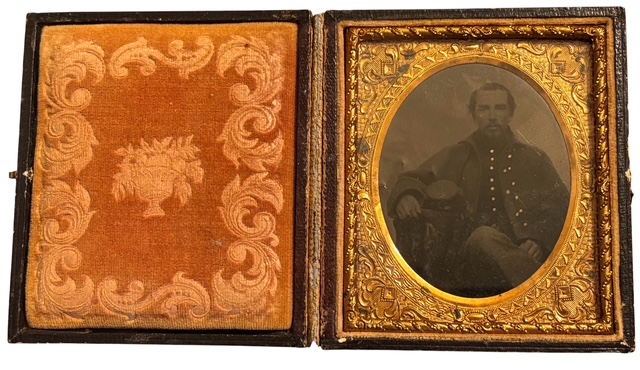
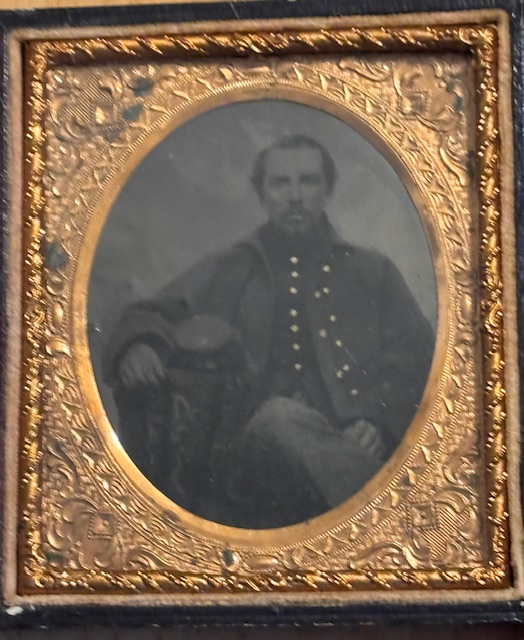
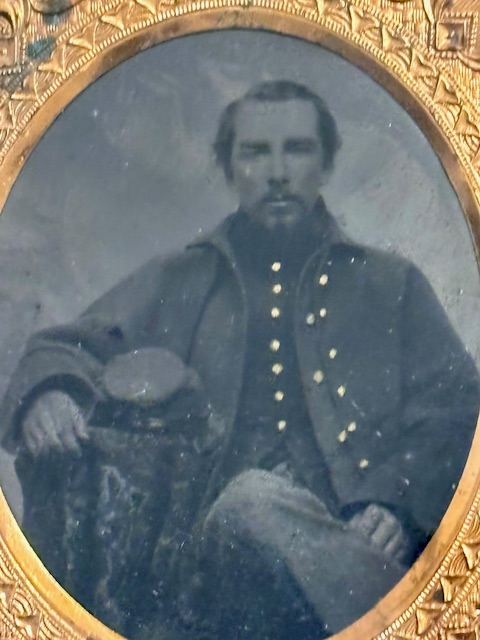
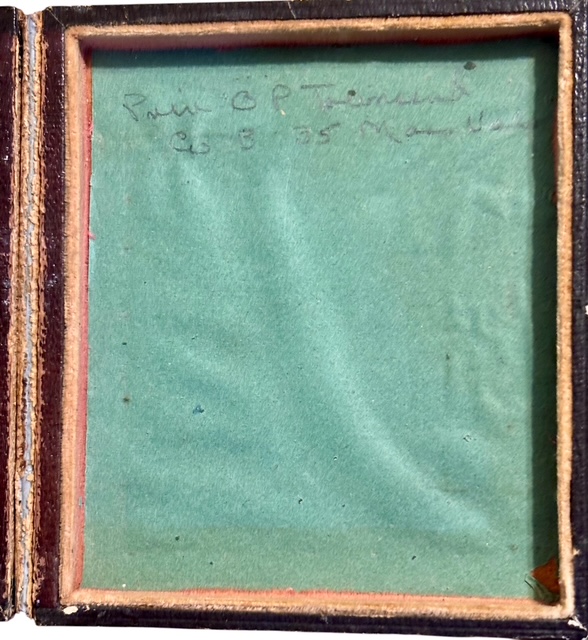
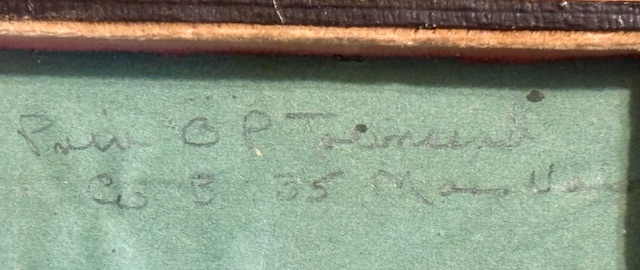
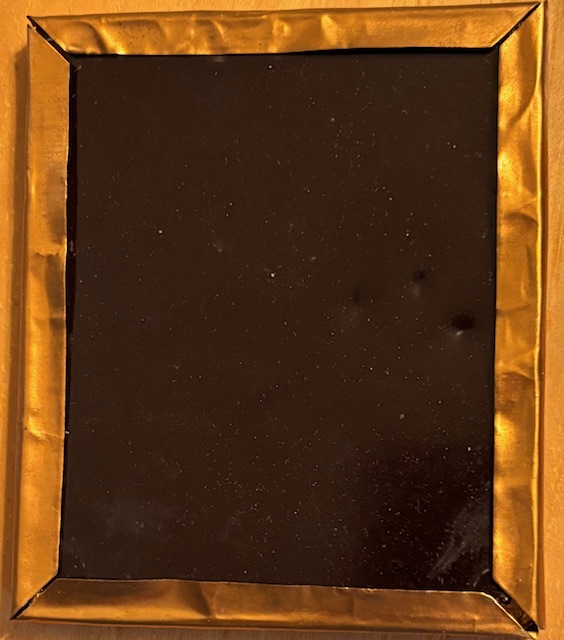
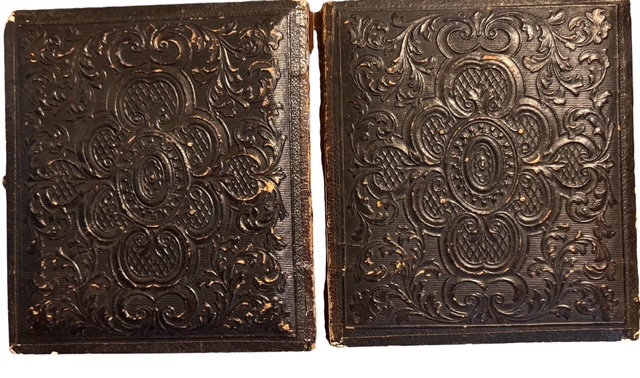
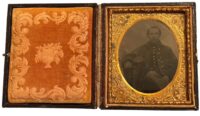
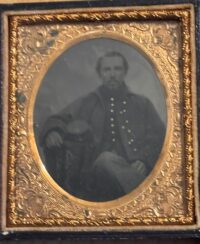
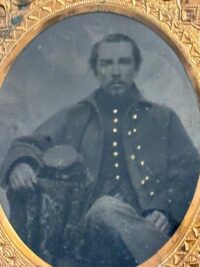
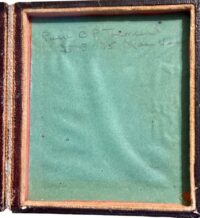
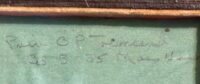
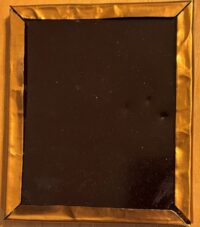
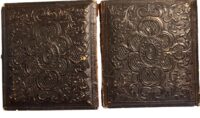
Id’d 1/6 Plate Tintype of Private Oliver P. Townsend Co. B 35th Massachusetts Infantry – This sixth plate tintype is housed in a full case; the image depicts a seated, Union enlisted man, wearing a greatcoat that may be a mounted version, as the collar is a layover style. The soldier is wearing what appears to be a high collar shell jacket, with his forage cap resting on the photographer’s table. When we carefully removed the image from its cased position, we found the following, penciled inscription on the blue paper lining the interior of the case:
“Priv O P Townsend
Co B 35 Mass Vols”
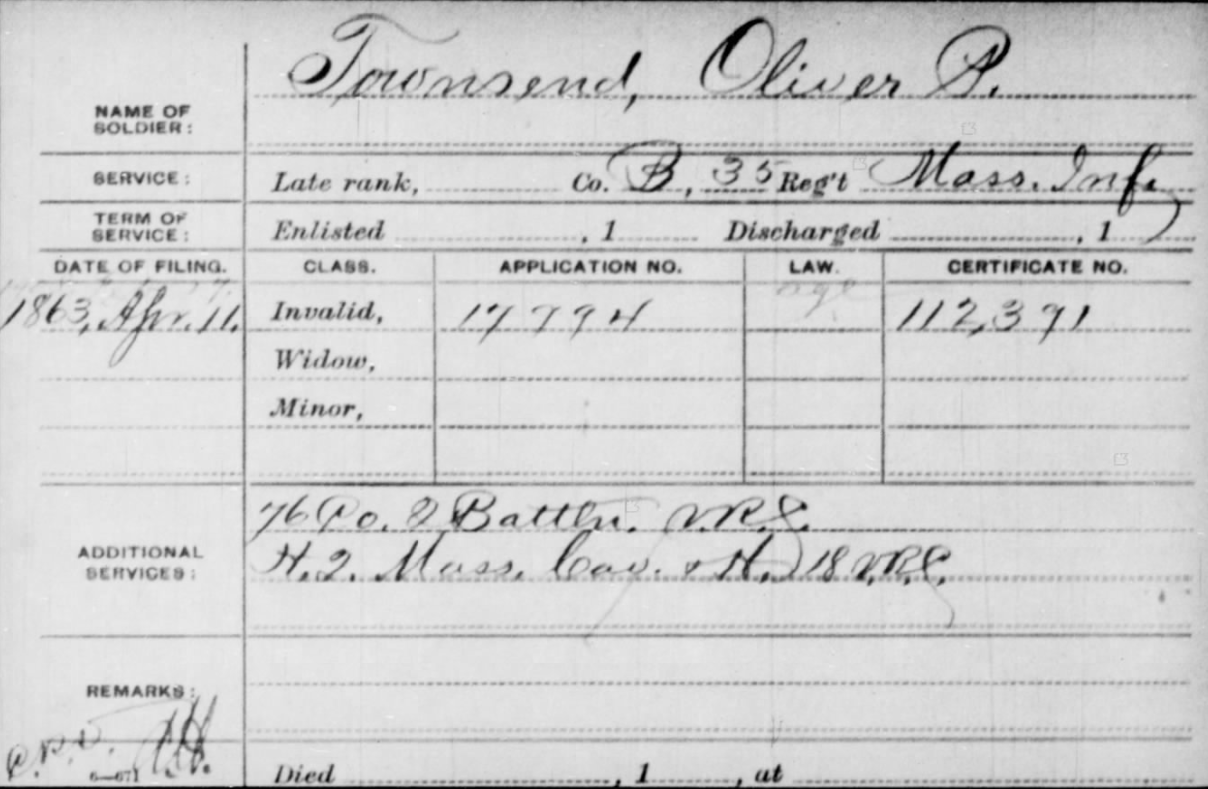
Research revealed that the soldier in the image was Private Oliver P. Townsend, from Newburyport, Massachusetts, who enlisted in August 1862, into Co. B of the 35th Massachusetts Infantry. Shortly after his enlistment, Private Townsend, with his regiment, would be engaged at the Battle of South Mountain on September 14 and, just three days later, be heavily engaged at the Battle of Antietam, on September 17, 1862; during the course of the 35th’s engagement at Antietam, Private Townsend would be wounded – after his recovery, which took several months, he was discharged in February 1863. Townsend would re-enlist in Co. H of the 2nd Mass. Cavalry in June 1863, but in October 1863, apparently unable to fulfill his combat ready obligations, Townsend transferred to Co. H of the Veteran Reserve Corps, ultimately mustering out of the army in July 1865. This image seemingly depicts Private Townsend when he was completing his brief tenure in the 2nd Mass. Cavalry.
The image remains in good condition, with reasonably good resolution; there is some very minor “pebbling” of the emulsion, but the image is clear and all features distinguishable.
About the 35th Massachusetts at the Battle of Antietam
Major Sumner Carruth commanded the 35th Massachusetts at the Battle of Antietam as Colonel Edward A. Wild had been wounded at the Battle of South Mountain. After Major Carruth was wounded Captain Stephen H. Andrews took command of the regiment. The regiment stormed Burnside’s Bridge and then advanced up the slope toward the village of Sharpsburg. It was then caught in a deadly crossfire when Burnside’s line was counterattacked by A.P. Hill. The 35th Massachusetts fought until they were out of ammunition and then fell back. They lost 214 casualties, of whom 79 were killed.
The Medal of Honor was awarded to two members of the 35th at Antietam. Sargent Marcus M. Haskell of Company C rescued a badly wounded comrade and carried him to safety while wounded and under heavy fire. Private Frank M. Whitman of Company G saved the lives of several comrades and was among the last to leave the field.
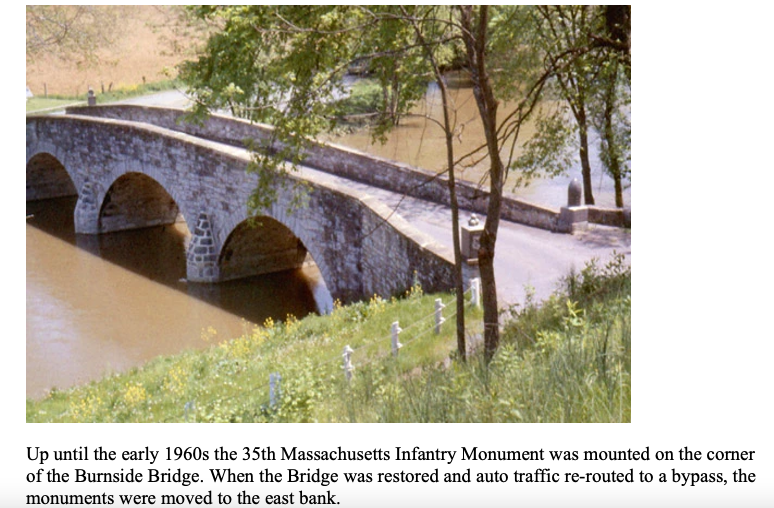
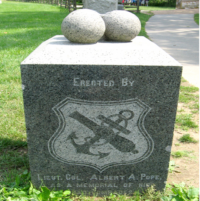
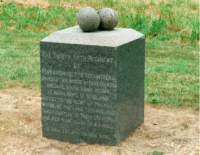
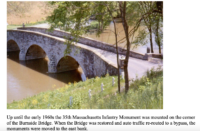
Up until the early 1960s the 35th Massachusetts Infantry Monument was mounted on the corner of the Burnside Bridge. When the Bridge was restored and auto traffic re-routed to a bypass, the monuments were moved to the east bank.
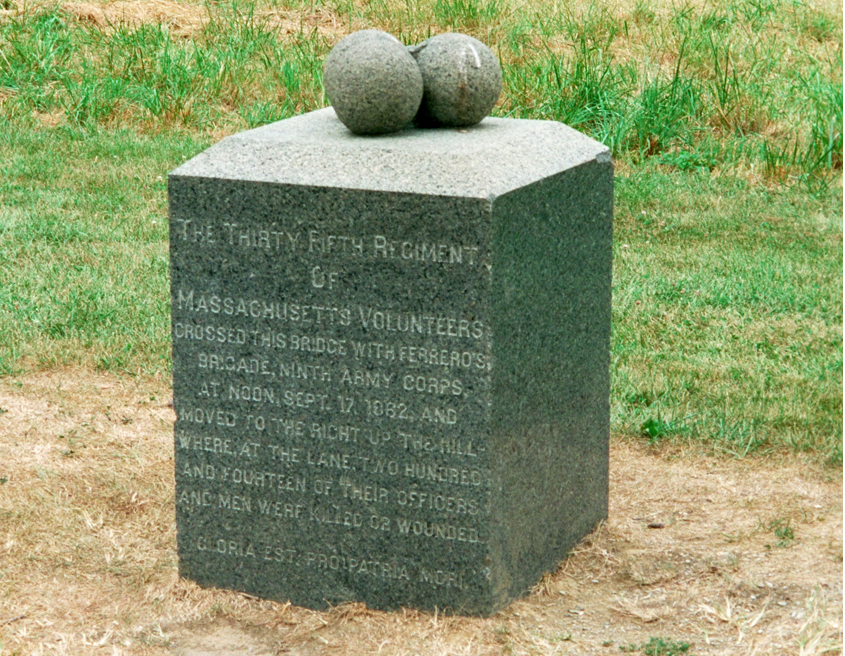
Text from the west face of the monument at Antietam:
The Thirty-fifth Regiment
of
Massachusetts Volunteers
crossed this bridge with Ferrero’s
Brigade, Ninth Army Corps
at noon, Sept. 17, 1862, and
moved to the right up the hill
where, at the lane, two hundred
and fourteen of their officers
and men were killed or wounded.
Gloria est Pro Patria Mori
From the north face of the monument:
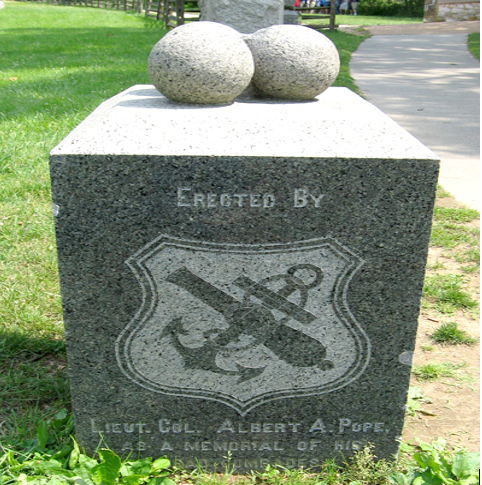
Erected by
Lieut. Col. Albert A. Pope,
as a memorial of his
dead comrades.
The 35th Massachusetts Infantry, a “rookie” regiment only weeks old, suffered 214 casualties—more than any other unit in their brigade—at the Battle of Antietam on September 17, 1862. Under Maj. Sumner Carruth, they stormed Burnside’s Bridge, advanced toward Sharpsburg, and held a crucial, exposed position before being forced back, suffering massive losses.
35th Massachusetts at Antietam:
- Command Structure: Commanded by Maj. Sumner Carruth after Col. Edward A. Wild was wounded at South Mountain; later Capt. Stephen H. Andrews took command after Carruth was wounded.
- Brigade/Corps: Part of Ferrero’s Brigade, 2nd Division, Ninth Army Corps.
- Action: Crossed Antietam Creek (“Burnside’s Bridge”) around noon and advanced toward the town of Sharpsburg.
- Casualties: The regiment suffered 214 officers and men killed or wounded in the action at the lane.
- Medals of Honor: Two soldiers received the Medal of Honor for heroism during the battle: Cpl. Frank Whitman (Company G) and Pvt. Marcus M. Haskell (Company C).
- Monument: A monument to the 35th Massachusetts is located on the east side of Antietam Creek at the Burnside Bridge site
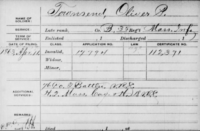
Oliver P. Townsend
Residence Newburyport, MA; a 24-year-old Stonecutter.
Enlisted on 8/6/1862 as a Priv.
On 8/19/1862, he mustered into “B” Co. Massachusetts 35th Infantry.
He was disch wounds on 2/11/1863
On 6/20/1863, he mustered into “H” Co. Massachusetts 2nd Cavalry.
He transferred out on 10/25/1863
On 10/25/1863, he transferred into “H” Co. Veteran Reserve Corps 18th Regt.
He was Mustered Out on 7/19/1865
He was listed as:
- Wounded 9/17/1862 Antietam, MD
Member of GAR Post # 49 (Albert W. Bartlett) in Newburyport, MA
Died 4/1/1909
| Name | Oliver Paine Townsend |
| Enlistment Age | 24 |
| Birth Date | abt 1838 |
| Birth Place | Newburyport, Massachusetts, USA |
| Enlistment Date | 6 Aug 1862 |
| Enlistment Rank | Private |
| Muster Date | 19 Aug 1862 |
| Muster Place | Massachusetts |
| Muster Company | B |
| Muster Regiment | 35th Infantry |
| Muster Regiment Type | Infantry |
| Muster Information | Enlisted |
| Casualty Date | 17 Sep 1862 |
| Casualty Place | Antietam, Maryland |
| Type of Casualty | Wounded |
| Muster Out Date | 11 Feb 1863 |
| Muster Out Information | disch wounds |
| Side of War | Union |
| Survived War? | Yes |
| Injured in Line of Duty? | Yes |
| Residence Place | Newburyport, Massachusetts |
| Death Date | 1 Apr 1909 |
| Occupation | Stonecutter |
| Additional Notes 2 | Muster 2 Date: 20 Jun 1863; Muster 2 Place: Massachusetts; Muster 2 Unit: 851; Muster 2 Company: H; Muster 2 Regiment: 2nd Cavalry; Muster 2 Regiment Type: Cavalry; Muster 2 Information: Enlisted; Muster 3 Date: 25 Oct 1863; Muster 3 Place: Massachusetts; Muster 3 Unit: 2620; Muster 3 Company: H; Muster 3 Regiment: 18th Regt; Muster 3 Information: Transferred; Muster Out 2 Date: 25 Oct 1863; Muster Out 2 Information: Transferred; Muster Out 3 Date: 19 Jul 1865; Muster Out 3 Information: Mustered Out |
When Oliver Paine Townsend and his twin sister Emily Paine were born on February 14, 1838, in Portland, Maine, their father, John, was 37, and their mother, Mary, was 33. He married Evelina Parker Whitney on July 21, 1867, in Newburyport, Massachusetts. They had three children during their marriage. He died on April 1, 1909, in Newburyport, Massachusetts, at the age of 71.
Private
Oliver P. Townsend
Home State: Massachusetts
Branch of Service: Infantry
Unit: 35th Massachusetts Infantry
Before Antietam
He was in Company B.
On the Campaign
He was wounded in action on 17 September 1862.
References & notes
A 24-year-old resident of Newburyport, MA, he enrolled at Private, Company B, 35th Massachusetts Infantry, and mustered in August 1862. He was in action on South Mountain and at Antietam, where he was wounded in the shoulder. He was discharged for disability from wounds on 11 February 1863. He was living in Newburyport in 1884.
THIRTY-FIFTH REGIMENT MASSACHUSETTS VOLUNTEER INFANTRY THREE YEARS The 35th Regt. Mass. Vol. Inf. was organized at Camp Stanton, Lynnfield, and was composed mostly of men enrolled in eastern Massachusetts. It was recruited during July and the early part of August, 1862, and its members were mustered into the service largely between August 9 and 19. Under Col. Edward A. Wild the regiment left for the seat of war August 22, reaching B. Washington on the 24th. On Sept. 8, it was assigned to Ferrero’s (2d) Brigade, Sturgis’ (2d) Division, Reno’s (9th) Corps. Joining the Army of the Potomac it took part in the battle of South Mountain, Sept. 14, 1862, where Col. Wild lost his left arm. At Antietam, Sept. 17, under command of Lieut. Col. Carruth, the regiment lost 214 officers and men, of whom 69 were killed or mortally wounded. At Fredericksburg, Dec. 13, 1862, it again suffered severely, losing Major Willard, who was in command. It camped during the early part of the winter near Falmouth. On Feb. 9, 1863, it was transferred to Newport News, Va., and, after a few weeks stay at this place, was sent with the 9th Corps into Kentucky, being stationed at Mount Stirling, Lancaster, Stanford, and other places. Lieut. Col. Carruth now became colonel of the regiment. It was next ordered to Vicksburg, Miss., to reinforce Gen. Grant, remaining about four weeks, until the surrender of the city, July 4. It participated in the pursuit of Johnston’s army to Jackson, Miss., and was present at the capture of the city, then returned to its old camp near Vicksburg. From here it proceeded by boat and train to Cincinnati, reaching there the 14th of August. Proceeding to Knoxville, Tenn., which it reached Oct. 22, it participated in the defense of the city against Longstreet. After the close of the siege, Dec. 4, the 35th soon proceeded to Blain’s Cross Roads, where it remained, enduring great privations, until January, 1864. After various movements -to Knoxville, Morristown, and elsewhere- the regiment returned to Cincinnati. Here, April 1, it entrained for Baltimore, Md., from whence it took boat for Annapolis. In the reorganization of the 9th Corps the regiment, now commanded by Major Nat Wales, became a part of Carruth’s (1st) Brigade, Stevenson’s (1st) Division. During the battle of the Wilderness, May 5 and 6, and the first part of that of Spottsylvania, May 8 to 12, the 35th was in charge of the supply train of the 1st Division, and was not engaged. Returning to its brigade, May 17, on the following day it was in the last assault on the Confederate lines at Spottsylvania, moving thence to the North Anna River, where it was again engaged, May 25. It was now detailed as an engineer corps for the 1st Division. At Cold Harbor, June 3, it was posted near Bethesda Church and suffered light loss. Crossing the James on June 15, the regiment participated in the siege of Petersburg. At the Crater fight, July 30, it was heavily engaged, losing 12 killed and 34 wounded. At Weldon Railroad, Aug. 19, it was again engaged with loss. It was now reduced to two officers and about 100 men present for duty. In another reorganization of the 9th Corps early in September it was assigned to Curtin’s (1st) Brigade, Potter’s (2d) Division. About this time there were added to the regiment 385 German and French substitutes, recently arrived in this country and ignorant of the English tongue. Major Hudson now commanded the regiment. At Poplar Spring Church, Sept. 30, it was severely engaged, losing 163 prisoners. For two months it was now posted near Forts Fisher and Welsh. During the midwinter it was stationed in the rear of Fort Sedgwick (Fort Hell). From March 7, 1865, until the fall of Petersburg, April 2, it formed a part of the garrison of this fort. It then joined in the pursuit of Lee’s army and was at Farmville when the news came of the surrender. Arriving at Alexandria, Va., April 28, it remained as a part of the garrison of the District of Columbia until June 9, when it transferred its recruits to the 29th Regiment and was mustered out of the service. Returning to Readville, Mass., on June 27, the men were paid off and discharged.
2nd MA Cavalry
Organized: Readville, MA & State of California on 1/1/1863
Mustered out: 7/20/1865
SECOND REGIMENT MASSACHUSETTS VOLUNTEER CAVALRY Three Years The 2nd Regt. Mass. Vol. Cav. was recruited during the fall of 1862 and the winter following. The first company, “A”, was raised in California by Capt. J. Sewell Reed, and was known as the ” California Hundred “. This company was mustered in at San Francisco, Dec. 10, 1862. It arrived in Boston, Jany. 3, 1863, and was assigned to the quota of Boston. Later four more companies were raised in California by Major Thompson, “E”, “F”, “L”, and “M”, and became known as the “California Battalion”. The remaining companies were raised largely in Boston and other places in the easterly part of Massachusetts, the last company, ” H “, not being mustered in until June 20, 1863. The regiment rendezvoused at Camp Meigs, Readville. Charles Russell Lowell, Jr., who had been a captain in the 6th Regt. U. S. Cavalry, and had served on the staff of Maj. Genl. George B. McClellan from July to November, 1862, was commissioned colonel of the regiment. Companies “A”, “B”, “C”, “D”, and “K” left for Baltimore, Md., Feb. 12, 1863, and proceeded thence to Fort Monroe and from there to Gloucester Point, opposite Yorktown, Va. This battalion under Maj. Caspar Crowninshield was engaged in various raids and expeditions in southeastern Virginia until Aug. 6, when it reported to Colonel Lowell who was at Centreville with the main body of the regiment. The main body of the regiment left Readville, Mass. for the seat of war May 11, proceeding to Washington and camping near that city until July 19, during which period it was engaged in raids and scouting expeditions in the region between Washington and the Blue Ridge. Having been joined by Major Crowninshield’s Battalion, Aug. 6, the career of the regiment as a unit began. At Coyle Tavern near Fairfax Court House, Aug. 24, 1863, in a fight with Mosby’s Battalion the 2d Cavalry lost two killed, two wounded, and several prisoners. About Sept. 15 the 3d Battalion under Major Thompson was transferred to Muddy Brook, Md., where it did picket and patrol duty during the fall and winter. The 1st and 2d Battalions at Centreville were commanded by Major Forbes and Captain Reed, Major Crowninshield commanding the regiment and Colonel Lowell the brigade. These battalions were transferred to Vienna in October and spent the following winter guarding against forays by guerilla bands. The first severe engagement of the regiment was at Dranesville, Feb. 22, 1864, where Captain Reed and about 125 of his men were surprised and defeated, the captain and nine men being killed, seven wounded, and 57 captured. When spring opened several line officers were discharged to accept commissions in the 4th and 5th Regiments of Massachusetts Cavalry. The 2d Regiment was active all through the spring of 1864 doing patrol duty and making raids in the northern part of Virginia. On April 24 its camp was moved to Falls Church. In June a detachment went to the Wilderness battlefield and brought off about fifty wounded men who had been left there. On July 6, Major Forbes, commanding a detachment of about 150 men, was defeated by Mosby’s men in a fight at Mount Zion Church near Aldie, Va., losing eight killed, nine wounded, and 38 prisoners including Major Forbes himself and Chaplain Humphreys. Captain Stone was mortally wounded in this action. Operating against General Early in July, 1864, during the latter’s raid toward Washington, the 2d Cavalry was engaged at Fort Stevens on July 12, and at Rockville, Md. on the 13th, suffering a loss of six killed and about 100 wounded or captured. The regiment followed with General Wright’s (6th) Corps in pursuit of the enemy until Early’s force had retired across the Shenandoah River, then returned to its camp at Falls Church. Again reporting to General Wright at Rockville, Md., July 26, the regiment was soon after assigned to the 3d Brigade, 1st Division, Cavalry Corps, but about Sept. 9 it was transferred to the Reserve Brigade of the same Division, the Brigade being commanded by Colonel Lowell. For twenty-one consecutive days in the month of August the regiment was under fire. Captain Phillips was wounded on the 22d, Captain Eigenbrodt was killed on the 25th at Halltown near Harper’s Ferry, Lieutenant Meader was killed on the 26th near Charlestown, and during the month the regiment lost six men killed, 28 wounded, and 20 prisoners. In reconnaissances on Opequan Creek between Sept. 7 and 13 it was frequently engaged with loss, on the 13th at Locke’s Ford losing four men mortally wounded and four wounded, not mortally. At Winchester, Sept. 19, its loss was slight. Pursuing the enemy as far as Waynesboro, here on Sept. 28 it had three killed, five wounded, and two captured. It was engaged at Round Top Mountain, Oct. 8, at Tom’s Brook, Oct. 9, and in the battle of Cedar Creek, October 19, losing in the latter action 10 killed, and 22 wounded. Here Colonel Lowell fell mortally wounded, dying the next morning in Middletown. Captain Smith also died of wounds on the evening after the battle. Lieutenant Colonel Crowninshield now became colonel, Major Forbes, lieutenant colonel, and Captain Rumery, major. During the rest of the fall the regiment was active in the lower valley, and the close of the year found it in camp on the Front Royal road a few miles south of Winchester. Late in February, 1865, it left the Valley and proceeded to join the Army of the Potomac before Petersburg. Outpost and scouting duty north and east of Richmond occupied the regiment until the last of March. On March 31, and April 1 the 2d Cavalry was sharply engaged at Dinwiddie Court House and Five Forks, losing on the 31st Lieutenant Munger killed, and Lieutenants Papanti and Thompson wounded. Lieutenant Tucker was wounded April 1. In all on these two days the regiment lost about 20 officers and men in killed, wounded, and missing. These engagements broke the Confederate right, uncovered the Southside Railroad, and insured the fall of Petersburg. Following in pursuit of the enemy, after the evacuation of Petersburg and Richmond, on the 6th of April it participated in the battle of Sailor’s Creek in which Generals Ewell, Kershaw, and Custis Lee were captured and Ewell’s Corps broken up. On the evening of April 8 it assisted in the capture of Lee’s supply trains at Appomattox Station, and on the following morning was with the troops which stopped the further progress of the Army of Northern Virginia at Appomattox Court House. Returning to Petersburg, April 18, six days later it started for North Carolina to operate against Johnston’s army, but, that force surrendering April 26, the 2d Cavalry soon returned to the north side of the Appomattox River. On May 10, it started northward, reaching Washington, D. C., May 21. After the Grand Review, May 23, the regiment went into camp near Cloud’s Mill and later at Fairfax Court House. Here, on the 20th of July, it was mustered out of the United States service. Two days later it started for Massachusetts, returning to its old rendezvous at Camp Meigs, Readville, where, on August 3, 1865, the men were paid off and the regiment disbanded.
Related Items
-
Model 1850 Non-regulation Field and Staff Officers Sword Presented to Lt. Col. Luke Lyman 27th Massachusetts Infantry in 1861
Model 1850 Non-regulation Field and Staff Officers Sword Presented to Lt. Col. Luke Lyman 27th Massachusetts Infantry in 1861March 7, 2023 -
Rare Civil War Officer’s Cloak Possibly Id’d to Gen. Horace Porter
$6,500Rare Civil War Officer’s Cloak Possibly Id’d to Gen. Horace PorterMarch 22, 2023 -
Renown Richmond Sculptor Edward V. Valentine’s Personal Photographs of General Robert E. Lee Utilized by Valentine When Sculpting a Statuette of Lee
$4,200Renown Richmond Sculptor Edward V. Valentine’s Personal Photographs of General Robert E. Lee Utilized by Valentine When Sculpting a Statuette of LeeMarch 29, 2024 -
Fine Civil War Officer’s Autograph Book – 3rd NY Infantry – Close to 40 Signatures
$850Fine Civil War Officer’s Autograph Book – 3rd NY Infantry – Close to 40 SignaturesApril 23, 2021